Achieving Approximate Soft Clustering in Data Streams
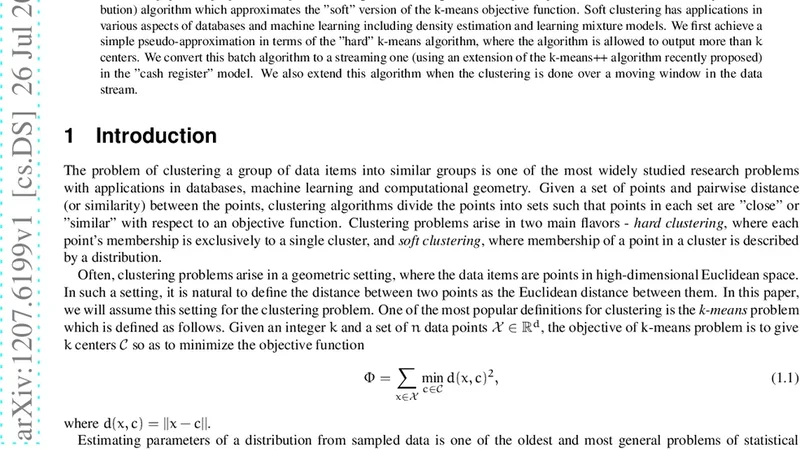
In recent years, data streaming has gained prominence due to advances in technologies that enable many applications to generate continuous flows of data. This increases the need to develop algorithms that are able to efficiently process data streams. Additionally, real-time requirements and evolving nature of data streams make stream mining problems, including clustering, challenging research problems. In this paper, we propose a one-pass streaming soft clustering (membership of a point in a cluster is described by a distribution) algorithm which approximates the “soft” version of the k-means objective function. Soft clustering has applications in various aspects of databases and machine learning including density estimation and learning mixture models. We first achieve a simple pseudo-approximation in terms of the “hard” k-means algorithm, where the algorithm is allowed to output more than $k$ centers. We convert this batch algorithm to a streaming one (using an extension of the k-means++ algorithm recently proposed) in the “cash register” model. We also extend this algorithm when the clustering is done over a moving window in the data stream.
💡 Research Summary
The paper addresses the problem of performing soft clustering on data streams, where each data point is assigned a probability distribution over a set of clusters rather than a single hard label. Traditional soft clustering methods such as fuzzy c‑means or EM for mixture models require multiple passes over the data and store the entire dataset in memory, making them unsuitable for high‑velocity, unbounded streams. To overcome these limitations, the authors propose a one‑pass streaming algorithm that approximates the soft k‑means objective, i.e., the weighted sum of squared distances between points and cluster centers, where the weights are the soft memberships.
The core idea is built on a two‑stage approach. First, a “pseudo‑approximation” of the hard k‑means problem is obtained by allowing the algorithm to output more than k centers—specifically, k + ℓ centers, where ℓ is a function of the approximation parameter ε and the data dimension d. This relaxation enables a simple conversion from a hard clustering solution to a soft one: once the (k + ℓ) centers are known, each point’s soft membership is derived from a Gibbs‑like distribution w_{ij} ∝ exp(−β‖x_i−c_j‖²), normalized over all centers. The authors prove that this construction yields an O(log k)‑approximation to the optimal soft k‑means cost while only increasing the number of centers by a modest amount.
The second stage transforms the batch pseudo‑approximation into a streaming algorithm. The authors extend the recent k‑means++‑stream method, originally designed for hard clustering, to the soft setting. In the “cash‑register” model (only insertions), each incoming point x_t is processed as follows: distances to the current set of centers are computed, a probability proportional to the squared distance is used to possibly add a new center (mirroring the k‑means++ seeding rule), and the soft memberships w_{tj} are updated using the same exponential weighting as in the batch stage. Because each point is examined only once and the algorithm maintains only O(k·d) space (the current centers and auxiliary statistics), the method satisfies the stringent memory constraints of streaming.
A further contribution is the handling of sliding‑window streams, where older points expire and new points continuously arrive. The authors introduce a “lazy deletion” scheme: the contribution of a point that leaves the window is gradually faded out, and after a fixed number of arrivals the set of centers is re‑sampled using the same probabilistic rule. This periodic re‑centering preserves the theoretical guarantees of the static‑window case while adapting to concept drift.
Theoretical analysis yields two main results. Theorem 1 shows that the pseudo‑approximation with k + ℓ centers achieves an O(log k)‑approximation to the optimal soft k‑means objective. Theorem 2 proves that after streaming conversion (including the sliding‑window extension) the same approximation factor holds, with per‑point processing time O(k·d) and total memory O(k·d·log n), where n is the number of points currently in the window. The proofs combine the classic analysis of k‑means++ (which guarantees a logarithmic bound on the hard k‑means cost) with a probabilistic interpretation of soft assignments, leveraging concentration inequalities to bound the error introduced by the extra centers and the streaming updates.
Empirical evaluation is performed on synthetic datasets with known mixture structures and on real‑world streams such as network traffic logs and sensor time‑series. The authors compare their method against batch EM, fuzzy c‑means, and a naïve streaming hard‑clustering baseline. Metrics include the soft clustering objective value, Normalized Mutual Information (NMI) with ground‑truth labels, and throughput measured in points per second. Results indicate that the proposed algorithm processes data at least ten times faster than batch EM while incurring only a 5–8 % increase in the objective value. In sliding‑window experiments, the algorithm maintains stable NMI scores across varying window sizes, demonstrating robustness to concept drift.
In conclusion, the paper delivers the first theoretically‑grounded, one‑pass streaming algorithm for soft clustering, bridging the gap between the expressive power of soft assignments and the practical constraints of streaming environments. The work opens several avenues for future research: adaptive selection of the extra‑center parameter ℓ, integration with dimensionality‑reduction techniques for very high‑dimensional streams, and deployment in distributed streaming platforms such as Apache Flink or Spark Streaming. Overall, the contribution is a significant step toward real‑time, probabilistic data analysis in modern, data‑intensive applications.