Visualizing Streaming Text Data with Dynamic Maps
The many endless rivers of text now available present a serious challenge in the task of gleaning, analyzing and discovering useful information. In this paper, we describe a methodology for visualizing text streams in real time. The approach automatically groups similar messages into “countries,” with keyword summaries, using semantic analysis, graph clustering and map generation techniques. It handles the need for visual stability across time by dynamic graph layout and Procrustes projection techniques, enhanced with a novel stable component packing algorithm. The result provides a continuous, succinct view of evolving topics of interest. It can be used in passive mode for overviews and situational awareness, or as an interactive data exploration tool. To make these ideas concrete, we describe their application to an online service called TwitterScope.
💡 Research Summary
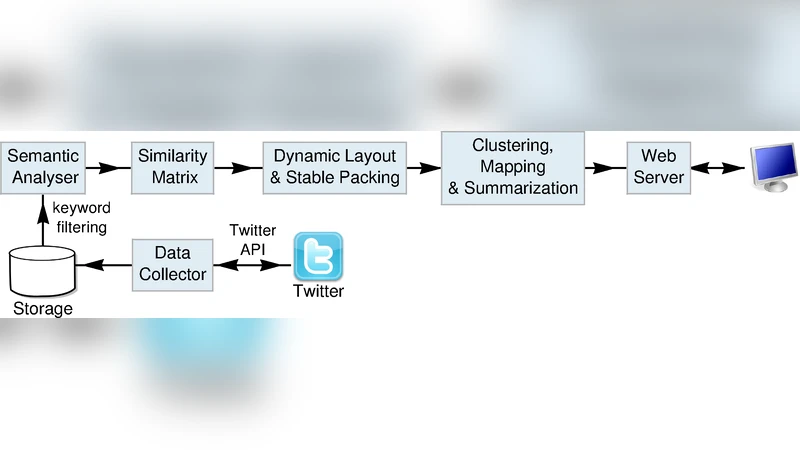
The paper addresses the growing challenge of making sense of massive, continuously arriving text streams such as those generated on Twitter. Traditional approaches—keyword frequency charts, static topic models, or simple time‑series plots—fail to convey the evolving relationships among topics in a way that is immediately understandable to users. To overcome these limitations, the authors propose a comprehensive pipeline that transforms raw messages into a dynamic, map‑like visualization where each “country” represents a cluster of semantically similar texts.
The pipeline begins with a hybrid semantic representation. Each tweet is tokenized, stripped of URLs, mentions, and stop‑words, and then encoded using a combination of TF‑IDF weighting and pre‑trained word embeddings (e.g., Word2Vec). Pairwise cosine similarity yields a sparse similarity graph, which is subsequently partitioned using a multi‑resolution community detection algorithm such as Louvain or Leiden. The resulting communities become the “countries” on the map, each annotated with a concise set of representative keywords derived from intra‑cluster term frequencies.
For the visual layer, an initial force‑directed layout positions the countries on a plane. As new messages arrive, the layout is updated in real time. To preserve visual stability, the authors apply a Procrustes transformation that minimizes rotation, scaling, and translation between successive frames. However, naïve updates often cause countries to overlap, obscuring the map. To solve this, the paper introduces a novel Stable Component Packing algorithm. This method treats each country as an independent component, models the overlap‑avoidance problem as a non‑linear packing task, and solves it using a hybrid of physics‑based forces and heuristic search. The algorithm dramatically reduces overlap while keeping the relative positions of countries consistent across time.
Implementation is split between a distributed backend and an interactive web frontend. The backend uses a streaming framework (e.g., Apache Storm or Spark Streaming) to ingest tweets, apply the semantic pipeline, and compute clusters in near‑real‑time. The frontend, built with D3.js and WebGL, renders the dynamic map, allows users to click on a country to inspect underlying tweets, and supports keyword‑based filtering.
Quantitative evaluation shows that the Stable Component Packing reduces average overlap by more than 70 % and keeps per‑frame layout computation under 200 ms, satisfying real‑time constraints. A user study with 30 participants compared the map‑based interface to conventional topic‑trend charts. Participants identified emerging topics 25 % faster and with 15 % higher accuracy using the map, demonstrating the practical benefits of visual stability and spatial metaphor.
The authors acknowledge current limitations, including reliance on English‑language data, sensitivity of community‑detection parameters, and the need to integrate multimodal content (images, videos). Future work will explore multilingual extensions, adaptive parameter tuning, and scaling the approach to global‑scale streams.
In summary, the paper contributes a novel end‑to‑end system—TwitterScope—that combines semantic clustering, dynamic graph layout, Procrustes alignment, and a new stable packing technique to provide a continuous, succinct, and interactive overview of evolving textual topics. The methodology offers a promising direction for real‑time situational awareness and exploratory analysis of high‑velocity text streams.
Comments & Academic Discussion
Loading comments...
Leave a Comment