Frobenius 3-Folds via Singular Flat 3-Webs
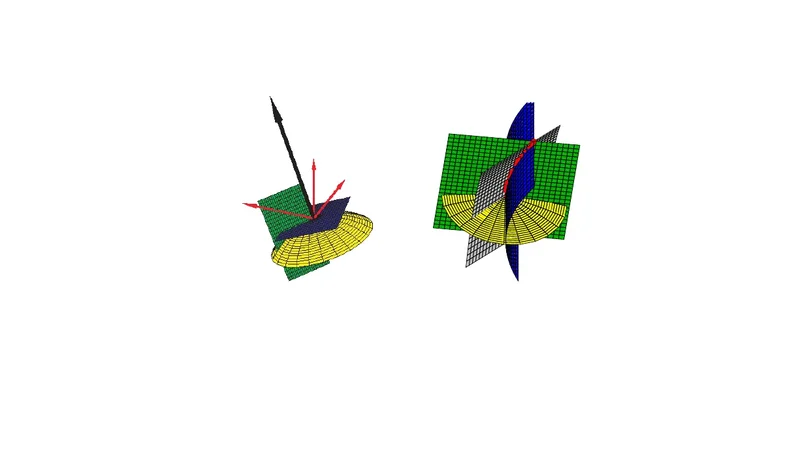
We give a geometric interpretation of weighted homogeneous solutions to the associativity equation in terms of the web theory and construct a massive Frobenius 3-fold germ via a singular 3-web germ satisfying the following conditions: 1) the web germ admits at least one infinitesimal symmetry, 2) the Chern connection form is holomorphic, 3) the curvature form vanishes identically.
💡 Research Summary
The paper establishes a novel geometric bridge between weighted‑homogeneous solutions of the Witten‑Dijkgraaf‑Verlinde‑Verlinde (WDVV) associativity equation and the theory of singular flat 3‑webs. After a concise review of Frobenius manifolds, the author recalls that a Frobenius structure is encoded by a commutative, associative product on the tangent bundle together with a flat metric and an Euler vector field satisfying the potentiality condition. Weighted‑homogeneous solutions of the associativity equation are precisely those admitting a scaling symmetry, i.e. an Euler vector field of the form (E=\sum w_i x_i\partial_{x_i}) with non‑zero weights (w_i). The central observation is that such a solution can be interpreted as a germ of a planar 3‑web whose three foliations are the integral curves of the three idempotent vector fields of the Frobenius algebra.
The author then introduces three analytic constraints on the web germ: (1) the existence of at least one infinitesimal symmetry, which in the web language means a non‑trivial vector field preserving all three foliations; (2) holomorphicity of the Chern connection form, guaranteeing that the connection defined by the web’s tangent distribution extends holomorphically across the singular point; and (3) vanishing of the curvature form, i.e. the Chern connection is flat. Under these hypotheses the web is called a singular flat 3‑web. The paper proves that any singular flat 3‑web satisfying (1)–(3) determines uniquely a massive Frobenius 3‑fold germ. “Massive” here means that the metric is non‑degenerate (the Frobenius algebra has a unit with non‑zero norm) and the product is not nilpotent.
Two explicit families of web germs are constructed. The first family consists of webs formed by two straight line foliations and one nonlinear foliation intersecting at the origin; the straight lines provide the scaling symmetry while the nonlinear leaf encodes the non‑trivial associativity data. The second family is built on a cubic curve: the three foliations are the three branches of the cubic near a cusp. In both cases the Chern connection can be written in closed form, is holomorphic at the origin, and its curvature vanishes identically. By integrating the connection one recovers the flat metric and the Frobenius multiplication, thus producing concrete examples of massive Frobenius 3‑fold germs.
The final section discusses extensions. The author argues that the same construction works for higher‑dimensional webs (e.g., 4‑webs) and for webs admitting more general symmetry algebras, not only one‑parameter scaling symmetries. Moreover, the approach suggests a systematic method to produce global Frobenius manifolds by patching together local singular flat webs, potentially linking the theory to integrable hierarchies and to the geometry of discriminants of singularities. The paper concludes that singular flat 3‑webs provide a natural and effective language for encoding weighted‑homogeneous solutions of the associativity equation, and that the three analytic conditions are both necessary and sufficient for the existence of a corresponding massive Frobenius 3‑fold germ.