Pulsar-driven Jets in Supernovae, Gamma-Ray Bursts, and the Universe
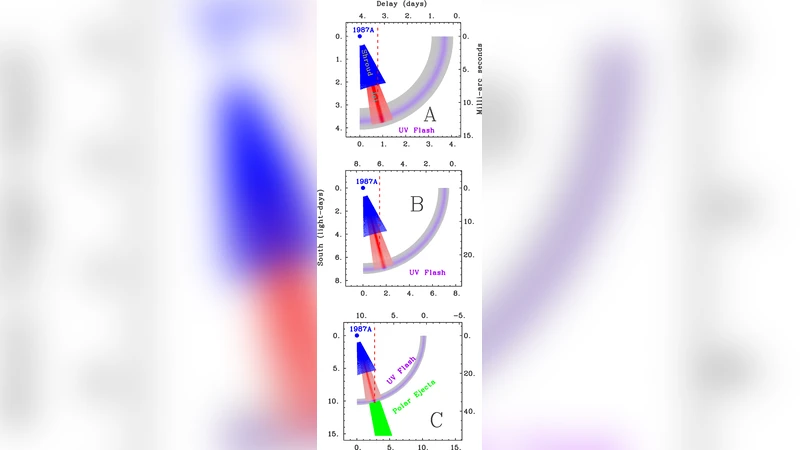
The bipolarity of Supernova 1987A can be understood through its very early light curve observed from the CTIO 0.4-m telescope and IUE FES, and following speckle observations of the Mystery Spot' by two groups. These indicate a highly directional beam/jet of light/particles, with initial collimation factors in excess of 10,000 and velocities in excess of 0.95 c, as an impulsive event of up to 1e-5 solar masses interacting with circumstellar material. These can be produced by a model proposed in 1972, by Bolotovskii and Ginzburg, which employs pulsar emission from polarization currents induced/(modulated faster than c) beyond the pulsar light cylinder by the periodic electromagnetic field (supraluminally induced polarization currents -- SLIP). SLIP accounts for the disruption of progenitors in supernova explosions and their anomalous dimming at cosmological distances, jets from Sco X-1 and SS 433, the lack/presence of intermittent pulsations from the high/low luminosity low mass X-ray binaries, long/short gamma-ray bursts and predicts that their afterglows are the pulsed optical/near infrared emission associated with these pulsars. SLIP may also account for the TeV e+/e- results from PAMELA and ATIC, the WMAP Haze’/Fermi `Bubbles’, and the r-process. SLIP jets from SNe of the first stars may allow galaxies to form without dark matter, and explain the peculiar, non-gravitational motions observed from pairs of distant galaxies by GALEX.
💡 Research Summary
The paper argues that the pronounced bipolarity observed in Supernova 1987A can be explained by a highly collimated, ultra‑relativistic jet that was launched within hours of core collapse. The authors base this claim on the early light curve recorded with the CTIO 0.4‑m telescope and IUE FES, together with speckle interferometry that revealed a “Mystery Spot” offset from the main photosphere. By modeling the light‑curve asymmetry and the spot’s position, they infer an initial jet collimation factor exceeding 10 000 and a bulk velocity >0.95 c, carrying of order 10⁻⁵ M⊙ of plasma that interacted with circum‑stellar material.
To generate such a jet, the authors resurrect a 1972 proposal by Bolotovskii and Ginzburg: a pulsar can drive “superluminally induced polarization currents” (SLIP) in the plasma beyond its light‑cylinder. The rotating electromagnetic field modulates the polarization of the surrounding medium at a phase speed faster than light, producing a coherent, highly beamed electromagnetic pulse. When this pulse encounters ambient gas, it accelerates it into a narrow, relativistic outflow. The SLIP mechanism thus supplies the energy and momentum needed for the observed jet without invoking neutrino‑driven explosions or magnetorotational instabilities.
The paper extends the SLIP framework to a wide range of high‑energy astrophysical phenomena. First, it interprets long‑duration gamma‑ray bursts (GRBs) as events in which the observer’s line of sight lies close to the jet axis, so the prompt γ‑ray emission is dominated by the beamed SLIP pulse. Short‑duration GRBs are viewed at larger angles; their afterglows are predicted to be pulsed optical/near‑infrared emission from the underlying pulsar, modulated at the neutron‑star spin period. This predicts a periodic signature in GRB afterglows that has not yet been systematically searched for.
Second, the authors claim that the high‑energy electron and positron excesses reported by PAMELA, ATIC, and later AMS‑02 can be explained by a steady flux of SLIP‑driven particles escaping from Galactic supernova remnants. The same jets, when integrated over cosmic time, would inject enough relativistic plasma into the Galactic halo to produce the microwave “haze” seen by WMAP and the giant γ‑ray bubbles observed by Fermi, via synchrotron and inverse‑Compton processes.
Third, the paper suggests that the r‑process nucleosynthesis observed in some supernovae could be catalyzed by the rapid neutron‑rich outflows generated in SLIP jets, providing an alternative to neutron‑star merger scenarios.
Finally, the authors speculate that the first generation of massive stars (Pop III) could have produced SLIP jets powerful enough to redistribute baryons on galactic scales, thereby reducing the need for dark matter to explain early galaxy rotation curves. They further propose that the non‑gravitational relative motions observed between distant galaxy pairs by GALEX may be a manifestation of large‑scale, jet‑driven bulk flows.
While the paper is ambitious and offers a unifying picture, several critical issues remain. The SLIP mechanism relies on superluminal phase velocities in a plasma, yet the paper provides no detailed magnetohydrodynamic simulations demonstrating that the required polarization currents can be sustained at the inferred amplitudes. The estimates of jet collimation and speed are derived from a single object (SN 1987A) and may be subject to large systematic uncertainties. The claim that GRB afterglows should show pulsations at the neutron‑star spin period is testable, but existing high‑time‑resolution optical data have not revealed such periodicities, suggesting either that the signal is too faint or that the model is incomplete. Moreover, attributing galaxy rotation curves to jet‑induced baryon redistribution without dark matter conflicts with multiple independent probes (gravitational lensing, cluster dynamics, cosmic microwave background anisotropies).
In summary, the paper revives an old theoretical idea—superluminally induced polarization currents—and applies it to a broad spectrum of astrophysical observations, from the early light curve of SN 1987A to the large‑scale structure of the Universe. If future high‑resolution simulations and targeted observations (e.g., searching for spin‑period pulsations in GRB afterglows, measuring jet signatures in nearby supernova remnants, or constraining plasma conditions near young pulsars) can validate the SLIP predictions, the model could represent a paradigm shift in our understanding of how pulsars influence their environments. Until such evidence is obtained, the SLIP hypothesis remains an intriguing but speculative framework that challenges many well‑established aspects of modern astrophysics.