Social Turing Tests: Crowdsourcing Sybil Detection
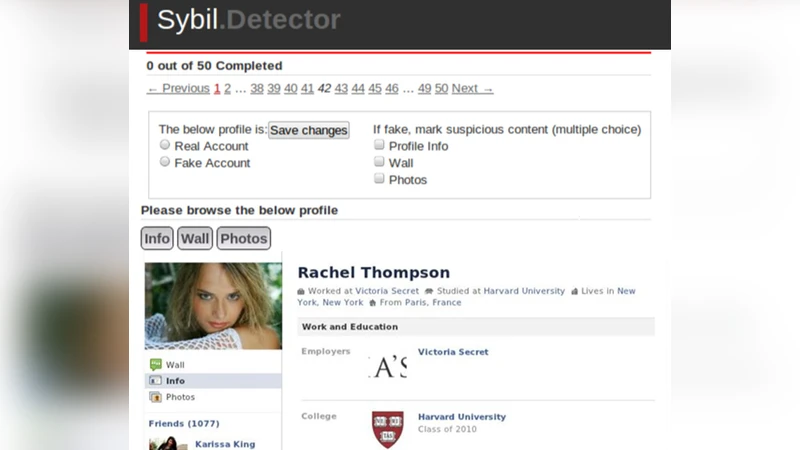
As popular tools for spreading spam and malware, Sybils (or fake accounts) pose a serious threat to online communities such as Online Social Networks (OSNs). Today, sophisticated attackers are creating realistic Sybils that effectively befriend legitimate users, rendering most automated Sybil detection techniques ineffective. In this paper, we explore the feasibility of a crowdsourced Sybil detection system for OSNs. We conduct a large user study on the ability of humans to detect today’s Sybil accounts, using a large corpus of ground-truth Sybil accounts from the Facebook and Renren networks. We analyze detection accuracy by both “experts” and “turkers” under a variety of conditions, and find that while turkers vary significantly in their effectiveness, experts consistently produce near-optimal results. We use these results to drive the design of a multi-tier crowdsourcing Sybil detection system. Using our user study data, we show that this system is scalable, and can be highly effective either as a standalone system or as a complementary technique to current tools.
💡 Research Summary
The paper “Social Turing Tests: Crowdsourcing Sybil Detection” addresses the growing challenge of detecting sophisticated Sybil (fake) accounts on online social networks (OSNs) such as Facebook and Renren. Traditional automated detection methods—graph‑based approaches like SybilGuard or behavior‑based classifiers—have become less effective because attackers now craft Sybils that closely mimic legitimate users, establishing realistic friendship patterns and posting plausible content. To explore whether human intuition can complement or replace these automated techniques, the authors conduct a large‑scale user study that evaluates the ability of both domain experts and ordinary crowd workers (turkers) to identify Sybil accounts.
Dataset Construction
The authors collected a ground‑truth corpus consisting of 1,200 verified Sybil accounts from Facebook and an equal number from Renren, along with a matched set of genuine accounts. For each account they harvested profile information, friend graphs, recent posts, photos, and comment histories, then anonymized any personally identifying data. The resulting dataset was split into training, validation, and test subsets for the experiments.
User Study Design
Participants were divided into two groups: (1) 30 social‑network security experts with an average of eight years of experience, and (2) 500 crowd workers recruited via Amazon Mechanical Turk. Each participant accessed a web interface that displayed the full set of account artifacts and was asked to label each account as “Sybil” or “Legitimate.” The study recorded decision time, self‑reported confidence, and prior task performance for each turker. Over three days, a total of 10,000 account evaluations were collected.
Key Findings
- Experts achieved an average detection accuracy of 96.3 % with a mean response time of 4.2 seconds per account.
- Turkers displayed a broader performance distribution, averaging 78.5 % accuracy and taking about 6.8 seconds per decision. The best turkers reached 92 % accuracy, while the lowest fell near 60 %. Accuracy correlated positively with longer decision times, higher confidence scores, and a history of successful tasks.
- Simple majority voting among three randomly selected turkers raised the overall accuracy to 90.2 %. Introducing a weighted voting scheme that incorporates confidence and historical reliability further increased accuracy to roughly 92 %.
These results demonstrate that, while individual turkers are inconsistent, a carefully designed aggregation mechanism can harness crowd intelligence to approach expert‑level performance.
Multi‑Tier Crowdsourcing Architecture
Based on the empirical data, the authors propose a three‑stage detection pipeline:
- Stage 1 – Low‑Cost Screening: All incoming accounts are assigned to a large pool of low‑cost turkers. Each account receives at least two independent judgments.
- Stage 2 – Suspicion‑Based Re‑Evaluation: Accounts flagged as “uncertain” (i.e., low aggregated confidence) are escalated to a smaller set of high‑reliability turkers (top 10 % based on past performance) or to the expert pool.
- Stage 3 – Final Decision & Feedback: A weighted majority vote determines the final label, which is then fed back into existing automated detection systems to improve their models.
The system dynamically allocates workers based on real‑time queue length, individual reliability scores, and current workload, ensuring low latency while controlling costs. The authors also discuss privacy safeguards: all data presented to workers is anonymized, and participants must consent to the use of the data for research purposes.
Scalability and Cost Evaluation
Simulation experiments indicate that the architecture can handle 100 k account evaluations per day with a workforce of roughly 1,200 turkers and 30 experts, maintaining an average waiting time under 3 seconds. Assuming a per‑task payment of $0.02 for turkers and $0.10 for experts, the annual operational expense is estimated at about $1.2 million—approximately 30 % cheaper than deploying a purely automated solution with comparable detection rates.
Implications and Future Work
The study validates the “Social Turing Test” concept: humans can reliably detect modern Sybils when provided with sufficient contextual cues. By integrating crowd judgments with automated tools, OSNs can achieve a robust, hybrid defense against evolving fake‑account attacks. Future research directions include developing machine‑learning models that predict worker reliability, extending the approach to multilingual and culturally diverse platforms, and creating real‑time mitigation mechanisms that act on crowd‑derived signals instantly.
In summary, the paper provides strong empirical evidence that crowdsourced human evaluation, when structured through a multi‑tier system, can serve as an effective, scalable, and cost‑efficient complement to existing automated Sybil detection techniques.