Error estimates for solid-state density-functional theory predictions: an overview by means of the ground-state elemental crystals
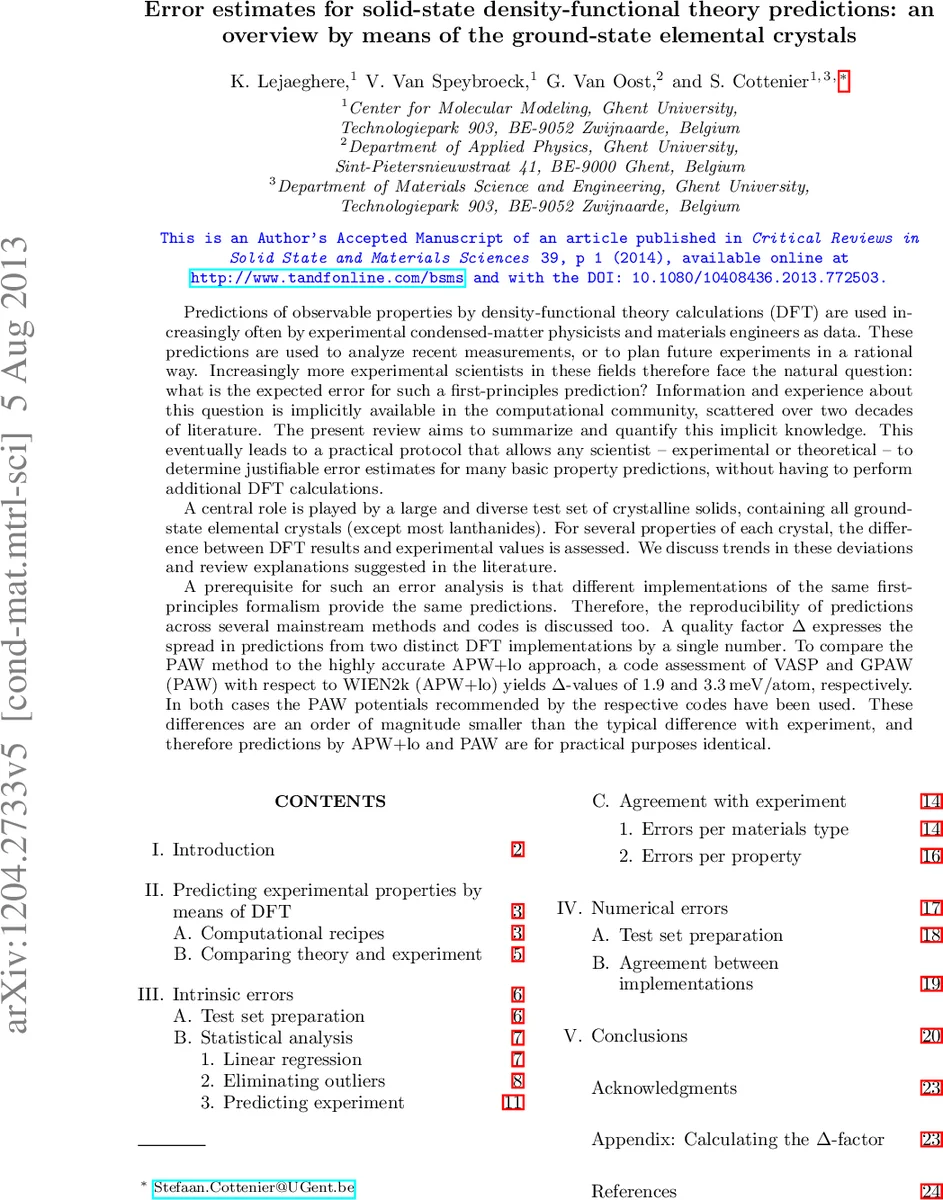
Predictions of observable properties by density-functional theory calculations (DFT) are used increasingly often in experimental condensed-matter physics and materials engineering as data. These predictions are used to analyze recent measurements, or to plan future experiments. Increasingly more experimental scientists in these fields therefore face the natural question: what is the expected error for such an ab initio prediction? Information and experience about this question is scattered over two decades of literature. The present review aims to summarize and quantify this implicit knowledge. This leads to a practical protocol that allows any scientist - experimental or theoretical - to determine justifiable error estimates for many basic property predictions, without having to perform additional DFT calculations. A central role is played by a large and diverse test set of crystalline solids, containing all ground-state elemental crystals (except most lanthanides). For several properties of each crystal, the difference between DFT results and experimental values is assessed. We discuss trends in these deviations and review explanations suggested in the literature. A prerequisite for such an error analysis is that different implementations of the same first-principles formalism provide the same predictions. Therefore, the reproducibility of predictions across several mainstream methods and codes is discussed too. A quality factor Delta expresses the spread in predictions from two distinct DFT implementations by a single number. To compare the PAW method to the highly accurate APW+lo approach, a code assessment of VASP and GPAW with respect to WIEN2k yields Delta values of 1.9 and 3.3 meV/atom, respectively. These differences are an order of magnitude smaller than the typical difference with experiment, and therefore predictions by APW+lo and PAW are for practical purposes identical.
💡 Research Summary
The paper addresses a fundamental question that is becoming increasingly relevant as density‑functional theory (DFT) is used not only to interpret experimental data but also to predict material properties for future experiments and materials design: how large are the errors associated with a DFT prediction? The authors systematically quantify two distinct sources of error—intrinsic errors arising from the approximations inherent to the exchange‑correlation functional, and numerical errors that stem from the implementation of the same functional in different electronic‑structure codes.
To obtain a comprehensive benchmark, the authors assemble a test set that includes the ground‑state crystal structures of essentially all elements (excluding most lanthanides). This choice satisfies two key criteria for a solid‑state benchmark: (i) maximal chemical diversity, because the periodic table spans a wide range of bonding types, and (ii) structural diversity, as the elemental phases range from high‑symmetry cubic and hexagonal lattices to low‑symmetry orthorhombic and monoclinic cells. Experimental reference data are taken from standard databases and are extrapolated to 0 K, with zero‑point vibrational contributions removed using a Debye‑model correction.
The study focuses on a limited but representative set of properties that can be obtained directly from total‑energy calculations: cohesive (atomization) energy (ΔE_coh), equilibrium volume (V₀), bulk modulus (B₀), its pressure derivative (B₁), and the full elastic stiffness tensor (C_ij). All calculations are performed with the PBE‑GGA functional, which is known to give reliable results for a broad class of solids. Five distinct DFT codes are considered, but the core comparison is between the highly accurate all‑electron APW+lo implementation in WIEN2k and two widely used projector‑augmented‑wave (PAW) codes, VASP and GPAW.
Intrinsic errors are evaluated by statistically comparing DFT results with the experimental reference for each property. Linear regression is employed to obtain mean deviations and standard deviations, and outliers are identified and removed iteratively. The analysis reveals systematic trends that correlate with the position of an element in the periodic table. For instance, PBE tends to overestimate equilibrium volumes for alkali metals while underestimating cohesive energies for transition metals, reflecting the functional’s handling of s‑ versus d‑electron exchange‑correlation. The bulk‑modulus derivative B₁ is found to be the most sensitive quantity, with small numerical fluctuations leading to relatively large relative errors, especially for soft materials.
Numerical errors are quantified using a single scalar metric, the Δ‑factor, which measures the average energy‑volume curve difference (in meV per atom) between two implementations of the same functional. When WIEN2k is taken as the reference, VASP yields a Δ of 1.9 meV/atom and GPAW a Δ of 3.3 meV/atom. These values are an order of magnitude smaller than the typical intrinsic deviations from experiment (tens of meV/atom), indicating that, for practical purposes, PAW implementations provide predictions that are essentially indistinguishable from the more computationally demanding APW+lo method.
Based on these findings, the authors propose a practical protocol for error estimation that can be applied by any researcher—experimental or theoretical—without performing additional DFT calculations. The protocol consists of (1) selecting the appropriate intrinsic‑error statistics for the property of interest and the relevant element or crystal class, (2) adding the Δ‑factor associated with the chosen code and functional (via a root‑sum‑square combination), and (3) reporting the resulting confidence interval alongside the DFT prediction. This approach enables scientists to attach quantitative uncertainty bars to DFT‑derived data, facilitating more reliable comparison with experiment and more informed decision‑making in materials design.
In conclusion, the paper delivers a thorough, data‑driven assessment of DFT accuracy for solid‑state systems, demonstrates that modern PAW codes achieve near‑APW+lo precision, and supplies a user‑friendly error‑estimation framework. The methodology is readily extensible to other exchange‑correlation approximations (e.g., LDA, hybrid functionals) and higher‑level many‑body techniques (GW, RPA), paving the way for systematic uncertainty quantification across the entire spectrum of first‑principles materials modeling.
Comments & Academic Discussion
Loading comments...
Leave a Comment