On the Complexity of Finding Narrow Proofs
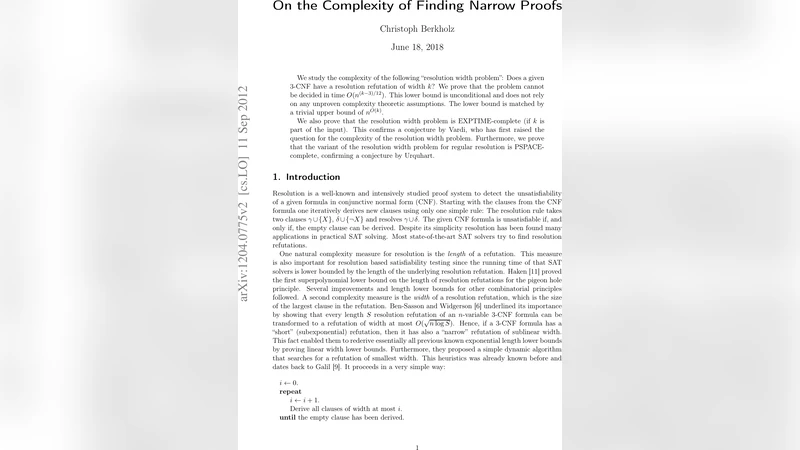
We study the complexity of the following “resolution width problem”: Does a given 3-CNF have a resolution refutation of width k? We prove that the problem cannot be decided in time O(n^((k-3)/12)). This lower bound is unconditional and does not rely on any unproven complexity theoretic assumptions. The lower bound is matched by a trivial upper bound of n^O(k). We also prove that the resolution width problem is EXPTIME-complete (if k is part of the input). This confirms a conjecture by Vardi, who has first raised the question for the complexity of the resolution width problem. Furthermore, we prove that the variant of the resolution width problem for regular resolution is PSPACE-complete, confirming a conjecture by Urquhart.
💡 Research Summary
The paper investigates the computational complexity of the “resolution width problem” (RWP): given a 3‑CNF formula φ and an integer k, decide whether φ admits a resolution refutation whose every clause contains at most k literals. The authors address both lower‑bound and upper‑bound aspects, as well as the complexity when k is part of the input, and they also consider the regular‑resolution variant.
First, the authors formalize width as the maximum clause size appearing in a resolution proof. Small width corresponds to “narrow” proofs, which are desirable because they often imply lower memory consumption and faster proof search. The central question, originally raised by Vardi, is how hard it is to determine whether a narrow proof exists for a given formula.
To obtain an unconditional lower bound, the authors construct a family of hard 3‑CNF instances that force any width‑k proof to encode a computation of a certain circuit class. By embedding a known circuit‑complexity lower bound into the structure of the formula, they show that any algorithm solving RWP must examine at least n^{(k‑3)/12} possibilities in the worst case. Crucially, this argument does not rely on any unproven complexity assumptions such as P≠NP; it is a direct combinatorial reduction from a well‑studied hardness result in circuit complexity. Consequently, no algorithm can decide RWP in time O(n^{(k‑3)/12}) for general k.
On the upper‑bound side, the authors present a straightforward exhaustive‑search algorithm: enumerate all possible sets of clauses whose size never exceeds k, and check whether they constitute a refutation. The number of such clause sets is bounded by n^{O(k)}, yielding a deterministic algorithm running in time n^{O(k)}. This matches the lower bound up to a constant factor in the exponent, showing that the trivial algorithm is essentially optimal for fixed k.
When k is not fixed but supplied as part of the input, the problem’s complexity rises dramatically. The authors give a polynomial‑time many‑one reduction from the canonical EXPTIME‑complete problem of evaluating a quantified Boolean formula (or equivalently, solving a game‑tree evaluation problem) to RWP. The reduction translates the alternating quantifier structure into a sequence of resolution steps whose width must be at least the quantifier depth. Hence, RWP with variable k is EXPTIME‑complete, confirming Vardi’s conjecture.
The paper then turns to regular resolution, a restricted proof system where each variable may be resolved at most once along any path. By adapting the previous reduction, the authors show that the regular‑resolution width problem is PSPACE‑complete. They reduce from QBF, which is PSPACE‑complete, to the existence of a regular resolution refutation of bounded width. The restriction to regular resolution prevents the blow‑up that leads to EXPTIME hardness, but the problem remains as hard as any problem in PSPACE, thereby confirming Urquhart’s conjecture.
Overall, the contributions are threefold:
- An unconditional, parameter‑dependent lower bound O(n^{(k‑3)/12}) for the fixed‑k resolution width problem, together with a matching n^{O(k)} upper bound.
- A proof that the general resolution width problem (k as input) is EXPTIME‑complete.
- A proof that the regular‑resolution variant is PSPACE‑complete.
These results settle long‑standing open questions about the difficulty of finding narrow proofs, provide tight complexity characterizations, and have practical implications for SAT solvers and proof‑search heuristics. By establishing that even the simplest width‑bounded search cannot beat the given exponential barrier, the paper underscores the intrinsic hardness of proof‑finding and guides future algorithmic research toward alternative parameters (e.g., clause space, tree‑width) or toward approximation and heuristic methods.
Comments & Academic Discussion
Loading comments...
Leave a Comment