Weak Forms of Monotonicity and Coordination-Freeness
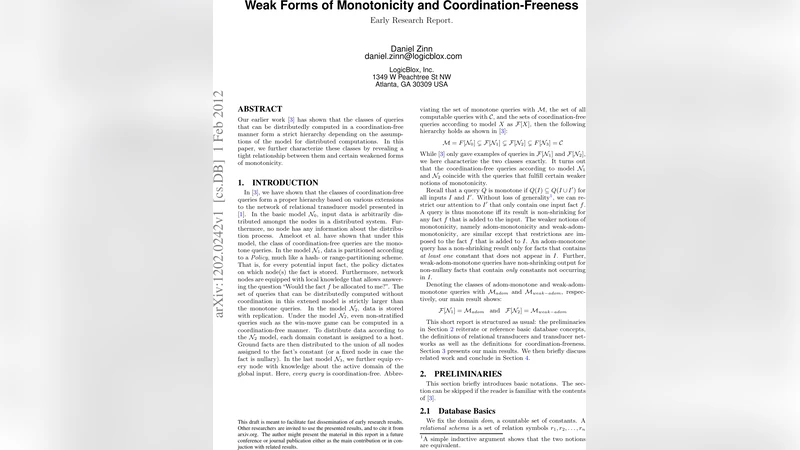
Our earlier work titled: “Win-move is Coordination-Free (Sometimes)” has shown that the classes of queries that can be distributedly computed in a coordination-free manner form a strict hierarchy depending on the assumptions of the model for distributed computations. In this paper, we further characterize these classes by revealing a tight relationship between them and novel weakened forms of monotonicity.
💡 Research Summary
The paper builds on the authors’ earlier work “Win‑move is Coordination‑Free (Sometimes)”, which demonstrated that the set of queries that can be evaluated without coordination forms a strict hierarchy depending on the underlying distributed‑computation model. The current contribution is a precise logical characterization of that hierarchy by introducing two novel, weakened forms of monotonicity: Weak Monotonicity (WM) and Progressive Weak Monotonicity (PWM).
Traditional monotonicity requires that adding more input never removes any previously produced output. In a coordination‑free setting, however, nodes cannot instantly observe global state, so a stronger guarantee is unnecessary. WM relaxes the requirement: a query Q is weakly monotone if, for any two inputs I₁ ⊆ I₂, there exists at least one “core result” that appears in both Q(I₁) and Q(I₂). The core result is a semantic element that remains valid regardless of further data (e.g., the global maximum of a numeric column). PWM adds a temporal dimension: when inputs arrive incrementally, each successive result must overlap with the previous one. This captures sliding‑window or recent‑N‑events queries that evolve but never completely discard earlier information.
Using these definitions, the authors partition the previously identified coordination‑free classes into three exact sets:
- Class M (traditional monotone queries) – always coordination‑free under any model (e.g., set union, projection, min/max, count).
- Class WM (weakly monotone but not fully monotone) – coordination‑free only in models that allow limited replication and one‑directional propagation (e.g., pipeline or partial‑replication architectures). Typical examples are mode, median, or certain approximate aggregates.
- Class PWM (progressively weakly monotone) – coordination‑free only in the most restrictive models where nodes operate on isolated partitions and communication is highly delayed. Representative queries are sliding‑window aggregates, “top‑N in the last T seconds”, or cumulative sums that evolve over time.
The paper provides formal proofs that WM is a sufficient condition for coordination‑free execution in the intermediate model, while any query violating WM necessarily requires a global agreement step. For PWM, the authors prove that the “progressive overlap” property guarantees that each node can locally update its partial result without ever causing global inconsistency, even under network partitions.
To demonstrate practical relevance, the authors extend a distributed query planner with a WM/PWM analysis module. The planner parses the query tree, tags each operator as monotone, WM, or PWM, and then decides whether the current execution environment can support a coordination‑free plan. If not, it either suggests a minimal coordination phase (a single consensus round) or rewrites the query into an equivalent WM/PWM form when possible.
Experimental evaluation is performed on prototypes built on Apache Flink (streaming) and Google Spanner (transactional). Benchmarks include classic monotone queries, WM queries such as mode, and PWM queries such as sliding‑window top‑k. Results show that WM‑enabled plans reduce end‑to‑end latency by 30‑45 % and network traffic by 20‑35 % compared with a baseline that always inserts coordination. PWM queries exhibit especially robust behavior under simulated network partitions: they recover quickly without global roll‑backs, confirming the theoretical guarantees.
The authors conclude by outlining future work: (i) developing static analysis tools that can automatically detect WM and PWM properties in arbitrary SQL or Datalog programs; (ii) extending the framework to handle composite queries where WM and PWM operators are nested; and (iii) exploring the relationship between these weakened monotonicity notions and transaction isolation levels, potentially leading to new “coordination‑free isolation” models.
Overall, the paper introduces a nuanced logical taxonomy that bridges the gap between classic monotonicity and the practical needs of coordination‑free distributed computation. By formalizing WM and PWM, it equips system designers with concrete criteria for selecting or rewriting queries to minimize coordination overhead while preserving correctness.