Meditations on Quantified Constraint Satisfaction
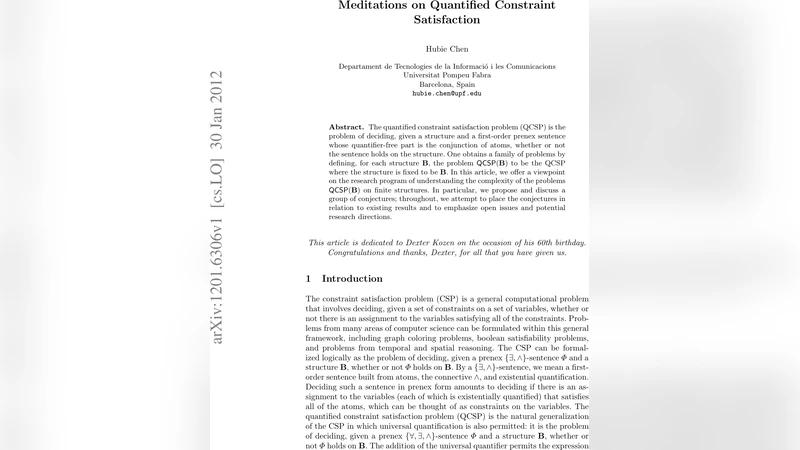
The quantified constraint satisfaction problem (QCSP) is the problem of deciding, given a structure and a first-order prenex sentence whose quantifier-free part is the conjunction of atoms, whether or not the sentence holds on the structure. One obtains a family of problems by defining, for each structure B, the problem QCSP(B) to be the QCSP where the structure is fixed to be B. In this article, we offer a viewpoint on the research program of understanding the complexity of the problems QCSP(B) on finite structures. In particular, we propose and discuss a group of conjectures; throughout, we attempt to place the conjectures in relation to existing results and to emphasize open issues and potential research directions.
💡 Research Summary
The paper provides a broad‑level perspective on the ongoing research program that seeks to classify the computational complexity of the quantified constraint satisfaction problem (QCSP) when the underlying relational structure is fixed. After recalling the definition of QCSP—first‑order prenex sentences whose quantifier‑free part is a conjunction of atomic formulas—the authors contrast it with the ordinary constraint satisfaction problem (CSP), emphasizing that the presence of alternating universal and existential quantifiers dramatically expands the expressive power and, consequently, the potential complexity of the problem.
The authors survey the state of the art, noting that while CSP has been the subject of a celebrated dichotomy conjecture (now a theorem) that every finite structure yields either a polynomial‑time algorithm or an NP‑complete problem, the analogous classification for QCSP remains open. They explain that the algebraic approach, which links the existence of certain polymorphisms (operations preserving all relations of the structure) to tractability, is still the most promising tool for QCSP. In particular, structures that are “cores” or “prime” and that admit rich families of polymorphisms (e.g., Siggers, Maltsev, or majority operations) are conjectured to give rise to polynomial‑time solvable QCSP instances.
Four central conjectures are presented. The first, the QCSP Dichotomy Conjecture, posits that for every finite structure B, QCSP(B) is either in P or PSPACE‑complete, mirroring the CSP dichotomy but with a higher upper bound due to quantifier alternation. The second, the Algebraic Dichotomy, claims that the presence or absence of certain polymorphisms completely determines whether QCSP(B) falls into the tractable or intractable side of the dichotomy. The third, the Bounded Alternation Conjecture, asserts that fixing the number k of quantifier alternations restricts the problem to the k‑th level of the polynomial‑time hierarchy (Σ_k^P or Π_k^P). Finally, the Universal‑Existential Collapse Conjecture suggests that for structures where the universal‑existential fragment (∀∃ sentences) already captures the full difficulty of QCSP, the general problem does not become harder.
For each conjecture the paper lists known positive results, counter‑examples, and partial proofs. For instance, group‑based structures with two or more alternations are shown to be PSPACE‑complete, while certain grid‑like or tree‑like structures possessing a majority polymorphism admit polynomial‑time algorithms. The authors also discuss recent work on “bounded alternation” that establishes Σ_2^P‑hardness for specific non‑core templates, illustrating that the hierarchy does not collapse trivially.
The discussion then turns to the major gaps in current knowledge. The most challenging open area concerns non‑symmetric structures that lack well‑understood polymorphisms; existing algebraic tools do not yet yield a clean classification for these cases. To address this, the authors propose several methodological directions: (1) developing a refined taxonomy of polymorphism classes that captures subtle structural properties, (2) constructing systematic reductions that preserve bounded alternation depth, and (3) exploring homomorphic‑image techniques that could “collapse” universal‑existential fragments into simpler forms.
Beyond theory, the paper highlights practical motivations. QCSP naturally models planning problems in artificial intelligence, verification of security protocols, and complex database queries where both existential and universal constraints appear. Understanding the tractability frontier could therefore have immediate algorithmic impact.
In concluding, the authors outline a research roadmap. They call for (i) a full algebraic dichotomy proof for QCSP, (ii) experimental validation of bounded‑alternation complexity on benchmark instances, (iii) deeper investigation of the universal‑existential collapse phenomenon in concrete application domains, and (iv) cross‑disciplinary collaborations that bring together universal algebra, descriptive complexity, and algorithm design. Achieving these goals would elevate the QCSP classification to the same level of completeness and elegance that now characterizes CSP, and would deepen our understanding of the interplay between logical quantification and computational difficulty.
Comments & Academic Discussion
Loading comments...
Leave a Comment