Two Hands Are Better Than One (up to constant factors)
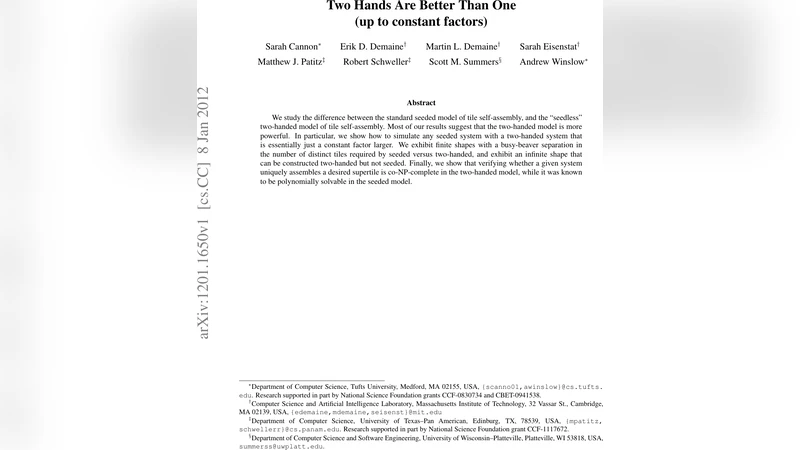
We study the difference between the standard seeded model of tile self-assembly, and the “seedless” two-handed model of tile self-assembly. Most of our results suggest that the two-handed model is more powerful. In particular, we show how to simulate any seeded system with a two-handed system that is essentially just a constant factor larger. We exhibit finite shapes with a busy-beaver separation in the number of distinct tiles required by seeded versus two-handed, and exhibit an infinite shape that can be constructed two-handed but not seeded. Finally, we show that verifying whether a given system uniquely assembles a desired supertile is co-NP-complete in the two-handed model, while it was known to be polynomially solvable in the seeded model.
💡 Research Summary
The paper conducts a systematic comparison between the classic seeded tile self‑assembly model (SAM) and the seedless two‑handed model (2HAM). While SAM starts from a single fixed seed tile and grows by attaching one tile at a time, 2HAM allows any two already‑formed supertiles to bind together provided the total glue strength across their interface meets a temperature threshold τ. This fundamental difference yields greater parallelism and combinatorial flexibility in 2HAM.
The first major contribution is a constant‑factor simulation theorem. For any τ‑SAM ⟨T,σ,τ⟩ the authors construct a 2HAM system ⟨T′,τ⟩ whose tile set size is at most c·|T| (with c = 2 in the presented construction) and that reproduces exactly the same terminal supertile as the original seeded system. The construction augments each original tile with two auxiliary labels—“hand‑code” and “seed‑code”—and designs glue rules so that the two‑handed binding dynamics emulate the presence of a seed even though none exists. Consequently, any behavior achievable in the seeded model can be replicated in the two‑handed model with only a constant overhead in tile variety.
The second result demonstrates a Busy‑Beaver separation in tile‑type complexity. The authors define a family of finite shapes S_n and prove that any τ‑SAM that assembles S_n requires at least f(n) distinct tile types, where f(n) grows as the Busy‑Beaver function (i.e., faster than any computable function). In contrast, a 2HAM can assemble the same shape using only O(f(n)/c) tile types. This shows that, in terms of the number of distinct tiles needed, the two‑handed model can be exponentially more efficient than the seeded model, a distinction that becomes stark when the tile inventory is experimentally limited.
The third contribution concerns infinite structures. The paper constructs an “infinite ladder” shape L and proves that for temperature τ ≥ 2, a 2HAM can generate an infinite supertile that grows indefinitely by repeatedly joining two large blocks. No seeded system, regardless of seed choice or tile set, can produce L, because SAM’s sequential single‑tile addition cannot maintain the required simultaneous binding pattern. This establishes a genuine expressive gap: there exist shapes realizable only in the two‑handed paradigm.
Finally, the authors analyze the computational complexity of the Unique Assembly Verification (UAV) problem, which asks whether a given system assembles a specified supertile uniquely. While UAV is known to be solvable in polynomial time for seeded systems, the paper proves that UAV is co‑NP‑complete for 2HAM. The proof proceeds via a polynomial‑time reduction from the complement of SAT, showing that confirming the non‑existence of an alternative assembly is as hard as any co‑NP problem. This result implies that verification tools that are efficient for seeded designs become infeasible for two‑handed designs unless NP = co‑NP.
Overall, the paper paints a nuanced picture: 2HAM is at least as powerful as SAM (constant‑factor simulation), can be dramatically more efficient in tile‑type usage (Busy‑Beaver separation), can construct shapes unattainable by seeded assembly (infinite ladder), and introduces a higher verification complexity (co‑NP‑completeness). These findings have practical implications for DNA‑based nanofabrication, programmable matter, and theoretical computer science, suggesting that future research should explore algorithmic design methods tailored to the two‑handed model, develop heuristic verification techniques for co‑NP‑hard problems, and investigate further separations in other resource dimensions such as time, space, and error tolerance.
Comments & Academic Discussion
Loading comments...
Leave a Comment