How much H and He is "hidden" in SNe Ib/c? I. - low-mass objects
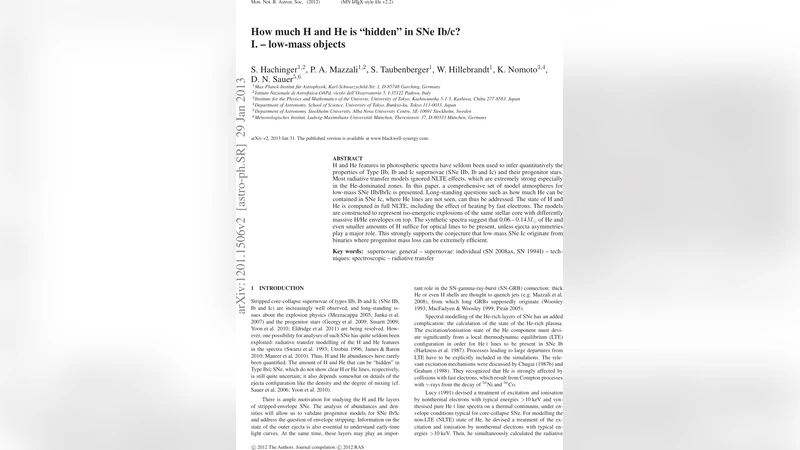
H and He features in photospheric spectra have seldom been used to infer quantitatively the properties of Type IIb, Ib and Ic supernovae (SNe IIb, Ib and Ic) and their progenitor stars. Most radiative transfer models ignored NLTE effects, which are extremely strong especially in the He-dominated zones. In this paper, a comprehensive set of model atmospheres for low-mass SNe IIb/Ib/Ic is presented. Long-standing questions such as how much He can be contained in SNe Ic, where He lines are not seen, can thus be addressed. The state of H and He is computed in full NLTE, including the effect of heating by fast electrons. The models are constructed to represent iso-energetic explosions of the same stellar core with differently massive H/He envelopes on top. The synthetic spectra suggest that 0.06 - 0.14 M_sun of He and even smaller amounts of H suffice for optical lines to be present, unless ejecta asymmetries play a major role. This strongly supports the conjecture that low-mass SNe Ic originate from binaries where progenitor mass loss can be extremely efficient.
💡 Research Summary
The paper presents a comprehensive set of NLTE (non‑local thermodynamic equilibrium) model atmospheres specifically designed for low‑mass Type IIb, Ib and Ic supernovae (SNe). The authors point out that most previous radiative‑transfer studies have relied on LTE approximations, which severely underestimate the strength of hydrogen and helium lines, especially in He‑dominated zones where non‑thermal processes dominate. To overcome this limitation, they compute the full NLTE level populations for H and He, explicitly including heating by fast electrons generated by radioactive decay.
All models share the same core explosion energy (≈10⁵¹ erg) and represent iso‑energetic explosions of a single stellar core. The only variable is the mass of the overlying H/He envelope, which is varied from a few hundredths to a few tenths of a solar mass. By keeping the core identical, the study isolates the effect of envelope mass on the emergent photospheric spectra.
Synthetic spectra generated from these models reveal that relatively modest amounts of helium—between 0.06 and 0.14 M☉—are sufficient to produce the classic He I optical lines (λ5876, λ6678, λ7065). Even smaller quantities of hydrogen (≈0.01 M☉ or less) can generate detectable H α features. The line formation is driven primarily by non‑thermal excitation and ionisation caused by fast electrons; this mechanism raises the temperature in the He‑rich layers to 5,000–8,000 K, ensuring over‑population of the relevant He I levels. Consequently, strong He I lines can appear without invoking large-scale asymmetries or extreme mixing.
The key implication is that the absence of He I lines in observed Type Ic spectra does not necessarily mean that helium is absent. Rather, the helium mass may simply lie below the detection threshold set by the NLTE excitation balance. Conversely, when He I lines are observed in Type Ib spectra, the inferred helium mass is consistent with the 0.06–0.14 M☉ range derived here. This supports the long‑standing conjecture that low‑mass SNe Ic arise from binary progenitors that have experienced very efficient envelope stripping, leaving only a thin residual He layer that may be spectroscopically invisible.
The authors also discuss the role of ejecta asymmetries. Their models demonstrate that, for the low‑mass explosions considered, asymmetries are not required to suppress or enhance the H/He lines; the line strengths are dominated by the envelope mass and the non‑thermal electron heating. Nonetheless, they acknowledge that extreme asymmetries could modify line profiles and should be explored in future three‑dimensional simulations.
In summary, the study provides a robust quantitative framework for estimating hidden hydrogen and helium masses in low‑mass stripped‑envelope supernovae. By employing full NLTE calculations with fast‑electron heating, it shows that as little as a few hundredths of a solar mass of He (and even less H) can produce observable optical features. This finding reinforces the binary‑evolution scenario for SNe Ic and offers a new diagnostic tool for interpreting early‑time spectra of stripped‑envelope supernovae.