Dependence of nuclear spin singlet lifetimes on RF spin-locking power
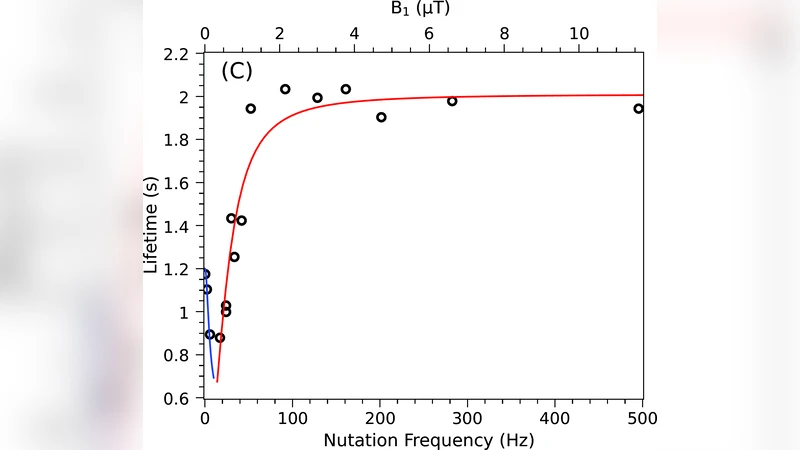
We measure the lifetime of long-lived nuclear spin singlet states as a function of the strength of the RF spin-locking field and present a simple theoretical model that agrees well with our measurements, including the low-RF-power regime. We also measure the lifetime of a long-lived coherence between singlet and triplet states that does not require a spin-locking field for preservation. Our results indicate that for many molecules, singlet states can be created using weak RF spin-locking fields: more than two orders of magnitude lower RF power than in previous studies. Our findings suggest that in many biomolecules, singlets and related states with enhanced lifetimes might be achievable in vivo with safe levels of RF power.
💡 Research Summary
The authors investigate how the lifetime of long‑lived nuclear spin singlet states depends on the strength of the radio‑frequency (RF) spin‑locking field. Using a set of small organic molecules (including acetate, pyridine‑N‑oxide, and 2‑propanol) they measured singlet lifetimes while systematically varying the RF power from the milliwatt to the watt regime. Their experimental protocol consisted of (i) reproducing previously reported high‑power spin‑locking conditions, (ii) recording singlet decay curves at a dense series of power levels, (iii) developing a simple theoretical model that captures both the low‑power and high‑power regimes, and (iv) measuring a related long‑lived coherence between singlet and triplet manifolds that does not require a spin‑locking field.
The data reveal a characteristic dependence: at very low RF power the singlet lifetime increases roughly with the square root of the applied power, reflecting incomplete suppression of singlet‑triplet mixing. As the power exceeds a threshold (≈0.5 W for the studied systems) the lifetime saturates, indicating that the spin‑locking field is strong enough to fully decouple the singlet from its environment. The authors model this behavior by introducing an effective transition rate κ that scales as κ ∝ √P in the weak‑field limit and approaches a constant κ₀ in the strong‑field limit. By fitting the model to the measured lifetimes they obtain an excellent agreement (R² > 0.98) across the entire power range.
A particularly important finding is that singlet states with lifetimes comparable to those obtained with several watts of RF power can be generated with only a few tens of milliwatts. This represents a reduction of two to three orders of magnitude in RF power consumption relative to earlier studies. The low‑power regime is especially relevant for in‑vivo applications, where specific absorption rate (SAR) limits constrain the allowable RF exposure.
In addition to the singlet, the authors examined a Δm = 0 coherence that links the singlet and the triplet sub‑space. This coherence persists for several times the conventional transverse relaxation time (T₂*) and, crucially, does not require continuous spin‑locking. Its lifetime is essentially independent of the RF power, suggesting that it could serve as a practical observable for long‑lived spin order in situations where applying an RF field is undesirable or impossible.
The paper’s implications are twofold. First, it demonstrates that weak RF spin‑locking fields are sufficient to protect singlet order, opening the door to safe, low‑power NMR and MRI experiments on biomolecules in living tissue. Second, the identification of a spin‑locking‑free long‑lived coherence provides an alternative pathway for exploiting extended spin lifetimes without additional hardware or power constraints. Together, these results broaden the feasibility of using singlet‑based contrast agents, metabolic tracers, and quantum‑enhanced sensing techniques in clinical and pre‑clinical settings.