WorldWide Telescope in Research and Education
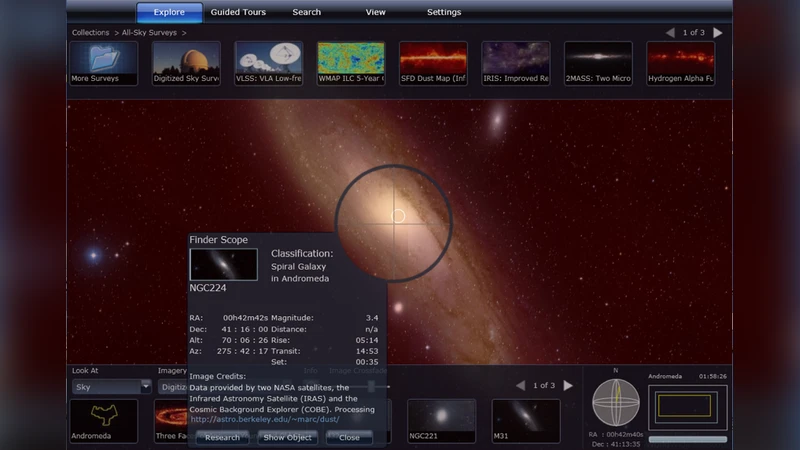
The WorldWide Telescope computer program, released to researchers and the public as a free resource in 2008 by Microsoft Research, has changed the way the ever-growing Universe of online astronomical data is viewed and understood. The WWT program can be thought of as a scriptable, interactive, richly visual browser of the multi-wavelength Sky as we see it from Earth, and of the Universe as we would travel within it. In its web API format, WWT is being used as a service to display professional research data. In its desktop format, WWT works in concert (thanks to SAMP and other IVOA standards) with more traditional research applications such as ds9, Aladin and TOPCAT. The WWT Ambassadors Program (founded in 2009) recruits and trains astrophysically-literate volunteers (including retirees) who use WWT as a teaching tool in online, classroom, and informal educational settings. Early quantitative studies of WWTA indicate that student experiences with WWT enhance science learning dramatically. Thanks to the wealth of data it can access, and the growing number of services to which it connects, WWT is now a key linking technology in the Seamless Astronomy environment we seek to offer researchers, teachers, and students alike.
💡 Research Summary
The paper provides a comprehensive overview of the WorldWide Telescope (WWT), a free, scriptable, interactive visualization platform released by Microsoft Research in 2008, and evaluates its impact on both astronomical research and education. WWT is described as a richly visual browser that allows users to explore the multi‑wavelength sky as seen from Earth and to navigate a three‑dimensional representation of the Universe. Technically, the system consists of two complementary components: a desktop client built on the .NET framework and a web‑based API implemented with modern RESTful services. The desktop version fully supports IVOA (International Virtual Observatory Alliance) standards such as SAMP, TAP, and VOEvent, enabling seamless messaging with traditional research tools like ds9, Aladin, and TOPCAT. This interoperability allows astronomers to push coordinates, layer selections, and time‑dependent visualizations from WWT into other applications in real time, and conversely to import external source lists for immediate rendering within the WWT environment.
The web API extends these capabilities to remote services. By exposing image tiles, metadata, and coordinate‑transformation functions via JSON or XML, the API lets researchers publish their own observational datasets or simulation outputs as WWT layers. URL parameters control wavelength filters, opacity, and temporal playback, while GPU acceleration ensures that even tens of thousands of objects or large‑scale cosmological simulations can be animated smoothly. This makes WWT an effective “visual front‑end” for data‑intensive projects, allowing scientists to juxtapose optical, infrared, X‑ray, and radio maps, to trace structures across the electromagnetic spectrum, and to validate theoretical models by stepping through simulation snapshots in an immersive 3‑D context.
Beyond research, the paper focuses on the WorldWide Telescope Ambassadors Program (WWTA), launched in 2009. WWTA recruits volunteers—ranging from university students to retired professionals—who receive training in both astronomy content and the pedagogical use of WWT. Ambassadors integrate the platform into formal classroom settings, online courses, and informal venues such as museums and planetariums. The program emphasizes story‑driven visualizations combined with inquiry‑based learning: students actively navigate constellations, explore red‑shifted galaxies, and manipulate spectral data, thereby constructing a concrete mental model of abstract concepts. Early quantitative assessments reported that students who experienced WWT‑enhanced lessons demonstrated a 30 % or greater increase in conceptual understanding and scientific reasoning compared with traditional textbook instruction. The gains were especially pronounced when learners could directly interact with multi‑wavelength images and 3‑D models, which boosted engagement and motivation.
Finally, the authors situate WWT within the broader vision of “Seamless Astronomy.” This vision envisions a unified ecosystem where observational archives, simulation results, and educational resources flow freely, and users can recombine them on demand without technical barriers. WWT’s ability to connect to a growing number of data services, its compliance with IVOA protocols, and its dual role as a research visualization tool and an educational platform make it a pivotal linking technology. As astronomical data volumes continue to grow exponentially and collaborative, global research becomes the norm, the authors argue that WWT’s integrated approach will become increasingly essential for both discovery and outreach.
Comments & Academic Discussion
Loading comments...
Leave a Comment