On context-free languages of scattered words
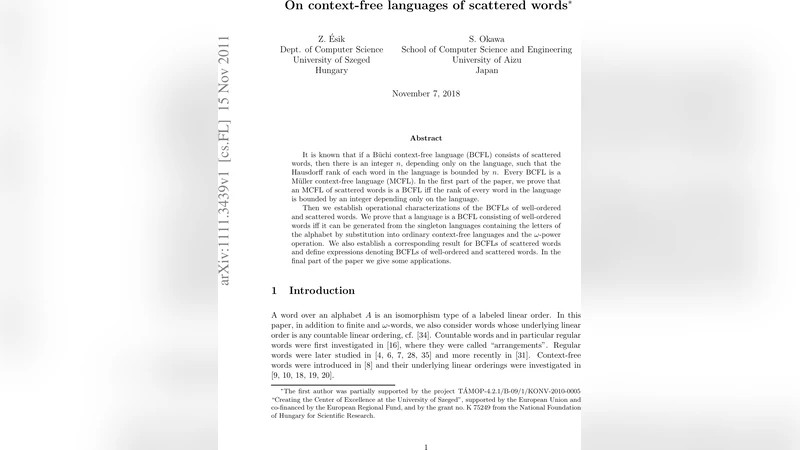
It is known that if a B"uchi context-free language (BCFL) consists of scattered words, then there is an integer $n$, depending only on the language, such that the Hausdorff rank of each word in the language is bounded by $n$. Every BCFL is a M"uller context-free language (MCFL). In the first part of the paper, we prove that an MCFL of scattered words is a BCFL iff the rank of every word in the language is bounded by an integer depending only on the language. Then we establish operational characterizations of the BCFLs of well-ordered and scattered words. We prove that a language is a BCFL consisting of well-ordered words iff it can be generated from the singleton languages containing the letters of the alphabet by substitution into ordinary context-free languages and the $\omega$-power operation. We also establish a corresponding result for BCFLs of scattered words and define expressions denoting BCFLs of well-ordered and scattered words. In the final part of the paper we give some applications.
💡 Research Summary
The paper investigates the relationship between Büchi context‑free languages (BCFLs) and Müller context‑free languages (MCFLs) when the underlying words are countable linear orderings, focusing on scattered and well‑ordered words. It begins by recalling that every BCFL is an MCFL, but the converse fails in general; for instance, the set of all well‑ordered countable words over a one‑letter alphabet is an MCFL but not a BCFL. A key observation from earlier work is that any BCFL consisting solely of scattered words has a uniform bound n on the Hausdorff rank of its words.
The first major result establishes a precise characterization: a scattered‑word MCFL L is a BCFL if and only if there exists an integer n such that every word u∈L has Hausdorff rank r(u)≤n. The proof analyses derivation trees of MCFLs. When the rank is bounded, every infinite path in a proper derivation tree must contain a repeating pattern of non‑terminals that satisfies the Büchi condition; the tree can be transformed into a Büchi‑acceptable one, showing L∈BCFL. Conversely, if the ranks are unbounded (for every countable ordinal α there is a word of rank >α), the Büchi condition cannot be met, so L cannot be a BCFL. Thus “bounded rank ⇔ BCFL” holds for scattered‑word MCFLs.
The second part of the paper provides operational characterizations of BCFLs of well‑ordered and scattered words. For well‑ordered words, the authors prove that any BCFL can be generated from the singleton languages {a} (a∈A) by two operations: (i) substitution of letters by ordinary context‑free languages, and (ii) the ω‑power operation (forming a^ω). This yields an expression language where each expression denotes a BCFL of well‑ordered words. For scattered words an additional “scattered sum” operation is required; it corresponds to the generalized sum of orderings used in Hausdorff’s hierarchy V_Dα. Using substitution, ω‑power, and scattered sum, every BCFL of scattered words can be built, and conversely any language built from these operations is a BCFL.
To formalize these constructions the authors introduce a syntax of expressions built from letters, union, concatenation, Kleene star, ω‑power, and the scattered‑sum operator. The semantics maps each expression to a language of countable words; by construction the resulting language always satisfies the bounded‑rank condition, hence is a BCFL. This provides a decidable syntactic criterion for BCFL membership.
The paper also studies linear BCFLs/MCFLs, where the underlying grammar is linear (right‑hand side contains at most one non‑terminal). Such grammars generate only words whose order type is either a finite ordinal n, ω+n, n+(−ω) or ω+(−ω); consequently every word has Hausdorff rank ≤1. Linear BCFLs coincide with languages recognized by Büchi automata on countable words, while linear MCFLs correspond to Müller automata.
Finally, several applications are sketched. The bounded‑rank characterization enables the design of verification tools that rely on Büchi automata: only languages with a uniform rank bound can be handled efficiently. In order‑theoretic contexts, the results give a clear demarcation of the V_Dα hierarchy in terms of automata‑theoretic acceptors. Moreover, the expression language can be used to specify infinite behaviours in program analysis, where the rank bound guarantees that the behaviours are amenable to Büchi‑based model checking.
In summary, the paper delivers a complete characterization of when a scattered‑word MCFL is a BCFL (exactly when the Hausdorff rank is uniformly bounded), provides constructive operational descriptions for BCFLs of well‑ordered and scattered words, introduces a robust expression formalism, and demonstrates the relevance of these theoretical insights to automata theory, order theory, and verification.
Comments & Academic Discussion
Loading comments...
Leave a Comment