An Enhanced Multiple Random Access Scheme for Satellite Communications
In this paper, we introduce Multi-Slots Coded ALOHA (MuSCA) as a multiple random access method for satellite communications. This scheme can be considered as a generalization of the Contention Resolution Diversity Slotted Aloha (CRDSA) mechanism. Instead of transmitting replicas, this system replaces them by several parts of a single word of an error correcting code. It is also different from Coded Slotted ALOHA (CSA) as the assumption of destructive collisions is not adopted. In MuSCA, the entity in charge of the decoding mechanism collects all bursts of the same user (including the interfered slots) before decoding and implements a successive interference cancellation (SIC) process to remove successfully decoded signals. Simulations show that for a frame of 100 slots, the achievable total normalized throughput is greater than 1.25 and 1.4 for a frame of 500 slots, resulting in a gain of 80% and 75% with respect to CRDSA and CSA respectively. This paper is a first analysis of the proposed scheme and opens several perspectives.
💡 Research Summary
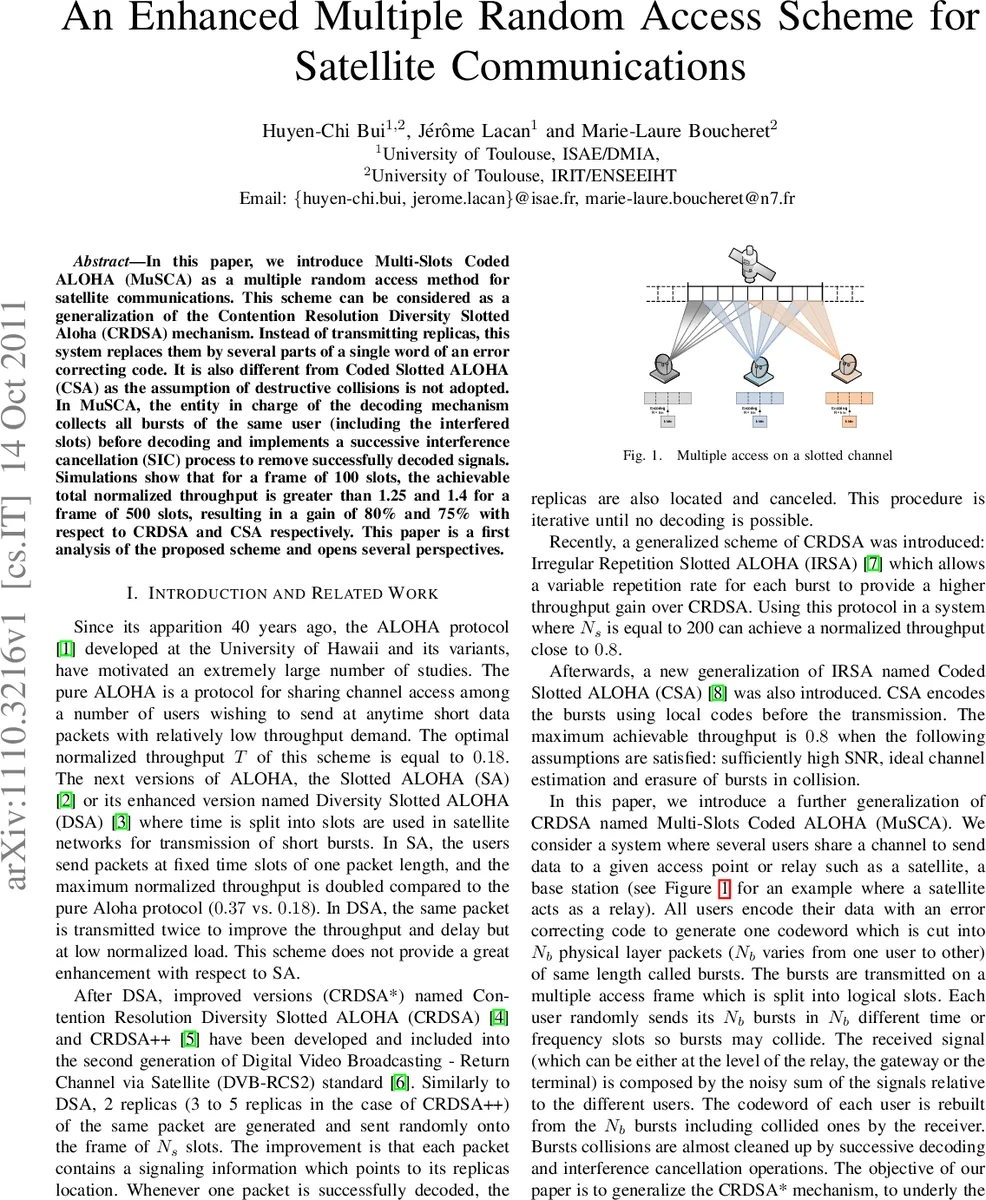
The paper introduces Multi‑Slots Coded ALOHA (MuSCA), a novel random‑access scheme for satellite uplinks that extends the ideas behind CRDSA, IRSA and Coded Slotted ALOHA (CSA). In MuSCA each user encodes a data block with an error‑correcting code, splits the resulting codeword into N b physical packets (bursts), and randomly places these bursts into N s slots of a slotted‑ALOHA frame. Every burst carries a short signaling field that points to the positions of the other bursts belonging to the same user.
At the receiver, decoding proceeds in two stages. First, the signaling fields are recovered using a low‑rate, high‑performance code (e.g., Reed‑Muller). Successful recovery reveals the full set of slots occupied by a given user. The receiver then collects all N b bursts of that user, reconstructs the full codeword, and attempts to decode the payload with a powerful error‑correcting decoder (e.g., CCSDS Turbo code). If decoding succeeds, the reconstructed signal is re‑modulated with the appropriate amplitude, phase and timing and subtracted from the composite received signal – this is the successive interference cancellation (SIC) step. The process iterates: after each successful cancellation, previously interfered bursts become cleaner, enabling further users to be decoded.
Unlike CSA, MuSCA does not treat collided bursts as erasures. Instead, bursts that are interfered by a limited number of other users (the paper uses a threshold of two interferers) are still used in the decoding of the full codeword. This key difference allows the system to extract useful information from collisions rather than discarding them, dramatically increasing the effective throughput, especially under high load conditions (G > 1).
Simulation results are presented for frames of 100, 200 and 500 slots, using a CCSDS Turbo code of rate R = 1/6 with QPSK modulation. With N b = 3 bursts per user, the normalized throughput reaches 1.25 for a 100‑slot frame and 1.40 for a 500‑slot frame at an SNR of E_s/N_0 = 10 dB. These figures represent a 75‑80 % gain over the best reported CSA performance (≈ 0.8) and a roughly two‑fold increase over CRDSA (≈ 0.7). Even at low SNR (E_s/N_0 = 0 dB) MuSCA can support about 80 simultaneous users, whereas CRDSA collapses.
The authors also explore a higher‑rate Turbo code (R = 1/4). Although the peak throughput drops to about 0.9, the amount of useful payload per slot increases, yielding higher net data rates at high SNR. This demonstrates that MuSCA can be tuned by selecting appropriate channel codes and burst parameters to meet different system objectives.
Key assumptions underlying the analysis include perfect slot and frame synchronization, equal received power from all users, and ideal channel estimation for accurate interference subtraction. The paper acknowledges that relaxing these assumptions (asynchrony, power imbalance, estimation errors) will inevitably degrade performance, and suggests future work to quantify these effects. Additionally, the need to wait for an entire frame before decoding introduces a latency proportional to the frame length, which may be a trade‑off in latency‑sensitive applications.
In summary, MuSCA offers a powerful new paradigm for random access in satellite communications: by integrating collided bursts into the decoding process and leveraging iterative SIC, it achieves near‑perfect success probabilities even when the channel is heavily overloaded. The scheme promises substantial throughput improvements over existing protocols and opens several avenues for further research, including asynchronous operation, robust channel estimation, and the design of tailored error‑correcting codes optimized for the MuSCA framework.
Comments & Academic Discussion
Loading comments...
Leave a Comment