The complexity of conservative valued CSPs
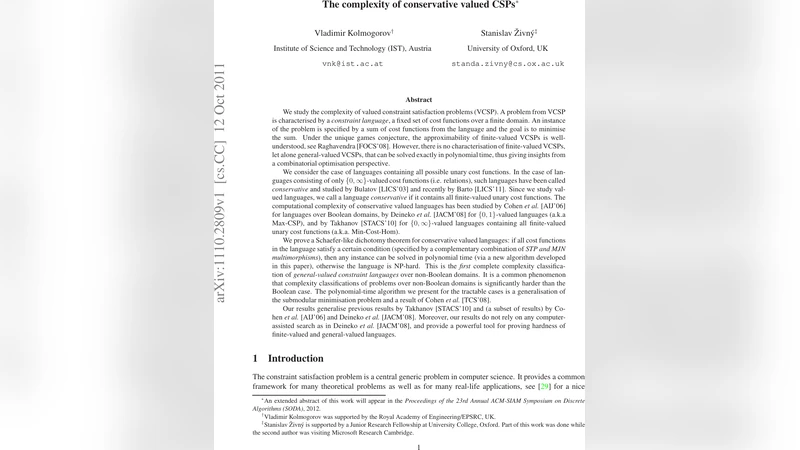
We study the complexity of valued constraint satisfaction problems (VCSP). A problem from VCSP is characterised by a \emph{constraint language}, a fixed set of cost functions over a finite domain. An instance of the problem is specified by a sum of cost functions from the language and the goal is to minimise the sum. We consider the case of languages containing all possible unary cost functions. In the case of languages consisting of only ${0,\infty}$-valued cost functions (i.e. relations), such languages have been called \emph{conservative} and studied by Bulatov [LICS'03] and recently by Barto [LICS'11]. Since we study valued languages, we call a language conservative if it contains all finite-valued unary cost functions. The complexity of conservative valued languages has been studied by Cohen et al. [AIJ'06] for languages over Boolean domains, by Deineko et al. [JACM'08] for ${0,1}$-valued languages (a.k.a Max-CSP), and by Takhanov [STACS'10] for ${0,\infty}$-valued languages containing all finite-valued unary cost functions (a.k.a. Min-Cost-Hom). We prove a Schaefer-like dichotomy theorem for conservative valued languages: if all cost functions in the language satisfy a certain condition (specified by a complementary combination of \emph{STP and MJN multimorphisms}), then any instance can be solved in polytime (via a new algorithm developed in this paper), otherwise the language is NP-hard. This is the \emph{first} complete complexity classification of \emph{general-valued constraint languages} over non-Boolean domains. This generalises previous results by Takhanov [STACS'10] and (a subset of results) by Cohen et al. [AIJ'06] and Deineko et al. [JACM'08]. Moreover, our results do not rely on any computer-assisted search as in Deineko et al. [JACM'08], and provide a powerful tool for proving hardness of finite- and general-valued languages.
💡 Research Summary
The paper addresses the long‑standing open problem of classifying the computational complexity of valued constraint satisfaction problems (VCSPs) when the constraint language is conservative, i.e., it contains all finite‑valued unary cost functions. While dichotomy theorems are known for Boolean domains, for crisp languages over larger domains, and for special cases such as Max‑CSP ({0,1}‑valued) or Min‑Cost‑Hom ({0,∞}‑valued), a complete classification for general‑valued languages on non‑Boolean domains had been missing.
The authors introduce two families of multimorphisms—STP (Symmetric Tournament Pair) and MJN (Majority‑Majority‑Minority)—and prove that a conservative language Γ is tractable iff it admits a complementary combination of these multimorphisms. An STP consists of two binary operations ⊓ and ⊔ that are conservative (they always return one of their arguments), commutative, and satisfy the submodular inequality f(x⊓y)+f(x⊔y) ≤ f(x)+f(y) for every cost function f in Γ. An MJN is a triple of ternary operations (Mj₁, Mj₂, Mn) where Mj₁ and Mj₂ are majority operations (return the element occurring twice) and Mn is a minority operation (return the unique element), again acting conservatively on triples. When both an STP and an MJN are multimorphisms of Γ, every cost function in Γ obeys the corresponding multimorphism inequalities, which enables a reduction of any VCSP instance over Γ to a submodular function minimisation problem.
A central technical tool is the graph G_Γ, whose vertices correspond to binary relations expressible over Γ and whose directed edges encode a certain “cost‑dominance” relation. The authors show that if G_Γ contains forbidden configurations (e.g., certain directed cycles), then Γ must be NP‑hard. Conversely, when G_Γ is well‑behaved, one can construct a partial STP and a partial MJN from the structure of G_Γ, and then extend them to full multimorphisms. This construction yields a polynomial‑time algorithm: the algorithm first clusters variables according to the structure of G_Γ, applies the STP operations to collapse binary constraints, uses the MJN operations to handle ternary interactions, and finally solves the resulting submodular instance using known algorithms (e.g., Iwata‑Fleischer‑Fujishige). The algorithm is a genuine generalisation of the classic submodular minimisation technique and subsumes earlier tractable cases identified by Cohen et al., Deineko et al., and Takhanov.
Importantly, the paper proves that adding all finite‑valued unary cost functions to a conservative language does not change its complexity class, so the weaker definition (containing only {0,1}‑valued unaries) suffices for the dichotomy. The condition “Γ admits STP + MJN” can be checked in polynomial time, providing a practical pre‑processing test for tractability.
The main theorem can be stated succinctly:
If a conservative language Γ admits a symmetric tournament pair and an MJN multimorphism, then VCSP(Γ) is solvable in polynomial time; otherwise VCSP(Γ) is NP‑hard.
This result unifies and extends all previously known dichotomies for Boolean, Max‑CSP, Min‑Cost‑Hom, and crisp conservative languages, and it does so without any computer‑assisted exhaustive search. Moreover, the techniques are robust enough to be adapted to non‑conservative languages, as later work by Jonsson et al. demonstrates.
From a broader perspective, the paper provides a powerful algebraic‑graphical framework for proving hardness and designing algorithms for a wide range of optimisation problems that can be expressed as VCSPs, including Gibbs energy minimisation, Markov Random Fields, and Min‑Sum problems. By establishing the first complete complexity classification of general‑valued constraint languages over non‑Boolean domains, it marks a significant milestone in the theory of constraint optimisation and opens new avenues for both theoretical investigation and practical algorithm design.
Comments & Academic Discussion
Loading comments...
Leave a Comment