NUM-Based Rate Allocation for Streaming Traffic via Sequential Convex Programming
In recent years, there has been an increasing demand for ubiquitous streaming like applications in data networks. In this paper, we concentrate on NUM-based rate allocation for streaming applications with the so-called S-curve utility functions. Due …
Authors: Ali Sehati, Mohammad Sadegh Talebi, Ahmad Khonsari
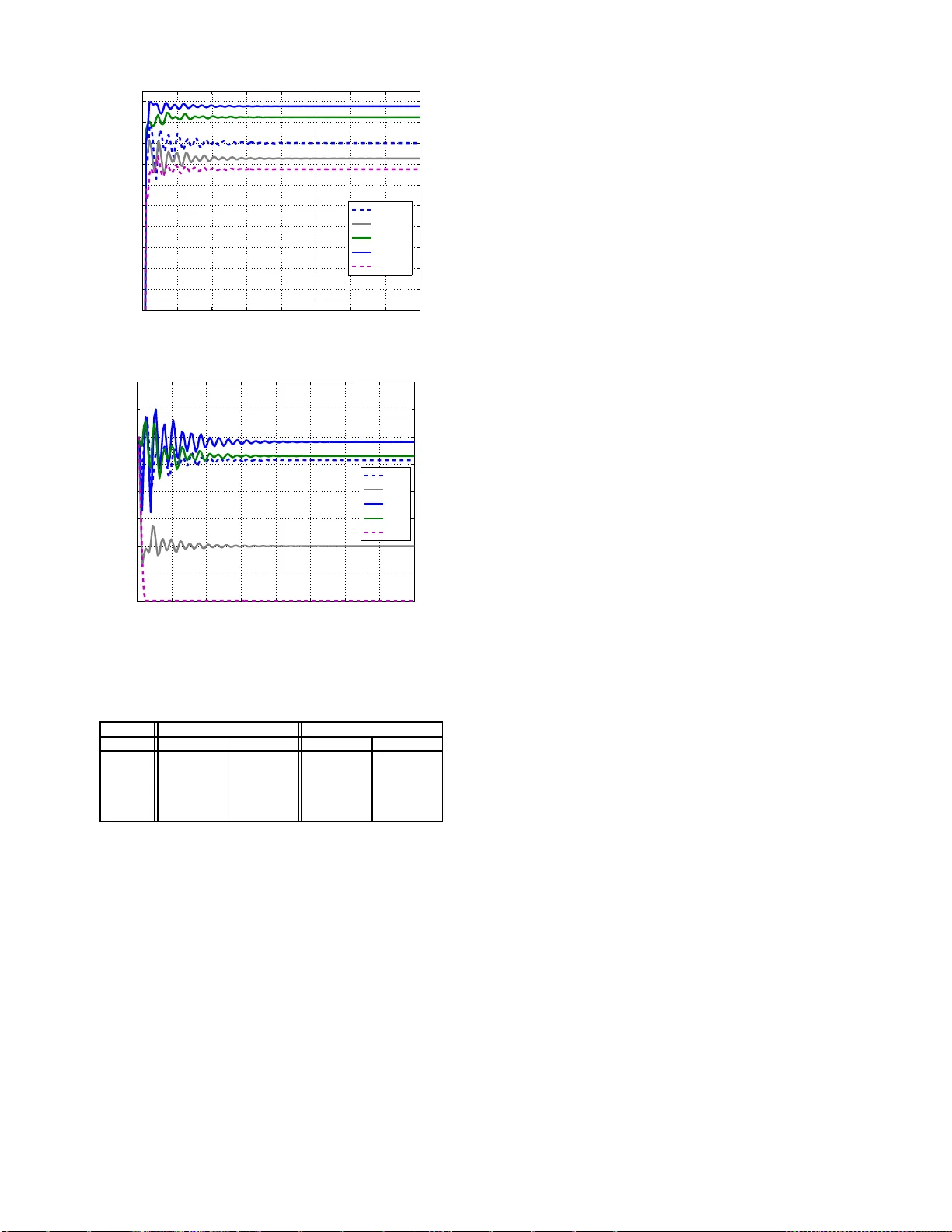
NUM-Based Rate Allocation for Streami ng T raf fic via Sequential Con v e x Programming Ali Sehati ECE Departmen t, Uni versity of T eh ran School of Com puter Science, IPM T eh ran, Iran. Email: a.sehati@ipm.ir Mohammad Sadegh T alebi School of Com puter Science, IPM T eh ran, Iran. Email: mstaleb i@ipm.ir Ahmad Khons ari ECE Depar tment, University of T ehran School of Com puter Science, IPM T eh ran, Iran. Email: khon sari@ut.ac.ir Abstract —In recent years , there has been an in creasing de- mand f or ubiqu itous streaming like applications in data netw orks. In this paper , we concentrate on NUM-based rate allocation fo r streaming applications with the so-ca lled S-curve utility functions. Due to non -conca vity of such u tility fun ctions, the underlying N UM problem wo uld b e n on-con vex f or w hich d ual methods might become quite useless. T o tackle the non-con vex problem, using elementary techni ques we make the util ity of the networ k conca ve, howev er this results in re verse -con vex con- straints whi ch make th e problem non-conv ex. T o deal with such a transfo rmed NUM, we leverage Sequential Conv ex Programming (SCP) approach to approximate the n on-con vex problem by a series of conv ex ones. Based on this approach, we propose a distributed rate allocation algorithm and demonstrate that u nder mild conditions, it conv erges to a locally opti mal solution of the original NUM . Numerical results validate the effectiveness, in terms of tractable con verge nce of the proposed rate all ocation algorithm. I . I N T RO D U C T I O N W ith recen t ad vances in network ing technolo gies and video compression , there is an increasing dema nd for ubiqu itous multimedia applications like liv e streamin g, video gaming , video conferencing , and v oice ov er I P . M ultimedia applications are characterized by a multitude o f QoS requiremen ts includ- ing stringent band width, delay , and delay jitter guarantees. The ev er increasing demand for streaming traffic has attracted a lot of research interests to develop efficient mechanisms for resource allocation b etween competing multimed ia sessions in a wide variety of network ing scenarios [1]-[3]. In th e co urse of the last decade, rate allo cation has been widely ad dressed as the (usually distributed) solution to Net- work Utility Maximiza tion (NUM), which has em erged as an analy tical framework to und erstand a nd design existing network protocols [4]-[5]. The g oal of NUM is to maximize the aggregate utility of the u sers subject to o peration al and practical con straints of the n etwork. In the b asic fo rm of NUM pr oposed in [4], th e feasib ility of rate allocation was accommo dated by cong estion in link s. So far, a plethora of studies hav e co ncentrated on NUM-based r ate allocation for services with elastic traffic such as tra ditional file transfer . Due to strict co ncavity an d differentiability of the utility function for elastic traffic, such NUMs are smooth and strictly c onv ex and thu s far h av e been efficiently solved u sing d ual or primal- dual metho ds ( see e.g. [ 5] and re ferences therein.) In contrast, applications that carry inelastic traffic like audio/vid eo streaming, can only toler ate a limited a mount of packet d elay or fluctu ation in rate. Hen ce, they ar e in possession of non-co ncave and o ften non- differentiable utility function s [1], [6]. This results in a non- conv ex and usually non-smo oth NUM f or which d ual/primal-d ual method s mig ht prove quite useless. There hav e been several works that have addressed non- conv ex NUM pro blems for resource allocation suppo rting inelastic services [6]-[12]. Lee et al. [7] outlined the possibility of div ergence o f dual method s for non-con cave utilities and propo sed a distributed “self- regulating” h euristic for r ate con- trol of non -concave utilities, where some of the sou rces turn themselves off acco rding to their local info rmation. Hande et al. [8] pro posed n ecessary and sufficient cond itions f or c anon- ical distributed algorith m to con verge to global o ptimum in the presence of non-co ncave u tilities. A centralized algorithm for non-co n vex NUM has been proposed in [9] in which su m-of- squares techniq ue was applied to a po lynomial appro ximation of the n on-co ncave utility function. Howe ver, this centralized approa ch suffers from high order of c omplexity . In [6], the authors exerted a redefined variant o f the non -concave utility function in a distributed flow contro l algorith m so that the network can achieve a utility-pro portion al fair ra te allocation. Authors of [ 10] merged the utility-prop ortional theo ry with a stochastic o ptimization f ramework to pr opose a rate co ntrol algorithm fo r th e mix ture of elastic and inelastic traffic in wireless sensor n etworks. In [1 1], the a uthors introduc ed a smooth utility functio n as an appr oximation to th e ideal stair- case utility function for SVC-encoded streams and lev eraged the utility-pro portion al a pproac h to redefine the NUM which is solvable using dual meth ods. Autho rs of [12], addressed NUM pr oblem in the con text of ra ndom access in WLANs for stations gen erating either elastic o r inelastic traffic. In this stud y , we focu s on NUM-based rate allocation fo r streaming ap plications with a class of non-concave utility function s. T owards this, we ad opt the so-called S-cu rve u tility function s for streaming traffic [ 2], [3] as they are shown to be capable of characterizing the user perceived qu ality for a broad range o f mu ltimedia streaming scen arios. I n o rder to tack le the resulting no n-convex NUM, we exp loit tran sformatio n technique s to gain a strictly concave objective. Howev er , this proced ure yields a class o f non -conve x DC (difference of conv ex) constrain ts, referred to as r everse-con vex co nstraints [13]. W e then dea l with the non-c onv ex tr ansform ed NUM using an approach called Seq uential Conve x P r ogramming with DC constraints , abbreviated as SCP-DC, which was propo sed in [13]. In this regard, SCP-DC approach tackles the pro blem with re verse-con vex constrain ts by solving a series of co n vex prob lems. Then we present a distributed rate allocation algor ithm obtained by solving the sequen ce of conv ex problem s in an iterative man ner . W e demonstrate that under mild assumptio ns, th e pr oposed algorithm will converge to a lo cally optima l solutio n of the original NUM pro blem. T o the best of o ur kn owledge, this is the first work that addr esses NUM with S-curve utilities with Sequential Conv ex Program - ming appr oach. Finally , our num erical exper iments con firm the tractab le convergence rate o f ou r pro posed algorith m and validate th e its effectiv eness in our experiment scenarios. The rest of this paper is organized as follows. In Section II, we describe the n etwork an d utility model an d in Section III, we establish prob lem form ulation. Then we pr esent our solution algorithm in Section IV. Numerical analysis is giv en in Section VI and conclusion is drawn in Section VII. I I . S Y S T E M M O D E L A. Network Model W e consider a commun ication network that consists of a set L = { 1 , . . . , L } o f u nidirection al links and a set S = { 1 , . . . , S } o f sou rces. W e d enote by c = ( c l , l ∈ L ) the link capacity vector where c l is the capacity of link l in bps. W e assume that each logical source s tr ansmits at ra te x s ∈ X s , [ m s , M s ] , wher e m s and M s are the min imum and th e m aximum rates, respectiv ely . There is a fixed set of links L ( s ) ⊆ L that sour ce s uses to reach its destinatio n. W e represent such routes u sing a ro uting matr ix R ∈ R L × S , which is defin ed as R ls = 1 if sour ce s passes th rough link l 0 otherwise Rate allocation is c onsidered to be feasible if an d only if the sour ce rate vector x = ( x s , s ∈ S ) satisfies th e following condition s C1. x s ∈ X s , s ∈ S C2. P S s =1 R ls x s ≤ c l , l ∈ L . B. Utility Model In order to measure the user satisfaction degree, we u se the well kn own notion of utility function . W e associate an in creas- ing a nd continuou sly d ifferentiable functio n U s ( x s ) with ea ch source s . As m entioned in [1], mu ltimedia applicatio ns, such as video strea ming and V oIP , fall in the category of inelastic traffic and un like elastic traf fic, the y are usually modeled by a family of no n-con cave utility function s refer red to as sigmoidal-like fu nctions 1 [7]. For example, previous studies 1 An increasing function f ( x ) is called a sigmoidal-li ke function , if it has one inflection point x 0 , and f ′′ ( x ) > 0 , for x < x 0 and f ′′ ( x ) < 0 , for x > x 0 . In ot her words, f ( x ) is con vex for x < x 0 and concav e for x > x 0 . 0 20 40 60 80 100 0 0.2 0.4 0.6 0.8 1 x s U s (x s ) C 1 =6, C 2 =2 C 1 =6, C 2 =6 C 1 =10, C 2 =6 C 1 =10, C 2 =20 Fig. 1: S-curve Utili ty Corresponding to differen t v alues of C 1 and C 2 have mo stly used sigmo idal logistic fun ction define d b elow as the utility f unction for inelastic tr affic [7] , [9]: U ( x ) = 1 1 + e − α ( x − β ) (1) which has the inflection point x infl = β . In this work , we focus on stream ing applicatio ns whic h are shown to admit utility f unction s refer red to a s S-curve [3], [2]. Such utility f unctions can capture th e perc eptual video quality of stream ing u sers as a function of transmission rate. In [2], the authors hav e propo sed the following mathem atical expression for this class o f utility f unction s U s ( x s ) = 1 − e − C 1 s ( x s r s ) C 2 s 1 − e − C 1 s (2) where r s is the con stant rate at which v ideo o f sourc e s is enc oded and x s is the av erage data rate rece i ved during transmission. Constants C 1 s > 0 and C 2 s ≥ 1 ar e some parameters that depend on the prope rties of the video sequence and v ideo en coder and m ight be determined in an o ffline fashion for stored med ia streaming. It is easy to verify that the inflection point of th e S-cur ve utility functio n is giv en by x infl = r s C 2 s − 1 C 1 s C 2 s 1 C 2 s The above equ ation im plies that C 2 s > 1 results in x infl > 0 which ma kes S-curve a no n-conc av e fun ction. Fig. 1 portrays some utility function s correspon ding to different values of parameters C 1 s and C 2 s . The family of S-cu rve utility functions ar e cap able o f capturing ch aracteristics o f fine-gran ularity scalable, layered and n on-scalable video streams as their special cases. For example, perceptua l quality o f FGS en coded video is smo oth and can easily be appr oximated by (2). Moreover , the step- wise utility of SVC video streams [14] can also be roug hly characterized b y S-cu rve (2 ). Ha rd real-tim e app lications such as traditio nal voice service requ ire fixed transmission r ate. For such ser vices, the utility below a th reshold r ate would be ze ro. These applica tions are no n-scalable and c an be rep resented by a step utility f unction. S-cur ve u tility fun ction (2) can also approx imate a step functio n a s C 2 s → ∞ [2]. I I I . P RO B L E M F O R M U L AT I O N W e model the rate allo cation f or streaming application s following the f ramework o f Network Utility Maximization (NUM) which was prop osed as the extension to optimization flow c ontrol in the seminal work of Lo w e t al. [4]. The objective is th e sum of u tility functions with utilities defin ed by (2) and the constrain ts a re feasibility condition s C1 - C2 . The rate allocation p roblem is de scribed as f ollows max x ∈ X P S s =1 U s ( x s ) subject to P s R ls x s ≤ c l ∀ l ∈ L (3) where X d enotes the Cartesian p rodu ct of all rate domain s X s , s ∈ S . As stated in the previous section , the S-curve utility function (2) is non-concave fo r C 2 s > 1 wh ich makes the ab ove problem n on-co n vex. W e would like to elabo rate on making this problem c onv ex so as to u se powerful method s d eveloped for conv ex o ptimization. W e can make the utility fu nction concave with th e following ch ange of variables: ˜ x s = x s r s C 2 s (4) Substituting the ab ove transfo rmation in (2), we obtain the transform ed utility function ˜ U s ( . ) as ˜ U s ( ˜ x s ) = 1 − e − C 1 s ˜ x s 1 − e − C 1 s (5) where the tran sformed variable ˜ x s belongs to ˜ x s ∈ ˜ X s , " m s r s C 2 s , M s r s C 2 s # The tr ansform ed utility functio n ˜ U s is strictly conc av e in ˜ x s , becau se for C 1 s > 0 , its second deriv ative satisfies ˜ U ′′ s ( ˜ x s ) = − ( C 1 s ) 2 1 − e − C 1 s e − C 1 s ˜ x s < 0 (6) Re writing the capacity c onstraint fo r link l , yields g l ( ˜ x ) , X s R ls r s ˜ x 1 C 2 s s ≤ c l ; ∀ l ∈ L . (7) Unfortu nately , the ab ove c apacity constra ints with trans- formed variables d o n ot cor respond to a conv ex con straint as th e (L .H.S) of (7) is a con cav e function. I ndeed, the set D l = { ˜ x s | g l ( ˜ x s ) − c l ≤ 0 } is a no n-conve x set, howe ver the set R S + − D l = { ˜ x s | g l ( ˜ x s ) − c l > 0 } is a con vex set. In optimization ter minolog y , suc h a constraint is ref erred to as a r everse-conve x con straint which is a special case of D iffer ence of Conve x ( DC) constraints [13], [15]. In or der to tackle such re verse-con vex co nstraints, we use the sequential con vex pr ogramming algo rithm with DC con- straints (SCP-DC) prop osed in [ 13]. In this a pproac h, the n on- conv ex function that border s the range of p ermissible values for a co nstraint is replaced by an affine approxim ation to make the con straint conve x. Using this ap proach , the L.H.S of ea ch reverse-con vex constraint g l ( ˜ x ) ≤ c l is r eplaced by its fir st order T aylor approxim ation aro und a feasible point ˜ x ′ , denoted by ˆ g l ( ˜ x , ˜ x ′ ) , as fo llows ˆ g l ( ˜ x , ˜ x ′ ) , g l ( ˜ x ′ ) + ∇ g l ( ˜ x ′ ) T ( ˜ x − ˜ x ′ ) ≤ c l (8) Since g l is differentiable, ∇ g exists at auxiliary variable ˜ x ′ s ∈ ˜ X s . I t’ s easy to verify tha t ˆ g l ( ˜ x , ˜ x ′ ) is affine in ˜ x and th ereby L.H.S of (8) is conve x. Thus, the constrain t (8) represents a convex co nstraint. For ˆ g l we get ˆ g l ( ˜ x , ˜ x ′ ) = X s R ls r s ( ˜ x ′ s ) 1 C 2 s + 1 C 2 s ( ˜ x ′ s ) 1 C 2 s − 1 ( ˜ x s − ˜ x ′ s ) (9) Finally , we rewrite the NUM pro blem with appr oximated constraints as max ˜ x , ˜ x ′ ∈ ˜ X S X s =1 1 − e − C 1 s ˜ x s 1 − e − C 1 s (10) subject to: ˆ g l ( ˜ x , ˜ x ′ ) ≤ c l ; ∀ l ∈ L . (11) The above pro blem is strictly conve x (in ˜ x ) since its o bjective is strictly con cav e beca use of (6) an d its constrain ts ar e affine function s. Before pro ceeding to solve the above problem, it’ s worth mentionin g that in case of sigmoidal logistic utility functions (1), if we de fine ˜ x s = e α ( x − β ) , we will come up with a conv ex objecti ve with DC c onstraints, which can be treated b y the afo remention ed technique to obta in a conv ex for mulation similar to proble m (10)-(1 1). Therefore, the solution procedur e to be discu ssed in the next section, will be applicable to the case of NUM with sigmoidal logistic utility functions. I V . O P T I M A L S O L U T I O N In this section, we solve problem ( 10)-(11) using dual methods [4], [ 16]. A. P rimal Pr oblem The Lagra ngian f unction is de riv ed a s [16]: L ˜ x , ˜ x ′ , µ = X s ˜ U s ( ˜ x s ) − X l µ l ˆ g l ( ˜ x , ˜ x ′ ) − c l (12) where µ l is the positive Lagrang e multiplier a ssociated with constraint (11) f or link l and µ = ( µ l , l ∈ L ) . According to Karush-Kuhn- T ucker (KKT) theorem, the stationary point of th e Lagrang ian, i.e. the solution to ∇ L ˜ x ∗ , ˜ x ′∗ , µ ∗ = 0 , provides the uniqu e solution to th e problem (10)-(11). Partial deriv atives of the La grangian with respect to ˜ x s is gi ven in (13) at the top of the next pag e, an d finally for the statio nary po int we get ˜ x ∗ s = 1 C 1 s ( A ∗ s − log ρ s ∗ ) (14) where A ∗ s = log C 1 s C 2 s r s (1 − e − C 1 s ) + 1 − 1 C 2 s log ˜ x ′∗ s ρ s ∗ = X l R ls µ ∗ l . (15) ∂ L ∂ ˜ x s = d d ˜ x s ˜ U s ( ˜ x s ) − d d ˜ x s X l µ l X s R ls r s ( ˜ x ′ s ) 1 C 2 s + 1 C 2 s ( ˜ x ′ s ) 1 C 2 s − 1 ( ˜ x s − ˜ x ′ s ) − c l ! = C 1 s e − C 1 s ˜ x s 1 − e − C 1 s − d d ˜ x s ( ˜ x ′ s ) 1 C 2 s + 1 C 2 s ( ˜ x ′ s ) 1 C 2 s − 1 ( ˜ x s − ˜ x ′ s ) r s X l R ls µ l = C 1 s e − C 1 s ˜ x s 1 − e − C 1 s − r s C 2 s ( ˜ x ′ s ) 1 C 2 s − 1 X l R ls µ l = 0 (13) It’ s easy to verify that the transfo rmed source rate ˜ x ∗ s is a decreasing fun ction with respect to µ ∗ l , l ∈ L . W e postp one findin g ˜ x ′∗ to the next sub section. W e will find µ ∗ by solving the dual pr oblem associated to the primal problem . T owards this, we first d erive the dual fu nction, which is defined as the following Lag rangian max imization [ 16]: D ( µ ) = max ˜ x , ˜ x ′ ∈ ˜ X L ˜ x , ˜ x ′ , µ = L ˜ x ∗ , ˜ x ′∗ , µ B. Du al Pr ob lem Having obtained the dual functio n, i.e. D ( µ ) = L ˜ x ∗ , ˜ x ′∗ , µ , the dual p roblem is defined as the following minimization pro blem [16]: min µ ≥ 0 D ( µ ) (16) Solving the above prob lem in clo sed fo rm mig ht be im- possible, and hence we solve it using iterative methods. As problem (10)-(11) is strictly co n vex, the dual fun ction D ( µ ) is d ifferentiable over the open set R L ++ and we can benefit from gradient p r ojection algo rithm to solve the dual problem [17]. In th is algo rithm, the dua l variable is iterativ ely updated in the o pposite directio n to ∇ D ( µ ) as follows: µ ( t +1) = [ µ ( t ) − γ ∇ D ( µ ( t ) )] + where γ > 0 is a sufficiently sm all step-size. Using Da nskin’ s Theo rem [17], the partial der iv atives of the dual fun ction are character ized as follows ∂ D ∂ µ l = c l − ˆ g l ( ˜ x , ˜ x ′ ) (17) In an iter ativ e setting, to find the o ptimal value of th e aux- iliary variable ˜ x ′∗ , similar to Proximal Optim ization Meth ods [17], we u pdate it as follows ˜ x ′ ( t +1) = ˜ x ( t ) Put anoth er way , it makes sense that, to calculate primal- optimal variable ˜ x ( t +1) at iteration step t , ˜ x ( t ) is the b est candidate f or ˜ x ′ along wh ich th e affine ap prox imation (8) can be made. Substituting ( 17) into gradien t p rojection up date formu la results in the following du al variable upd ate µ ( t +1) l = h µ ( t ) l − γ ( c l − ˆ g l ( ˜ x ( t ) , ˜ x ′ ( t ) )) i + = h µ ( t ) l − γ ( c l − ˆ g l ( ˜ x ( t ) , ˜ x ( t − 1) )) i + (18) where ˜ x ( t ) is the value of optima l transform ed rate g iv en µ ( t ) . Moreover , for rate c omputatio n at iter ation t , we get ˜ x ( t +1) s = 1 C 1 s A ( t +1) s − log ρ s ( t ) (19) where A ( t +1) s = log C 1 s C 2 s r s (1 − e − C 1 s ) + 1 − 1 C 2 s log ˜ x ( t ) s Finally , by taking the in verse tr ansform ation of ( 4), fo r sou rce rate at iterate t + 1 , we g et x ( t +1) s = r s ˜ x ( t +1) s 1 C 2 s X s (20) where [ . ] X s is the p rojection onto X s . V . R AT E A L L O C AT I O N A L G O R I T H M A. A lgorithm The eq uations ob tained in the pr evious sectio n fo r op timal source rate calculatio n, i.e. (19) and (20), an d dual variable update, i.e. (18), can w ork togeth er to f orm a d istributed solution to p roblem (3). Below we have shown a co ncise form of this iterative algo rithm a s Algorithm 1. As we can see, implementatio n of this algorithm ne cessitates two mechan isms for info rmation exchange b etween links and sources. 1) Each link l updates its price and communicates the result to the co rrespon ding source s. 2) Each source s calcu lates its new rate and in forms the links in its p ath. This type of information exchange can be carried out explic- itly , fo r example v ia flooding -like mechan isms as sugg ested in [18]. Th is is in contrast to the implicit mechanisms inhe rent in Optim ization Flow Con trol app roach [4] where each so urce can infer aggregate p rice of its p ath using either queu eing delay or p acket loss r atio, a nd e ach lin k ju st n eeds to measure its curren t flow to update its price. B. Conver gence First we no te that at the steady state, i.e. when ˜ x ( t +1) = ˜ x ( t ) , or equivalently when ˜ x ′ ( t +1) − ˜ x ( t +1) = 0 , the appro ximated capacity constrain ts (8 ) would becom e X s R ls r s ( ˜ x ( t +1) s ) 1 C 2 s ≤ c l , l ∈ L , (21) and ther eby conve x ified constraints (8) will b ecome equivalent to DC constraints (7). Therefo re, if the algorith m co n verges to the stead y state, the conve xified constraints (8) will be equiv- alent to the original constraints of the transformed problem. In [13], it has bee n proved that und er mild co nditions on the objective function, such as strict convexity , the SCP-DC algorithm co n verges to a local m aximizer of the no n-convex problem (3). Theref ore, the proposed rate allocation algo rithm will reach a lo cal maximum of pr oblem (3) provid ed that γ is chosen sufficiently small so that the grad ient projectio n algorithm will co n verge [1 7]. Based on the results stated in [1 3], if SCP-DC algorithm conv erges, then the steady state point is a statio nary point of the o ptimization p roblem. Put ano ther way , the steady state point is a lo cal o ptimal of the optimization pro blem. It has also bee n p roved in [13] that fo r strictly conve x objectives , the SCP-DC alg orithm al ways con verges to a KKT point of the or iginal optimization pro blem (3 ). Algorithm 1 Distrib uted Rate Control Algori thm f or Strea ming T raffic Using SCP-DC Algorithm Initializ ation 1) Set of s ources and links including the routin g m atrix 2) r s , C 1 s , C 2 s for s ∈ S 3) γ and c l for l ∈ L Main Loop Do until max s | x ( t +1) s − x ( t ) s | < ǫ 1) For each l ∈ L , update link price µ l by: µ ( t +1) l = h µ ( t ) l − γ ( c l − ˆ g l ( ˜ x ( t ) , ˜ x ( t − 1) )) i + 2) For each s ∈ S , ˜ x s is calcula ted by: A ( t +1) s = log C 1 s C 2 s r s (1 − e − C 1 s ) + 1 − 1 C 2 s log ˜ x ( t ) s ˜ x ( t +1) s = 1 C 1 s A ( t +1) s − l og ρ s ( t ) and ρ s ( t ) = P l R ls µ l ( t ) . Then calculat e x ( t +1) s as x ( t +1) s = r s ˜ x ( t +1) s 1 C 2 s X s V I . N U M E R I C A L A N A LY S I S In this section, we in vestigate the perf orman ce and validity of the p roposed rate allocation alg orithm listed in the p revious section as Algo rithm 1. A. S cenario 1 W e first con sider a simple topology with a single b ottleneck link with cap acity c = 1 Mbps. V id eo sequen ces f or all sources ar e assumed to be en coded at the co nstant bit rate r s = 256 Kb ps. Sour ces ha ve utility func tions with parame ters C 1 s = 6 , ∀ s and ( C 21 , . . . , C 25 ) = (2 , 4 , 6 , 8 , 10) . The 2nd column of T able I lists the results of th e proposed rate allocation alg orithm with step size γ = 1 0 − 4 and the stopping criterion ǫ = 0 . 1 . Fig. 3(a) and Fig. 3(b) display the evolution of sou rce r ates and link pric e, respectiv ely . From Fig. 3(a), it is observable 5 x 1 x 4 x 3 x 2 x 1 c 2 c 3 c 4 c 5 c Fig. 2: Network topology and flow rates 0 10 20 30 40 50 60 0 50 100 150 200 250 Source Rates Iteration Source1 Source2 Source3 Source4 Source5 (a) E volut ion of Flow Rates 0 10 20 30 40 50 60 2 3 4 5 6 7 8 9 10 x 10 −3 Link Price Iteration Link1 (b) Evolu tion of Shado w Price Fig. 3: Evolution of (a) Source rates and (b) Link price for the first scenario that the stop ping criterion is met in iteration step t = 12 wh ich implies the p roper conver gence rate of th e algorithm . B. S cenario 2 Now we focus on a scenario with multiple b ottleneck links whose top ology is shown in Fig. 2 with cap ac- ity vector c = (210 , 4 25 , 6 10 , 4 25 , 2 10) Kbps. Sou rces have utility function s with p arameters C 2 s = 6 , ∀ s and ( C 11 , . . . , C 15 ) = (2 , 4 , 6 , 8 , 10) . Similar to the previous sce- nario, we set r s = 256 , γ = 10 − 4 , and ǫ = 0 . 1 . Th e 4th column o f T able I lists the results of the prop osed rate a llo- cation algorith m. Fig. 4( a) and Fig. 4(b) display th e ev olution of source rates and link prices, respectively . As shown in Fig. 4(a), the stopping c riterion is satisfied in iteration step t = 70 0 20 40 60 80 100 120 140 160 130 140 150 160 170 180 190 200 210 220 230 Source Rates Iteration Source1 Source2 Source3 Source4 Source5 (a) Evoluti on of Flow Rates 0 20 40 60 80 100 120 140 160 0 1 2 3 4 5 6 7 8 x 10 −3 Link Prices Iteration link1 Link2 Link3 Link4 Link5 (b) Evolu tion of Shadow Prices Fig. 4: Evolution of (a) Source r ates and (b) L ink prices for t he second scenario Scenari o 1 Scenari o 2 Source Algorith m fmincon Algorithm fmincon 1 118.1668 117.9658 209.8065 210.0000 2 191.2863 191.1745 202.4938 202.6043 3 219.4306 219.3638 222.3787 227.3957 4 232.2970 232.2520 227.6564 227.6043 5 239.2770 239.2439 197.3906 197.3957 T ABLE I: Rate allocation results which again demonstra tes th e tr actable conver gence rate of the p roposed algo rithm in a top ology with multiple b ottleneck links. C. V alidatio n In order to validate the rate allocation results obtained above, we ha ve also solved the proble m (3) by in voking fmincon function in Matlab [19]. When calling this fun ction, we choose Interio r -P oint Method [16], [17] as its solv ing algorithm . T he r esults retu rned by fmincon for th e two scenarios along with th ose obtaine d by our algorithm are listed in T able I. It is easy to confirm that the rate allocation resu lts completely match th ose obtained fro m fmincon . V I I . C O N C L U S I O N In this p aper, we addressed r ate allocation f or strea ming applications with non -conve x S-curve utility function s. First we conve xified the u tility fun ctions with elemen tary transfor- mation tec hniques. Th en, we exploited th e SCP-DC approach [13] to h andle the resu ltant reverse-con vex constraints. Using dual meth od, we then propo sed a distributed rate allocation algorithm which was shown to achie ve a locally optimal solution of the no n-convex NUM . Simula tion results validated the tractable conv ergence and accuracy of the pro posed rate allocation algorithm . As a possible direction to continu e this research, it is promising to add ress rate allocation fo r such streaming application s in wireless networks. R E F E R E N C E S [1] S. Shenker , “Fundamenta l design issues for the future Internet, ” IEEE J. Sel. Areas Commun. , vol. 13, no. 7, pp. 1176-1188, Sep. 1995. [2] V . V ukadinovi c and G. Karlsson, “Multicast scheduling with resource fair ness constra ints, ” ACM/Spring er W ireless Netw . , vol. 15, no. 5, pp. 571-583, July 2009. [3] V . Rodriguez, D. J. G oodman, and Y . W ang, “Optimal Coding Rate and Po wer Alloca tion for the Streaming of Scalably Encoded V ideo Over a W irel ess L ink, ” in Proc . IEEE ICASSP , May 2004. [4] S. H. Low , and D. E. Lapsley , “Optimiz ation flow control, I: basic algorit hm and con vergenc e, ” IEEE/ACM T rans. Netw . , vol. 7, no. 6, pp. 861-874, Dec. 1999. [5] M. Chiang, S. H. L o w , A. R. Calderban k, and J. C. Doyle, “Layering as optimiza tion decompositi on: A mathematica l theory of network architec- tures, ” Proc . IEEE , vol. 95, no. 1, pp. 255-312, Jan. 2007. [6] M. H. W ang, M. P alan iswami, and S. H. Lo w , “ Applicati on-Orient ed Flow Control: Fundamentals, Algorithms and Fairness, ” IEEE/ACM T rans. Netw . , vol. 14, no. 6, pp. 1282-1291, Dec. 2006. [7] J. W . L ee, R. R. Mazumdar , and N. Shrof f, “Non-con vex optimizati on and rate control for multi-cla ss services in the Intern et, ” IEEE /AC M T rans. Netw . , vol. 13, no. 4, pp. 827-840, Aug. 2005. [8] P . Hande, S. Zhang, and M. Chiang, “Distribut ed rate allo catio n for inela stic flows, ” IEEE/ACM Tr ans. Netw . , vol. 15, no. 6, pp. 1240-1253, Dec. 2007. [9] M. Faz el and M. Chiang, “Nonconca ve network utility maximization by sum of squares programming, ” in P r oc. IE EE CDC , December 2005. [10] J. Jin, A. Sridharan, B. Krishnamachari, and M. Palaniswa mi, “Handli ng inela stic traffic in wire less sensor netw orks, ” IEE E J . Sel. Areas C ommun. , vol. 28, no. 7, pp. 1105–1115, 2010. [11] M. S. T alebi, A. Khonsari, and M. H. Hajiesmai li, “Utilit y-proport ional bandwidt h sharing for multimedia transmission s upporting scalable video coding, ” Elsevi er Computer Communicat ions , vol. 33, no. 13, pp. 1543– 1556, 2010. [12] M. H. Cheung, A.-H. Mohsenian -Rad, V . W ong, and R. Schober , “Random access for elastic and inelastic traf fi c in wlans, ” IEEE T rans. W ire less Commun. , vol. 9, no. 6, pp. 1861–1866, 2010. [13] T . D. Quoc and M. Diehl. (2011, Jul.) “Sequential Con ve x Program- ming Metho ds for Solving Nonlinear Optimiza tion Problems with DC constrai nts, ” [Online ]. A v aila ble: http: //arxi v .org/abs/1107.5841 . [14] A dvance d V ideo Coding for Generic Audio visual Servic es, ITU-T Rec. H.264 and ISO/IEC 14496-10 A V C, v3: 2005, Amendment 3: Scalab le V ideo Coding. [15] S. Boyd, “Sequentia l Con ve x Progra mming, ” EE364b Lecture Notes, Stanford Uni versi ty . [16] S. Boyd and L. V andenber ghe, Con vex Optimization , Cambridge Uni- versi ty Press, 2003. [17] D. Bertsek as, Nonli near Pro gramming , Athena Scientific, 1999. [18] M. Chiang, “Balanci ng transpo rt and physical layers in wirele ss mul- tihop networ ks: Jointly optimal congestion control and power contro l, ” IEEE J . Sel. A re as Commun. , vol. 23, no. 1, pp. 104-116, 2005. [19] MA TLAB version R2009b . T he MathW orks Inc., 2009.
Original Paper
Loading high-quality paper...
Comments & Academic Discussion
Loading comments...
Leave a Comment