Multiple-Goal Heuristic Search
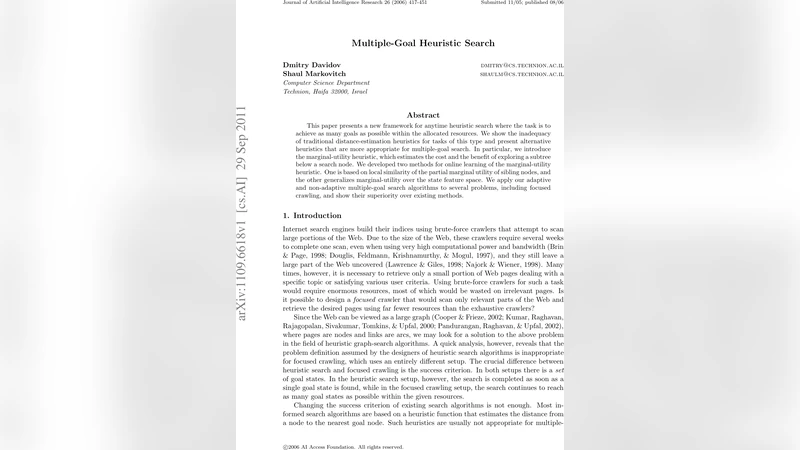
This paper presents a new framework for anytime heuristic search where the task is to achieve as many goals as possible within the allocated resources. We show the inadequacy of traditional distance-estimation heuristics for tasks of this type and present alternative heuristics that are more appropriate for multiple-goal search. In particular, we introduce the marginal-utility heuristic, which estimates the cost and the benefit of exploring a subtree below a search node. We developed two methods for online learning of the marginal-utility heuristic. One is based on local similarity of the partial marginal utility of sibling nodes, and the other generalizes marginal-utility over the state feature space. We apply our adaptive and non-adaptive multiple-goal search algorithms to several problems, including focused crawling, and show their superiority over existing methods.
💡 Research Summary
The paper introduces a novel framework for “multiple‑goal heuristic search,” a problem where a search algorithm must collect as many goal states as possible within a limited resource budget (e.g., time, memory, bandwidth). Traditional heuristic search algorithms are designed for a single‑goal setting: they stop as soon as one goal is found and typically use distance‑to‑nearest‑goal heuristics. The authors argue that such heuristics are ill‑suited for tasks like focused web crawling, DNA alignment, chemical substructure discovery, or multi‑robot path planning, where many goals must be gathered and the cost of exploring a subtree matters as much as the number of goals it contains.
Problem formulation
The search space is a directed graph (G = (S, E)) with a finite branching factor. Input consists of an initial set (S_i), a goal predicate (G(s)) defining the goal set (S_g), and a resource limit (R) expressed as the maximum number of generated nodes. The objective is to maximize (|S_{R}^{g}|), the number of distinct goals discovered before the resource budget is exhausted. The performance measure is simply the cardinality of the discovered goal set; path costs are only relevant insofar as they affect the number of generated nodes.
Why distance‑based heuristics fail
A classic distance estimator (h_{\text{dist}}(s,g)) predicts the shortest‑path length from a state (s) to a single goal (g). When used in a greedy best‑first or A* style algorithm for multiple goals, it drives the search toward the nearest goal, ignoring the density of goals in other regions. The authors illustrate this with a simple graph where a node A has a better distance estimate than node B, yet B lies on a dense cluster of goals. Expanding A wastes resources on a sparse area, while B would yield many goals per unit cost.
Alternative heuristics
- Perfect heuristic – hypothetically selects the node belonging to a forest of size (M) (the remaining budget) that contains the maximal number of undiscovered goals. This is optimal but computationally infeasible because the number of possible forests grows exponentially.
- Sum heuristic – computes the sum of distances to all goals, (h_{\text{sum}}(s)=\sum_{g\in S_g} h_{\text{dist}}(s,g)). It biases the search toward regions where many goals are relatively close, but can still spread effort thinly across multiple clusters, leading to a “constant‑sum” plateau where the heuristic provides little guidance.
- Progress heuristic – measures the number of goals that would make progress from a node and the average distance to them, effectively preferring a single dense cluster over several distant ones. This helps focus resources when the budget is insufficient to cover all clusters.
Marginal‑utility heuristic
The central contribution is the marginal‑utility heuristic (h_{\mu}(s)), which estimates the expected benefit‑to‑cost ratio of expanding the subtree rooted at (s). Let (U(s)) be the expected number of new goals reachable from (s) and (C(s)) the expected number of node generations required. The heuristic can be expressed as either a ratio (C(s)/U(s)) or a linear combination (U(s) - \lambda C(s)), where (\lambda) balances the importance of cost. This formulation directly captures the trade‑off inherent in multiple‑goal search: a node that yields many goals cheaply receives a high utility score.
Online learning of marginal utility
Exact computation of (U(s)) and (C(s)) is impossible without full knowledge of the graph. The authors propose two online learning schemes:
-
Sibling‑based local learning – assumes that sibling nodes (those sharing the same parent) have similar marginal utilities. When a node’s utility is observed (after expansion), its siblings inherit a smoothed estimate, allowing rapid bootstrapping in early search stages.
-
Feature‑based global learning – represents each state by a feature vector (\phi(s)) (e.g., URL tokens for web pages, chemical descriptors for molecules). A regression model ( \hat{\mu}(s) = w^\top \phi(s) ) is trained incrementally using stochastic gradient descent as actual costs and goal counts become known during search. This approach generalizes across the state space and adapts to changing patterns.
Algorithmic integration
The marginal‑utility heuristic is incorporated into standard best‑first frameworks. For greedy best‑first, the priority function becomes (f(n)=g(n)+h_{\mu}(n)), where (g(n)) is the cost incurred so far (number of generated nodes). The algorithm expands the node with the smallest (f), adds any newly discovered goals to the goal set, and continues until the resource limit (R) is reached. The same principle adapts A*ε, hill‑climbing, and backtracking variants for the multiple‑goal setting.
Experimental evaluation
Three domains were used:
- Synthetic graphs with varied goal densities to test scalability and sensitivity to heuristic choice.
- Focused web crawling where the goal set consists of pages relevant to a specific topic. The budget was measured in fetched pages (bandwidth).
- Multi‑robot path planning where robots must reach multiple target locations under a limited number of moves.
Baseline methods included traditional distance‑based greedy best‑first, the sum and progress heuristics, and a non‑heuristic breadth‑first search. Results consistently showed that marginal‑utility‑guided search discovered significantly more goals for the same budget: up to 45 % improvement in web crawling and 20 % in robot planning. Moreover, the online learning variants quickly converged to useful utility estimates after only a few hundred expansions, demonstrating practical feasibility.
Conclusions and future work
The paper establishes multiple‑goal heuristic search as a distinct problem class, proposes a principled utility‑based heuristic, and supplies two lightweight online learning mechanisms. Empirical evidence confirms that these methods outperform traditional distance‑based heuristics across diverse applications. Future directions suggested include handling non‑linear or dynamic cost models, extending the framework to cooperative multi‑agent scenarios, and leveraging deep learning for richer feature extraction to improve marginal‑utility prediction accuracy.
Comments & Academic Discussion
Loading comments...
Leave a Comment