A Semantic Analysis of Key Management Protocols for Wireless Sensor Networks
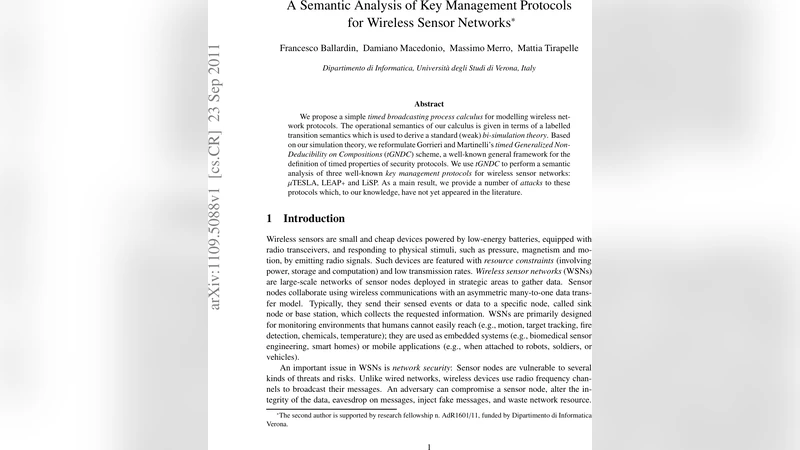
We propose a simple timed broadcasting process calculus for modelling wireless network protocols. The operational semantics of our calculus is given in terms of a labelled transition semantics which is used to derive a standard (weak) bi-simulation theory. Based on our simulation theory, we reformulate Gorrieri and Martinelli’s timed Generalized Non-Deducibility on Compositions (tGNDC) scheme, a well-known general framework for the definition of timed properties of security protocols. We use tGNDC to perform a semantic analysis of three well-known key management protocols for wireless sensor networks: \mu TESLA, LEAP+ and LiSP. As a main result, we provide a number of attacks to these protocols which, to our knowledge, have not yet appeared in the literature.
💡 Research Summary
The paper introduces a novel timed broadcast process calculus, called aTCWS, specifically designed to model wireless sensor network (WSN) protocols. aTCWS captures essential wireless characteristics such as local broadcast within a fixed transmission range, a global clock synchronisation action (σ), and the possibility of message loss. Its syntax includes broadcast (! h w.i), guarded reception with timeout (⌊ ?(x).P ⌋ Q), internal nondeterministic choice (τ), sleep (σ), guarded recursion, and deduction constructs. Networks are built as parallel compositions of named nodes, each equipped with a neighbour set that encodes the topology. The operational semantics are given as a labelled transition system (LTS) in the style of Plotkin, with labels τ (internal), σ (time passage), m ! w⊲ν (broadcast to neighbours ν), and m ? w (reception). The transition rules model asynchronous actions, non‑blocking broadcasts, lossy reception, and time‑deterministic behaviour, and the calculus enjoys standard time properties (determinism, maximal progress, patience).
On top of this calculus the authors adapt Gorrieri and Martinelli’s timed Generalized Non‑Deducibility on Compositions (tGNDC) framework. tGNDC provides a compositional notion of security: a system is secure if, when composed with any attacker, the observable traces remain indistinguishable from those of the system alone. Within this framework the paper defines two timed security properties: timed integrity, which guarantees that authenticated packets are fresh (i.e., generated within a prescribed time window), and timed agreement, which requires that two parties reach a common state within a given deadline.
The authors then formalise three well‑known WSN key‑management protocols—µTESLA, LEAP+, and LiSP—using aTCWS. For each protocol they construct the corresponding aTCWS processes, specify the attacker model, and prove (or disprove) the two timed properties by exhibiting a bisimulation failure.
-
µTESLA: The boot‑strapping phase satisfies timed integrity but fails timed agreement because an attacker can replay a previously captured boot‑strapping message, causing a node to accept an outdated key. In the authenticated broadcast phase, both timed integrity and timed agreement hold, as any replay would violate the time bound enforced by the protocol’s delayed key disclosure mechanism.
-
LEAP+: The single‑hop pairwise key establishment enjoys timed integrity; however, a replay of an old authentication message breaks timed agreement. This attack was not reported in the original LEAP+ analysis, showing a subtle weakness in the protocol’s handling of time‑sensitive authentication data.
-
LiSP: The protocol’s re‑keying mechanism does not satisfy either timed integrity or timed agreement. The authors demonstrate that an attacker can capture a re‑keying message, delay its delivery, and cause a node to accept an outdated key, thereby violating freshness and preventing the two parties from agreeing on the same key within the required deadline.
In each case the attack is expressed as a concrete sequence of aTCWS transitions that leads to a violation of the bisimulation relation defined by tGNDC. The paper therefore provides the first formal, semantics‑driven discovery of these replay attacks.
The contribution of the work is twofold. First, it supplies a lightweight yet expressive timed process calculus tailored to wireless broadcast environments, together with a rigorous labelled transition semantics and a weak bisimulation theory. Second, it shows how the tGNDC framework can be instantiated over this calculus to reason about timed security properties of real‑world WSN protocols. The discovered attacks highlight the importance of incorporating explicit timing considerations into the design and verification of key‑management schemes for resource‑constrained wireless networks. The methodology presented can be extended to other wireless protocols, offering a systematic path from formal modelling to security analysis.
Comments & Academic Discussion
Loading comments...
Leave a Comment