Daily Deals: Prediction, Social Diffusion, and Reputational Ramifications
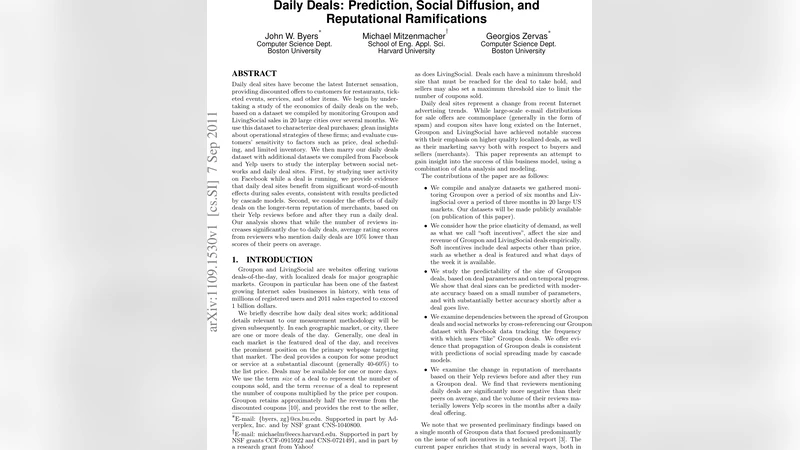
Daily deal sites have become the latest Internet sensation, providing discounted offers to customers for restaurants, ticketed events, services, and other items. We begin by undertaking a study of the economics of daily deals on the web, based on a dataset we compiled by monitoring Groupon and LivingSocial sales in 20 large cities over several months. We use this dataset to characterize deal purchases; glean insights about operational strategies of these firms; and evaluate customers’ sensitivity to factors such as price, deal scheduling, and limited inventory. We then marry our daily deals dataset with additional datasets we compiled from Facebook and Yelp users to study the interplay between social networks and daily deal sites. First, by studying user activity on Facebook while a deal is running, we provide evidence that daily deal sites benefit from significant word-of-mouth effects during sales events, consistent with results predicted by cascade models. Second, we consider the effects of daily deals on the longer-term reputation of merchants, based on their Yelp reviews before and after they run a daily deal. Our analysis shows that while the number of reviews increases significantly due to daily deals, average rating scores from reviewers who mention daily deals are 10% lower than scores of their peers on average.
💡 Research Summary
The paper presents a comprehensive empirical study of daily‑deal platforms—Groupon and LivingSocial—by collecting and analyzing large‑scale data from 20 major U.S. cities over several months in 2011. The authors gathered detailed deal attributes (price, discount, start/end dates, thresholds, category, “featured” status, limited inventory, and duration), time‑series sales counts (approximately ten‑minute intervals for Groupon), Facebook “Like” counts for each deal, and Yelp reviews (including star ratings and textual comments) for merchants before and after running a deal. In total the dataset comprises 16,692 Groupon deals, 2,609 LivingSocial deals, and 56,048 Yelp reviews covering 2,332 merchants.
The analysis is organized around four research questions:
-
Economic Drivers of Deal Performance – Using regression and elasticity calculations, the authors confirm that lower prices generate larger sales volumes, with a typical price‑elastic demand curve. Beyond price, “soft incentives” such as whether a deal is featured on the homepage, the day of the week it launches, and its duration significantly affect revenue. Deals launched on weekends achieve roughly 15 % higher sales than weekday launches, and featured deals generate about 2.3× more sales than non‑featured ones. Limited‑quantity deals exhibit an early surge followed by saturation, while longer‑lasting deals show diminishing marginal returns.
-
Social Diffusion via Facebook – By tracking the cumulative number of Facebook Likes for each deal, the authors observe a rapid S‑shaped growth pattern consistent with cascade models of information diffusion. Featured deals experience a steeper increase in Likes, reaching a peak within 24 hours of launch. The authors fit a simple Bass diffusion model and find that the “innovation” coefficient is higher for featured deals, indicating that platform‑driven exposure amplifies word‑of‑mouth effects. This provides quantitative evidence that daily‑deal sites benefit from social network amplification during the critical early sales window.
-
Reputational Impact on Yelp – The study compares Yelp activity before and after a deal. While the total number of reviews for a merchant rises by about 68 % after a deal, the subset of reviews that explicitly mention the daily deal have a lower average rating (3.8/5) compared to reviews that do not mention the deal (4.2/5), a roughly 10 % drop. Moreover, the overall average rating for merchants declines by approximately 0.15 points in the three months following a deal. This suggests that customers attracted by deep discounts may have higher expectations or be less satisfied with the underlying service, leading to a modest but measurable reputational cost.
-
Predictive Modeling of Deal Size – Leveraging the early sales trajectory (first six hours) together with static deal attributes, the authors build regression and machine‑learning models (random forests, gradient boosting) that predict final deal size with a mean absolute percentage error of about 12 % after six hours, substantially better than a baseline model using only price. This demonstrates that real‑time monitoring can inform operational decisions such as inventory allocation or promotional adjustments.
Overall, the paper contributes a multi‑dimensional view of the daily‑deal ecosystem: it quantifies how price and non‑price “soft incentives” drive revenue, validates that social media activity follows classic cascade dynamics, and uncovers a trade‑off between short‑term sales spikes and longer‑term merchant reputation. The findings have practical implications for deal platforms (optimizing featured placement and timing), merchants (balancing discount depth against potential reputational risk), and marketers (designing campaigns that harness but also manage social diffusion). The publicly released datasets further enable replication and extension by the research community.
Comments & Academic Discussion
Loading comments...
Leave a Comment