Heat Transfer and Reconnection Diffusion in Turbulent Magnetized Plasmas
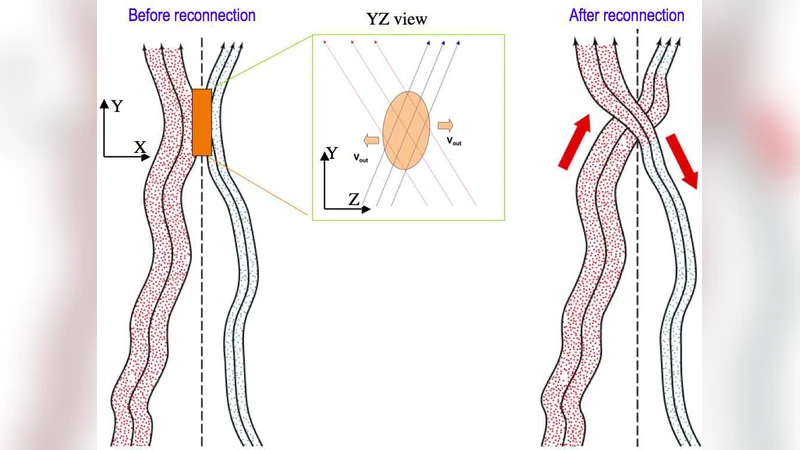
It is well known that magnetic fields constrain motions of charged particles, impeding the diffusion of charged particles perpendicular to magnetic field direction. This modification of transport processes is of vital importance for a wide variety of astrophysical processes including cosmic ray transport, transfer of heavy elements in the interstellar medium, star formation etc. Dealing with these processes one should keep in mind that in realistic astrophysical conditions magnetized fluids are turbulent. In this review we single out a single transport process, namely, heat transfer and consider how it occurs in the presence of the magnetized turbulence. We show that the ability of magnetic field lines to constantly change topology and connectivity is at the heart of the correct description of the 3D magnetic field stochasticity in turbulent fluids. This ability is ensured by fast magnetic reconnection in turbulent fluids and puts forward the concept of reconnection diffusion at the core of the physical picture of heat transfer in astrophysical plasmas. Appealing to reconnection diffusion we describe the ability of plasma to diffuse between different magnetized eddies explaining the advection of the heat by turbulence. Adopting the structure of magnetic field that follows from the modern understanding of MHD turbulence, we also discuss thermal conductivity that arises as electrons stream along stochastic magnetic field lines. We compare the effective heat transport that arise from the two processes and conclude that in many astrophysically-motivated cased eddy advection of heat dominates. Finally, we discuss the concepts of sub and superdiffusion and show that the subdiffusion requires rather restrictive settings. At the same time, accelerated diffusion or superdiffusion of heat is possible on the scales less than the injection scale of the turbulence.
💡 Research Summary
This review addresses the problem of heat transport in magnetized astrophysical plasmas that are inevitably turbulent. The authors begin by recalling the classic picture: magnetic fields freeze plasma and suppress particle diffusion across field lines, thereby limiting thermal conduction perpendicular to the field. They argue that this picture is incomplete for realistic astrophysical environments because turbulence constantly reshapes magnetic topology.
The paper first outlines the ubiquity of turbulence in the interstellar medium, galaxy clusters, and other cosmic settings, citing observations of electron‑density fluctuations (the “Big Power Law in the Sky”) and velocity‑channel analyses that reveal a Kolmogorov‑like inertial range. It then summarizes modern magnetohydrodynamic (MHD) turbulence theory, focusing on the Goldreich‑Sridhar (GS95) model of strong Alfvénic turbulence. In this framework, eddies are anisotropic, with parallel scales (l_{\parallel}) scaling as (l_{\perp}^{2/3}). The authors also discuss weak turbulence, which behaves more like interacting wave packets, and note that the transition from weak to strong turbulence occurs as the cascade proceeds to smaller scales.
A central element of the review is the Lazarian‑Vishniac (LV99) model of fast magnetic reconnection in a turbulent medium. Unlike the Sweet‑Parker model, where reconnection is limited by resistive diffusion, LV99 shows that stochastic wandering of magnetic field lines broadens the outflow region, allowing reconnection rates comparable to the Alfvén speed. This rapid reconnection breaks the ideal “frozen‑in” condition and enables plasma elements to exchange magnetic connectivity across different turbulent eddies. The authors term the resulting transport process “reconnection diffusion.”
Two distinct mechanisms for heat transfer are then examined. The first is electron thermal conduction along stochastic magnetic field lines. The effective conductivity depends on the electron thermal speed, the electron mean free path, and the degree of field line wandering, which is itself set by the turbulence spectrum (GS95 scaling). The second mechanism is advection of heat by turbulent eddies. Because reconnection diffusion allows plasma to move freely between eddies, the eddy turnover motions can carry thermal energy much like ordinary hydrodynamic turbulence. The authors derive scaling estimates for the conductive diffusivity (\kappa_{\rm cond}\sim v_e \lambda_e) and the turbulent diffusivity (\kappa_{\rm turb}\sim v_l l), where (v_e) and (\lambda_e) are the electron thermal speed and mean free path, while (v_l) and (l) are the turbulent velocity and eddy size at a given scale.
By inserting typical astrophysical parameters (e.g., cluster core temperatures of several keV, magnetic fields of a few microgauss, turbulence injection scales of 10–100 kpc, and Alfvén Mach numbers near unity), they find that (\kappa_{\rm turb}) exceeds (\kappa_{\rm cond}) by one to two orders of magnitude. Consequently, on scales larger than the turbulence injection scale, heat transport is dominated by eddy advection rather than electron conduction. This conclusion holds for a wide range of environments, from the hot intracluster medium to the warm interstellar medium and star‑forming clouds.
The review also discusses anomalous diffusion regimes. Sub‑diffusion (mean‑square displacement growing slower than linearly with time) would require magnetic field lines to remain tightly correlated over long times, a situation that only arises in highly ordered, low‑turbulence regions where reconnection is suppressed. In contrast, super‑diffusion (faster than linear growth) naturally emerges on scales smaller than the turbulence injection scale, where field line wandering follows Richardson‑type scaling, leading to (\langle \Delta x^2\rangle\propto t^{3/2}). This super‑diffusive behavior can significantly accelerate heat spreading in the early stages of turbulent cascade.
In the concluding section, the authors emphasize that reconnection diffusion provides a unified framework for understanding heat transport, magnetic flux removal in star formation, and the suppression of cooling flows in galaxy clusters. They advocate for high‑resolution MHD simulations that explicitly resolve both turbulent eddies and reconnection layers, as well as for observational tests (e.g., measuring temperature anisotropies correlated with turbulent velocity statistics). The paper thus positions reconnection‑driven diffusion as a cornerstone concept for future studies of magnetized astrophysical plasmas.
Comments & Academic Discussion
Loading comments...
Leave a Comment