Three-term Method and Dual Estimate on Static Problems of Continuum Bodies
This work aims to provide standard formulations for direct minimization approaches on various types of static problems of continuum mechanics. Particularly, form-finding problems of tension structures are discussed in the first half and the large deformation problems of continuum bodies are discussed in the last half. In the first half, as the standards of iterative direct minimization strategies, two types of simple recursive methods are presented, namely the two-term method and the three-term method. The dual estimate is also introduced as a powerful means of involving equally constraint conditions into minimization problems. As examples of direct minimization approaches on usual engineering issues, some form finding problems of tension structures which can be solved by the presented strategies are illustrated. Additionally, it is pointed out that while the two-term method sometimes becomes useless, the three-term method always provides remarkable rate of global convergence efficiency. Then, to show the potential ability of the three-term method, in the last part of this work, some principle of virtual works which usually appear in the continuum mechanics are approximated and discretized in a common manner, which are suitable to be solved by the three-term method. Finally, some large deformation analyses of continuum bodies which can be solved by the three-term method are presented.
💡 Research Summary
The paper presents a unified framework for solving static problems in continuum mechanics by direct minimization of an energy‑like functional. It begins by recasting static equilibrium as the stationary condition of a scalar functional Π(x), where x collects all free nodal coordinates. Two recursive algorithms are introduced. The “two‑term method” is essentially a steepest‑descent scheme: the normalized gradient r = ∇Π/‖∇Π‖ defines the search direction and the update is x_{k+1}=x_k−α r_k, with a constant step‑size α chosen by the user. While simple, this method suffers from slow global convergence when the initial guess is far from the solution.
To overcome this limitation, the authors propose the “three‑term method”. By introducing a velocity‑like vector q and a damping factor β≈0.98, the iteration becomes q_{k+1}=β q_k−α r_k and x_{k+1}=x_k+α q_{k+1}. The factor β removes 2 % of the “momentum” each step, guaranteeing a monotonic decrease of a discrete energy and dramatically accelerating convergence. The three‑term scheme can be interpreted as a simplified dynamic relaxation or as a member of the conjugate‑gradient family; numerical experiments on a cable‑net example show that it reaches the minimum in far fewer iterations than the two‑term method and reduces the gradient norm to below 10⁻³.
When equality constraints g(x)=0 are present, the functional is augmented with Lagrange multipliers λ, forming L(x,λ)=Π(x)+λ·g(x). Directly solving ∇_x L=0 is impossible because λ is unknown, making ∇Π ill‑defined. The paper resolves this by employing a “dual estimate” (pseudo‑inverse) technique. The Jacobian J of the constraints is used to compute a Moore‑Penrose inverse J⁺=Jᵀ(JJᵀ)⁻¹. The multipliers are then estimated as λ=−∇Π_w J⁺, where ∇Π_w is the gradient of the original objective. Substituting back yields a projected gradient ∇Π=∇Π_w·(I−J J⁺). This projection enforces the constraints without explicitly solving for λ, allowing both the two‑ and three‑term methods to be applied unchanged. The approach is mathematically equivalent to dual scaling in linear programming.
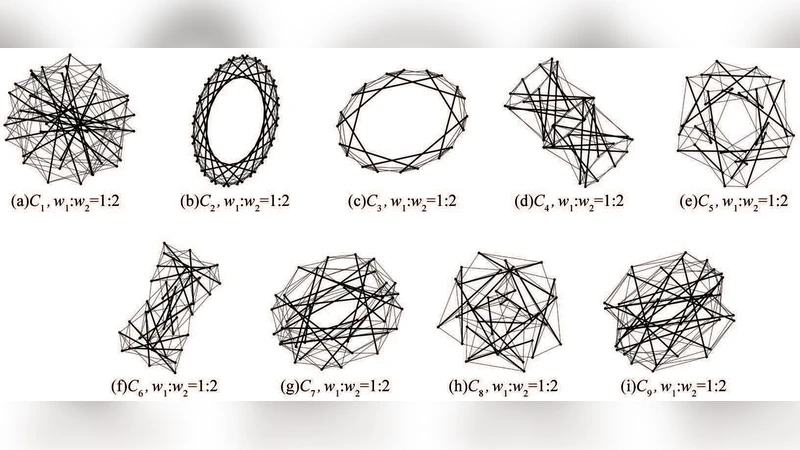
The authors extend the methodology to general continuum bodies by discretizing the principle of virtual work. Virtual displacements δx and internal forces f are defined for each degree of freedom, leading to the discrete equilibrium condition δΠ=∇Π·δx=0. The same three‑term recursion is then applied to the resulting nonlinear system, making the technique suitable for large‑deformation analyses. Several examples are presented: (1) form‑finding of a tensegrity structure with fixed compression‑member lengths, where the dual estimate enforces those lengths while the three‑term method rapidly minimizes the sum of fourth powers of tension‑member lengths; (2) a tensioned membrane under prescribed loads, demonstrating that the method converges with a modest number of iterations even for highly nonlinear material behavior; (3) a large‑deformation solid problem, where the three‑term method outperforms traditional Newton–Raphson in terms of iteration count and robustness, thanks to the built‑in damping.
In conclusion, the three‑term method provides superior global convergence, stability, and ease of parameter tuning compared with the two‑term steepest‑descent approach. The dual‑estimate projection offers a practical way to handle equality constraints without solving a saddle‑point system. Together, they constitute a versatile, easy‑to‑implement toolbox for static analysis of tension structures, tensegrities, membranes, and general nonlinear continuum bodies, opening avenues for efficient shape optimization and form‑finding in engineering practice.
Comments & Academic Discussion
Loading comments...
Leave a Comment