Distributed Agreement in Dynamic Peer-to-Peer Networks
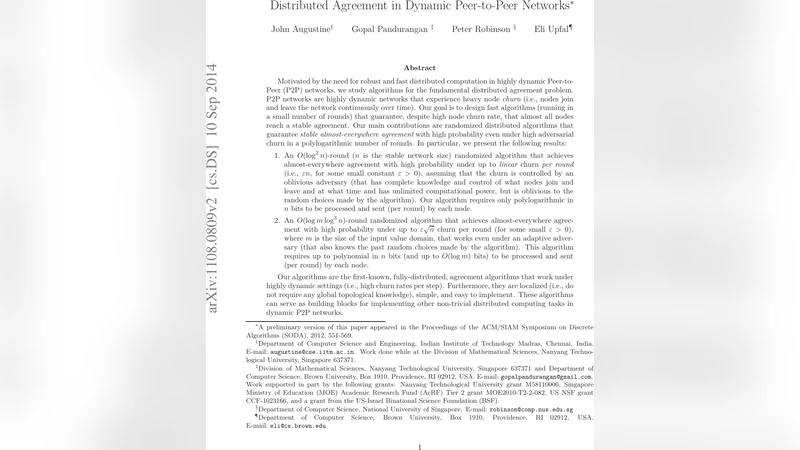
Motivated by the need for robust and fast distributed computation in highly dynamic Peer-to-Peer (P2P) networks, we study algorithms for the fundamental distributed agreement problem. P2P networks are highly dynamic networks that experience heavy node {\em churn}. Our goal is to design fast algorithms (running in a small number of rounds) that guarantee, despite high node churn rate, that almost all nodes reach a stable agreement. Our main contributions are randomized distributed algorithms that guarantee {\em stable almost-everywhere agreement} with high probability even under high adversarial churn in a polylogarithmic number of rounds: 1. An $O(\log^2 n)$-round ($n$ is the stable network size) randomized algorithm that achieves almost-everywhere agreement with high probability under up to {\em linear} churn {\em per round} (i.e., $\epsilon n$, for some small constant $\epsilon > 0$), assuming that the churn is controlled by an oblivious adversary (that has complete knowledge and control of what nodes join and leave and at what time and has unlimited computational power, but is oblivious to the random choices made by the algorithm). Our algorithm requires only polylogarithmic in $n$ bits to be processed and sent (per round) by each node. 2. An $O(\log m\log^3 n)$-round randomized algorithm that achieves almost-everywhere agreement with high probability under up to $\epsilon \sqrt{n}$ churn per round (for some small $\epsilon > 0$), where $m$ is the size of the input value domain, that works even under an adaptive adversary (that also knows the past random choices made by the algorithm). This algorithm requires up to polynomial in $n$ bits (and up to $O(\log m)$ bits) to be processed and sent (per round) by each node.
💡 Research Summary
The paper addresses the fundamental problem of distributed agreement (consensus) in highly dynamic peer‑to‑peer (P2P) networks where a substantial fraction of the nodes may join or leave in every communication round. Real‑world measurements show that up to half of the peers can be replaced within an hour, yet the total number of peers remains roughly stable. Existing consensus protocols either assume static topologies or tolerate only a small number of permanent faults; none are known to work under the extreme churn rates observed in practice.
To fill this gap, the authors formalize a dynamic network model in which the set of nodes stays of size n, but in each synchronous round an adversary may delete up to ε·n (linear churn) or ε·√n (sub‑linear churn) nodes and insert the same number of new nodes, rewiring the edges arbitrarily while preserving a bounded‑degree expander structure. Two adversarial capabilities are considered: an oblivious adversary, which knows the entire churn schedule but not the random choices of the algorithm, and an adaptive adversary, which also observes all past random bits. The goal is stable almost‑everywhere agreement: with high probability (1 − 1/n^γ) all but a β·c(n) fraction of the nodes (where c(n) is the churn magnitude) must decide on the same value, and this decision must remain stable in subsequent rounds.
The technical core consists of two probabilistic tools that work despite the constantly changing topology.
-
Flooding on Expanders – By exploiting the rapid mixing of bounded‑degree expanders, the authors prove that if a β‑fraction of the current nodes initiate a broadcast, the message reaches almost every node within O(log n) rounds, even when up to ε·n nodes are replaced each round. To reason about information flow in a setting where distances can become infinite, they introduce the notion of dynamic distance and influence sets, extending the classic effective‑diameter concept to churn‑heavy environments.
-
Support Estimation – Each node attaches a random weight drawn from an exponential distribution to its current value. By aggregating these weights through the flooding process, nodes can obtain an unbiased estimator of the total “support” (i.e., the number of nodes holding each candidate value) with high accuracy. This technique works with only polylog n bits of communication per node per round in the oblivious setting. For the adaptive setting, the estimator is replaced by a variance‑based sampling method that requires polynomial‑in‑n bits (or O(log m) bits when the input domain size is m).
Using these tools, the paper presents two randomized consensus algorithms.
Algorithm 1 (Oblivious, Linear Churn) – In O(log² n) rounds, the algorithm achieves almost‑everywhere agreement under up to ε·n churn per round. The procedure consists of (i) random sampling of candidate values, (ii) flooding of these candidates, and (iii) support estimation to select the most popular value. Each node processes and sends only polylog n bits per round, making the protocol highly scalable.
Algorithm 2 (Adaptive, Sub‑Linear Churn) – When the adversary can adapt to past randomness, the algorithm tolerates up to ε·√n churn per round and runs in O(log m·log³ n) rounds, where m is the size of the input value domain. The algorithm replaces support estimation with a variance‑based probabilistic voting scheme that still guarantees that a constant‑fraction of the nodes converge on the same value with high probability. The communication cost per node per round rises to polynomial n bits (or O(log m) bits), which is shown to be necessary to defeat an adaptive adversary.
The authors also prove an impossibility result: no deterministic protocol can guarantee almost‑everywhere agreement under any constant churn rate, because an adversary can continually replace a small set of nodes to prevent convergence. This underscores the essential role of randomness in dynamic consensus.
Overall, the paper makes several significant contributions:
- It introduces a rigorous dynamic‑network model that captures realistic P2P churn while preserving expander connectivity.
- It develops novel analytical concepts (dynamic distance, influence sets) and combines flooding with support estimation to enable fast information spreading in a churn‑heavy environment.
- It provides the first fully‑distributed, localized consensus algorithms that achieve polylogarithmic round complexity under linear churn (oblivious adversary) and sub‑linear churn (adaptive adversary).
- It establishes a deterministic lower bound, highlighting the necessity of randomization.
These results open the door to robust building blocks for higher‑level distributed tasks—such as leader election, distributed storage, and collaborative filtering—in real‑world P2P systems where nodes constantly join and leave. The techniques are likely to influence future work on dynamic distributed computing, including blockchain sharding, decentralized machine‑learning coordination, and large‑scale sensor networks.
Comments & Academic Discussion
Loading comments...
Leave a Comment