CBR with Commonsense Reasoning and Structure Mapping: An Application to Mediation
Mediation is an important method in dispute resolution. We implement a case based reasoning approach to mediation integrating analogical and commonsense reasoning components that allow an artificial mediation agent to satisfy requirements expected from a human mediator, in particular: utilizing experience with cases in different domains; and structurally transforming the set of issues for a better solution. We utilize a case structure based on ontologies reflecting the perceptions of the parties in dispute. The analogical reasoning component, employing the Structure Mapping Theory from psychology, provides a flexibility to respond innovatively in unusual circumstances, in contrast with conventional approaches confined into specialized problem domains. We aim to build a mediation case base incorporating real world instances ranging from interpersonal or intergroup disputes to international conflicts.
💡 Research Summary
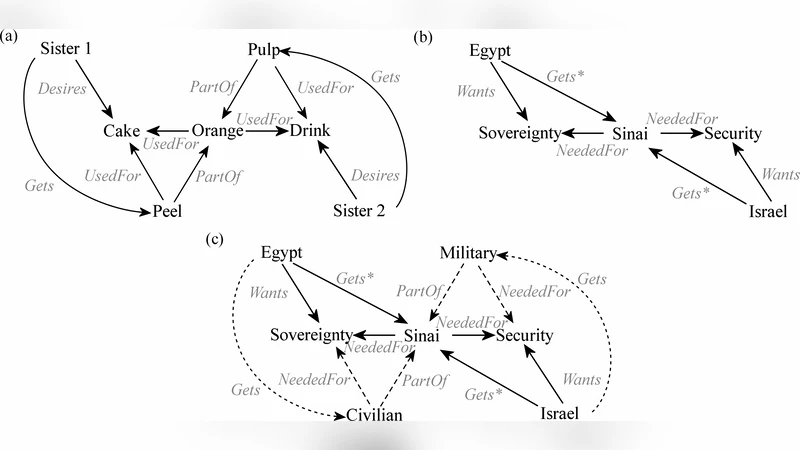
The paper presents an artificial mediation system that integrates case‑based reasoning (CBR) with analogical reasoning based on the Structure Mapping Theory (SMT) and commonsense reasoning using ConceptNet and WordNet. Each mediation case is represented as an ontology capturing the parties’ perceptions, goals, reservations, and the eventual solution. During the retrieval phase, the Structure Mapping Engine (SME) computes structural correspondences between the current dispute ontology and those stored in the case base, producing an SMEScore that quantifies similarity. The highest‑scoring past cases are selected as candidates for adaptation. In the adaptation stage, the analogical mapping is used to transfer goals, constraints, and solution components from the retrieved case to the target domain, effectively redefining the dispute’s structure (e.g., mapping “pulp” and “peel” of an orange to “military” and “civilian” aspects of a territorial conflict).
The commonsense module expands the ontology by attaching additional concepts and relations drawn from ConceptNet, while WordNet normalizes relation labels, allowing richer analogies to emerge. An expansion factor η controls how many new concepts are added; experiments show that η≈6 balances the number of discovered analogies with their quality.
A concrete example illustrates the approach: an orange‑division dispute between two sisters is analogically mapped to the Egypt‑Israel Sinai conflict, revealing a solution that separates civilian and military control of the territory. The system’s architecture includes dialogue management, ontology generation/expansion, SME‑driven retrieval and adaptation, and case storage for continual learning.
Key contributions are: (1) ontology‑based case representation enabling cross‑domain mediation, (2) integration of SMT via SME for structural similarity assessment, (3) use of commonsense knowledge bases to broaden analogical search space, and (4) a full CBR cycle that can handle multi‑agent negotiations. Limitations include the manual effort required to build domain ontologies, incompleteness of commonsense resources, and limited explainability of generated solutions in highly complex disputes. Future work aims at automated ontology learning, scaling the case base, tighter human‑mediator interaction, and performance optimization.
Comments & Academic Discussion
Loading comments...
Leave a Comment