Hairy graphs and the unstable homology of Mod(g,s), Out(F_n) and Aut(F_n)
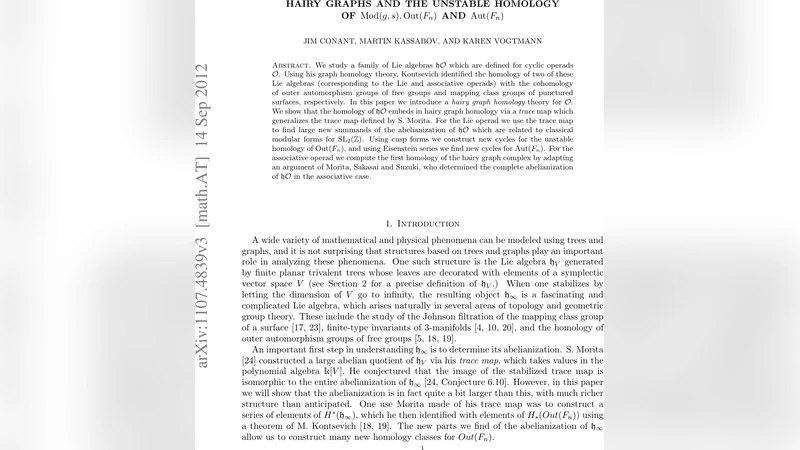
We study a family of Lie algebras {hO} which are defined for cyclic operads O. Using his graph homology theory, Kontsevich identified the homology of two of these Lie algebras (corresponding to the Lie and associative operads) with the cohomology of outer automorphism groups of free groups and mapping class groups of punctured surfaces, respectively. In this paper we introduce a hairy graph homology theory for O. We show that the homology of hO embeds in hairy graph homology via a trace map which generalizes the trace map defined by S. Morita. For the Lie operad we use the trace map to find large new summands of the abelianization of hO which are related to classical modular forms for SL(2,Z). Using cusp forms we construct new cycles for the unstable homology of Out(F_n), and using Eisenstein series we find new cycles for Aut(F_n). For the associative operad we compute the first homology of the hairy graph complex by adapting an argument of Morita, Sakasai and Suzuki, who determined the complete abelianization of hO in the associative case.
💡 Research Summary
The paper develops a new “hairy graph” homology theory associated to any cyclic operad O and uses it to study the Lie algebras h_O that arise from O‑decorated trees with legs labelled by a symplectic vector space V. Building on Kontsevich’s identification of the homology of h_O (for the Lie and associative operads) with the cohomology of Out(F_n) and mapping‑class groups, the authors introduce a trace map \
Comments & Academic Discussion
Loading comments...
Leave a Comment