A Satisfiability Algorithm for AC$^0$
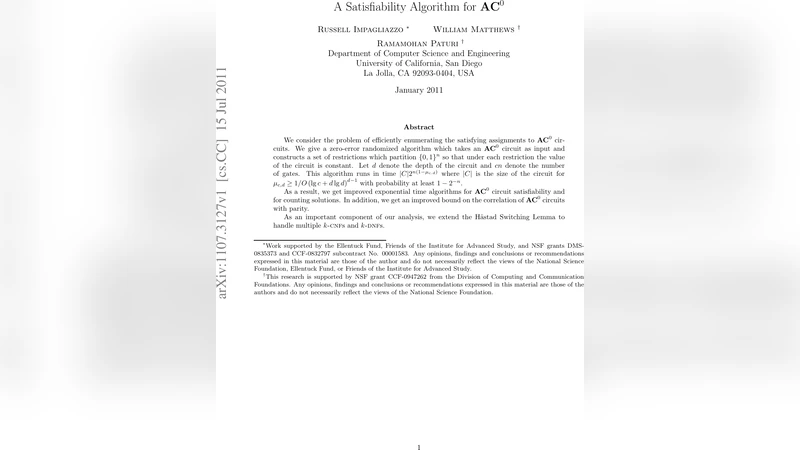
We consider the problem of efficiently enumerating the satisfying assignments to $\AC^0$ circuits. We give a zero-error randomized algorithm which takes an $\AC^0$ circuit as input and constructs a set of restrictions which partition ${0,1}^n$ so that under each restriction the value of the circuit is constant. Let $d$ denote the depth of the circuit and $cn$ denote the number of gates. This algorithm runs in time $|C| 2^{n(1-\mu_{c.d})}$ where $|C|$ is the size of the circuit for $\mu_{c,d} \ge 1/\bigO[\lg c + d \lg d]^{d-1}$ with probability at least $1-2^{-n}$. As a result, we get improved exponential time algorithms for $\AC^0$ circuit satisfiability and for counting solutions. In addition, we get an improved bound on the correlation of $\AC^0$ circuits with parity. As an important component of our analysis, we extend the H{\aa}stad Switching Lemma to handle multiple $\kcnf$s and $\kdnf$s.
💡 Research Summary
The paper addresses the fundamental problem of enumerating all satisfying assignments of Boolean circuits belonging to the AC⁰ class—circuits of constant depth d with unbounded fan‑in AND/OR gates and a total of cn gates (c may depend on n). The authors present a zero‑error randomized (Las Vegas) algorithm that, given such a circuit C, constructs a collection of partial assignments (restrictions) {ρ₁,…,ρ_r} that partition the Boolean hypercube {0,1}ⁿ. For each restriction ρ_i the restricted circuit C|_{ρ_i} evaluates to a constant (either always 0 or always 1). Consequently, the set of all satisfying assignments can be obtained simply by enumerating the restrictions that evaluate to 1, and the total number of satisfying assignments can be counted by summing the sizes of the corresponding sub‑cubes.
The running time of the algorithm is |C|·2^{n·(1‑µ_{c,d})}·poly(n) with success probability at least 1‑2^{-n}. The key quantitative guarantee is a “savings” factor µ_{c,d} that satisfies
µ_{c,d} ≥ 1 / O((log c + d·log d)^{d‑1}).
Thus, for constant depth d and constant gate‑per‑layer factor c, µ_{c,d} is a positive constant, yielding an exponential‑time algorithm that beats brute‑force search by a factor 2^{Ω(n)}. Even when c grows polynomially with n, the bound remains non‑trivial, improving upon prior work where the savings vanished quickly as depth increased.
The technical heart of the paper is an Extended Håstad Switching Lemma. The classic switching lemma shows that a random restriction that leaves a p‑fraction of variables unset turns a k‑CNF (or k‑DNF) into a decision tree of depth O(p·k) with high probability. The authors generalize this to a sequence of m formulas φ₁,…,φ_m, each a k‑CNF or k‑DNF, and prove that after a random restriction leaving pn variables free, the probability that the combined decision tree has a path of length at least s is at most (2m‑1)·(13·p·k)^{s}. This bound simultaneously controls the interaction among many sub‑formulas, which is essential when reducing depth‑d circuits to depth‑(d‑1) circuits.
The algorithm proceeds in several stages:
-
Depth Reduction via Switching – The bottom two layers of the circuit are expressed as a collection of k‑CNFs (or k‑DNFs). A random restriction ρ is sampled that fixes roughly n/k variables. By the extended switching lemma, with overwhelming probability each sub‑circuit collapses to a shallow decision tree of depth k′ = O(p·k). Those trees are then rewritten as k′‑DNFs (or k′‑CNFs).
-
Construction of Restriction Blocks – For each successful restriction the algorithm records a pair (R, ρ) where R is a k′‑CNF representing the remaining OR‑gate layer and ρ is the partial assignment. The set of all such pairs forms a partition of the hypercube; each block corresponds to a sub‑cube where the circuit’s output is constant.
-
Recursive Application – The restricted circuit C|_{ρ} now has depth d‑1 and operates on n′ = Ω(n/k) variables. The same procedure is applied recursively until depth 1 is reached, at which point the circuit is a single gate and its value is trivially constant.
-
Error‑Tolerant Analysis – Not every restriction yields shallow decision trees for all sub‑circuits. The algorithm tolerates a small failure probability (exponentially tiny in k′) by simply discarding the failing branches; the overall expected number of restrictions remains bounded by poly(n)·|C|·2^{n·(1‑µ_{c,d})}. Because the algorithm is Las Vegas, it repeats the random sampling until a successful partition is found, guaranteeing zero error.
The authors derive three important corollaries:
-
Improved SAT for AC⁰ – The algorithm decides satisfiability in time |C|·2^{n·(1‑µ_{c,d})}, improving upon earlier results where the savings factor deteriorated rapidly with depth or with the gate‑to‑variable ratio.
-
Counting and Enumeration – By enumerating the constant‑output blocks, the algorithm also counts the exact number of satisfying assignments within the same time bound, extending the savings from decision to counting.
-
Correlation with Parity – Using the same partition, they show that any depth‑d, size‑cn AC⁰ circuit has correlation at most 2^{‑µ_{c,d}·n} with the parity function. For constant c and d this yields an exponentially small correlation, strengthening previous bounds that were only sub‑exponential.
The paper emphasizes that the achieved µ_{c,d} is essentially optimal for the technique: any substantial improvement (e.g., µ_{c,d} = Ω(1) for super‑polynomial c) would, via Williams’ framework, imply NEXP ⊈ NC¹, a major breakthrough in circuit complexity. Thus the presented algorithm not only advances the state of the art for AC⁰ SAT and counting but also delineates the frontier of what can be achieved without collapsing major complexity class separations.
Comments & Academic Discussion
Loading comments...
Leave a Comment