Polyceptron: A Polyhedral Learning Algorithm
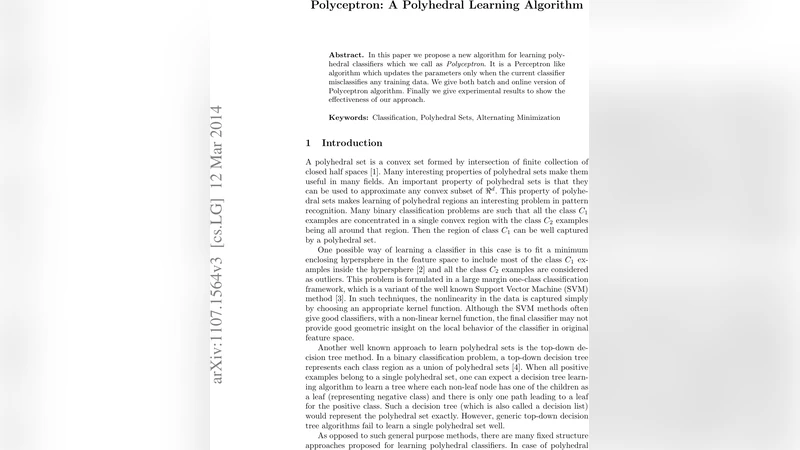
In this paper we propose a new algorithm for learning polyhedral classifiers which we call as Polyceptron. It is a Perception like algorithm which updates the parameters only when the current classifier misclassifies any training data. We give both batch and online version of Polyceptron algorithm. Finally we give experimental results to show the effectiveness of our approach.
💡 Research Summary
**
The paper introduces Polyceptron, a novel learning algorithm for polyhedral classifiers that extends the classic Perceptron idea to the setting where a decision region is defined by the intersection of K half‑spaces (hyperplanes). In a K‑polyhedral separable problem, all positive examples must satisfy every hyperplane, while a negative example needs to violate at least one. The authors formalize a loss function, the Polyceptron criterion,
(E_P(\Theta)= -\sum_{n=1}^{N} y_n,h(x_n,\Theta),\mathbf{1}{y_n h(x_n,\Theta)<0}),
where (h(x,\Theta)=\min_{k}(w_k^\top x+b_k)). This loss is zero for correctly classified points and equals (-y_n h(x_n,\Theta)) for mis‑classifications, mirroring the Perceptron’s hinge‑like penalty.
Two algorithmic variants are presented:
-
Batch Polyceptron – An alternating minimization scheme. For a given parameter set (\Theta^{(c)}), each training point is assigned to the hyperplane that yields the smallest inner product, forming disjoint sets (S^{(c)}_k). Holding these sets fixed, the loss decomposes into a sum of K independent Perceptron‑type sub‑losses, each depending only on a single weight vector (w_k). Gradient descent (or the classic Perceptron update) is applied to each (w_k) separately, then the assignment sets are recomputed. The process repeats until the total change in weight vectors falls below a threshold (\gamma). This method leverages the Perceptron’s guaranteed finite‑step convergence for linearly separable data, but the global convergence of the alternating scheme is not proven because the assignment step introduces non‑convexity.
-
Online Polyceptron – A single‑sample update rule. At iteration c, the algorithm receives ((x_c,y_c)) and selects the hyperplane (r = \arg\min_k w_k^{(c-1)\top} x_c). If the sign of (w_r^{(c-1)\top} x_c) disagrees with (y_c), only (w_r) is updated as (w_r^{(c)} = w_r^{(c-1)} + y_c x_c); otherwise all weights remain unchanged. This mirrors the classic Perceptron’s mistake‑driven update but the choice of r is a heuristic for the “credit assignment” problem (identifying which hyperplane caused the error). No convergence proof is offered; the authors rely on empirical observations.
The paper situates Polyceptron among three families of prior work:
- Constrained optimization approaches (e.g., successive linear programs) that treat the “OR” condition on negative examples as a non‑convex constraint, leading to expensive enumeration or iterative LP solving.
- Fixed‑structure methods that assume a known subset of negative examples for each hyperplane, an unrealistic assumption in many practical settings.
- Probabilistic discriminative models (e.g., logistic‑based polyhedral learning) that use batch EM‑like optimization but lack an online counterpart.
Polyceptron’s contribution is to avoid explicit enumeration of credit assignments and to provide both batch and incremental learning modes with relatively low computational overhead. The algorithm’s simplicity allows straightforward parallelization across hyperplanes.
Experimental evaluation compares Polyceptron against three baselines:
- OC1 – an oblique decision‑tree learner that builds a top‑down tree whose leaves represent polyhedral regions.
- PC‑SLP – a method that repeatedly solves linear programs to refine each hyperplane.
- SPLA1 – a probabilistic logistic approach from prior work.
Two synthetic datasets are generated: a 10‑dimensional polyhedral set defined by three half‑spaces, and a second synthetic set (details omitted). Real‑world datasets are also used, though the paper provides limited description. Results show that batch Polyceptron attains accuracy comparable to PC‑SLP and often exceeds OC1, while the online version runs faster than OC1 and matches SPLA1’s performance. However, the experiments are confined to modest dimensions and sample sizes; scalability to high‑dimensional or massive datasets is not demonstrated.
Strengths of the work include:
- A clear formulation that maps polyhedral learning to a Perceptron‑style loss.
- An elegant alternating‑minimization batch algorithm that reuses well‑understood Perceptron updates.
- An online variant that enables incremental learning, useful for streaming scenarios.
- Simplicity of implementation and modest memory requirements.
Weaknesses and open issues:
- No theoretical convergence guarantee for either batch or online versions when the data are only polyhedrally separable (as opposed to linearly separable). The alternating scheme may get stuck in local minima because the assignment sets (S_k) are themselves functions of the weights.
- Credit assignment heuristic in the online version may select the wrong hyperplane, potentially slowing learning or causing oscillations.
- Sensitivity to hyperparameters (learning rate η, stopping threshold γ) and to the initialization of the K hyperplanes is not systematically analyzed.
- Scalability concerns: As K grows, the assignment step becomes costlier (O(KN) per iteration) and the risk of ambiguous assignments increases.
- Limited empirical scope: Experiments lack high‑dimensional (>100) or large‑scale (>10⁵) benchmarks, and the paper does not report runtime complexities or memory footprints quantitatively.
In conclusion, Polyceptron offers a pragmatic, Perceptron‑inspired framework for learning polyhedral decision regions, bridging a gap between fully convex optimization methods and heuristic tree‑based approaches. Its batch and online formulations are attractive for applications where interpretability of the hyperplane set is important and computational resources are limited. Future research should focus on establishing convergence properties (perhaps via surrogate convex relaxations), improving credit assignment (e.g., probabilistic soft assignments or EM‑style updates), and evaluating the algorithm on large‑scale, high‑dimensional problems to assess its practical viability.
Comments & Academic Discussion
Loading comments...
Leave a Comment