Geometry of Complex Networks and Topological Centrality
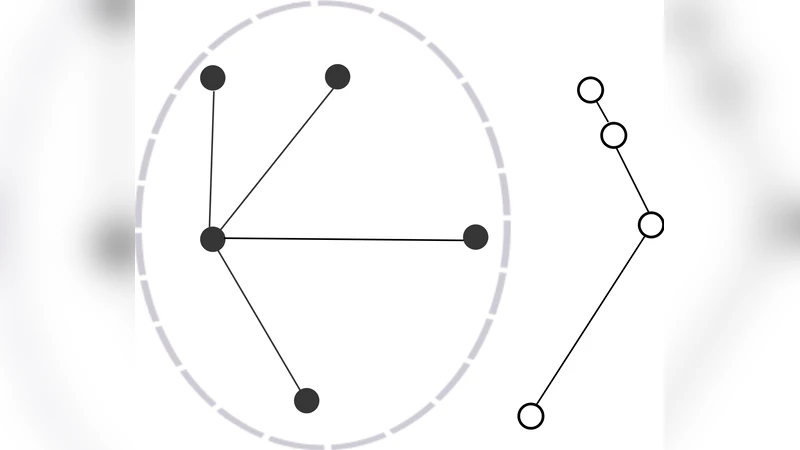
We explore the geometry of complex networks in terms of an n-dimensional Euclidean embedding represented by the Moore-Penrose pseudo-inverse of the graph Laplacian $(\bb L^+)$. The squared distance of a node $i$ to the origin in this n-dimensional space $(l^+{ii})$, yields a topological centrality index $(\mathcal{C}^{*}(i) = 1/l^+{ii})$ for node $i$. In turn, the sum of reciprocals of individual node structural centralities, $\sum_{i}1/\mathcal{C}^(i) = \sum_{i} l^+_{ii}$, i.e. the trace of $\bb L^+$, yields the well-known Kirchhoff index $(\mathcal{K})$, an overall structural descriptor for the network. In addition to this geometric interpretation, we provide alternative interpretations of the proposed indices to reveal their true topological characteristics: first, in terms of forced detour overheads and frequency of recurrences in random walks that has an interesting analogy to voltage distributions in the equivalent electrical network; and then as the average connectedness of $i$ in all the bi-partitions of the graph. These interpretations respectively help establish the topological centrality $(\mathcal{C}^{}(i))$ of node $i$ as a measure of its overall position as well as its overall connectedness in the network; thus reflecting the robustness of node $i$ to random multiple edge failures. Through empirical evaluations using synthetic and real world networks, we demonstrate how the topological centrality is better able to distinguish nodes in terms of their structural roles in the network and, along with Kirchhoff index, is appropriately sensitive to perturbations/rewirings in the network.
💡 Research Summary
The paper introduces a geometric framework for analyzing complex networks by embedding a graph into an n‑dimensional Euclidean space using the Moore‑Penrose pseudo‑inverse of its combinatorial Laplacian, L⁺. In this embedding each node i is represented by a vector x_i such that the squared distance from the origin equals the diagonal entry l⁺{ii} of L⁺. The authors define a node‑level metric called topological centrality as C⁎(i)=1/l⁺{ii}. A node that lies close to the origin (small l⁺_{ii}) receives a high centrality score, indicating a structurally central position and greater robustness to multiple edge failures.
The sum of all diagonal entries, Tr(L⁺)=∑i l⁺{ii}, is shown to be identical to the classical Kirchhoff index K, a global descriptor of network robustness. The paper proves that K is the total “volume” of the embedding: the more compact the point cloud, the smaller K, and the more resilient the network.
Beyond the geometric definition, the authors provide three complementary topological interpretations of C⁎(i):
-
Forced detour overhead in random walks – If a random walk between any source‑destination pair is forced to pass through node i, the expected extra number of steps equals l⁺_{ii}. Hence a high C⁎(i) corresponds to a low detour cost, reflecting a central location in the network.
-
Electrical‑network analogy – Interpreting L as the conductance matrix of an equivalent resistor network, l⁺{ij} represents the effective resistance between nodes i and j. The self‑resistance l⁺{ii} is proportional to the voltage drop when unit current is injected at i and extracted at the reference node. Consequently, C⁎(i) measures how little voltage is lost at i, and it also inversely relates to the probability that a random walk, after visiting i, returns to its origin (recurrence).
-
Average connectedness in bi‑partitions – Consider all possible edge failures that split the graph into two connected components. The expected size of the component containing i averaged over all such bi‑partitions is proportional to C⁎(i). Thus C⁎(i) quantifies the node’s immunity to multiple edge failures.
The paper situates these concepts within the broader literature, contrasting them with degree, joint‑degree, betweenness, closeness, random‑walk centralities, subgraph centrality, and recent vibration‑based measures. It argues that many existing indices capture either local connectivity or specific path‑based notions, whereas C⁎(i) integrates global spectral information (through the full Laplacian spectrum) and therefore reflects both position and overall connectivity.
Experimental evaluation is performed on synthetic models (Erdős‑Rényi, Barabási‑Albert, Watts‑Strogatz) and real‑world networks (email communication, protein‑protein interaction, social graphs). Results show that:
* C⁎(i) discriminates core, gateway, and bridge nodes more sharply than traditional centralities.
* Both C⁎ and K are highly sensitive to small perturbations such as edge rewiring or node removal, whereas many classic measures remain relatively unchanged.
* The Kirchhoff index K correlates strongly with known robustness metrics (e.g., algebraic connectivity) and provides a compact scalar for comparing networks of equal size.
On computational aspects, the exact calculation of L⁺ requires O(n³) time, but the authors note that only the diagonal of L⁺ is needed. Using iterative eigen‑solvers (Lanczos, power iteration) to approximate the smallest non‑zero eigenvalues and corresponding eigenvectors reduces the cost to O(m·k) where m is the number of edges and k the number of retained eigenpairs, making the approach scalable to large sparse graphs.
In conclusion, the paper offers a unified geometric‑spectral perspective on network centrality and robustness. By linking the pseudo‑inverse Laplacian to effective resistance, random‑walk detours, and partition‑based connectivity, it provides a theoretically grounded yet practically computable toolkit for assessing node importance and overall network resilience. Future work is suggested on dynamic networks, extensions to normalized Laplacians, and applications to infrastructure, biological, and social systems.
Comments & Academic Discussion
Loading comments...
Leave a Comment