$k$-quasi planar graphs
A topological graph is \emph{$k$-quasi-planar} if it does not contain $k$ pairwise crossing edges. A topological graph is \emph{simple} if every pair of its edges intersect at most once (either at a vertex or at their intersection). In 1996, Pach, Sh…
Authors: Andrew Suk
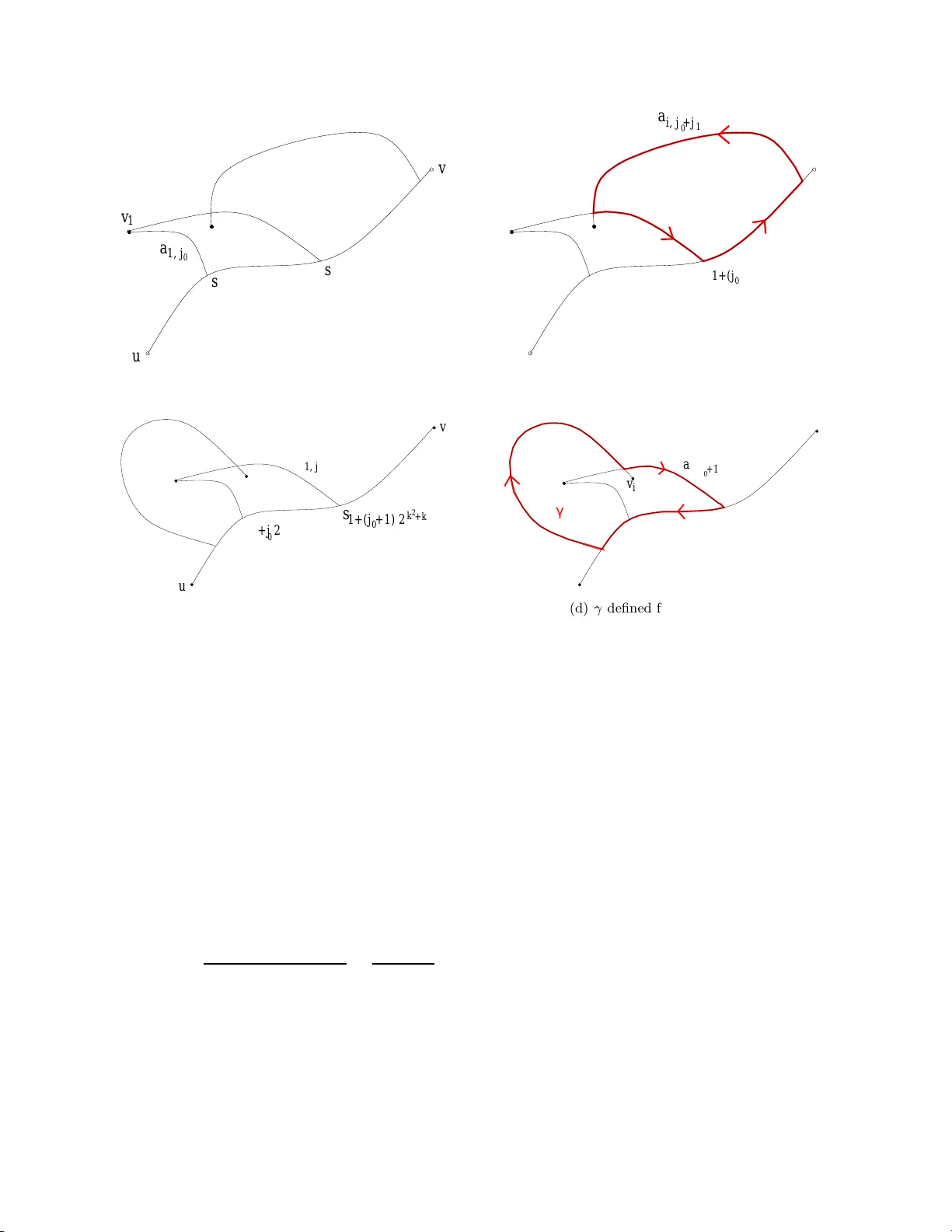
k -quasi planar graphs Andrew Suk ∗ August 13, 2018 Abstract A top ological g raph is k -quasi-planar if it do es not contain k pair wise cro ssing edges. A top ological graph is si mple if every pair of its edges in tersect a t mo s t o nc e (either at a vertex or at their int ersection). In 1996, Pach, Shahrokhi, and Szegedy [16] s howed that every n -vertex simple k -q ua si-planar graph contains at mos t O n (log n ) 2 k − 4 edges. This uppe r b ound was recently improv ed (for lar ge k ) by F ox and Pac h [8] to n (log n ) O (log k ) . In this note, we show that all such gr aphs cont ain at most ( n log 2 n )2 α c k ( n ) edges, wher e α ( n ) denotes the inv erse Ac kermann function and c k is a constant that depends only on k . 1 In tro duction A top o lo gic al gr aph is a graph dra wn in the plane suc h that its v ertice s are represented by p oints and its edges are rep r esen ted b y non-self-in tersect ing arcs connecting the corresp onding p oin ts. The arcs are allo wed to in tersect, bu t they may not pass throu gh ve rtices except for their endp oints. F urthermore, the edges are n ot allo w e d to ha v e tangencies, i.e., if t w o ed ges share an int erior p oin t, then they m ust pr op erly cross at th at p oint in common. W e on ly consider graph s without parallel edges or self-lo ops. A top ological graph is si mple if ev ery pair of its edges intersect at most once. If the edges are dra wn as straigh t-line segmen ts, th en the graph is ge ometric . Tw o edges of a top ologica l grap h cr oss if their in teriors share a p oin t. Finding the maxim um n um b er of edges in a top ological graph with a forb idden cr ossin g pattern has b een a classic pr ob lem in extremal top ological graph th eory (see [2, 3 , 4, 6, 8, 10, 15, 19, 21]). It follo ws from Euler’s P olyhedral F orm ula that ev ery top ologica l graph on n vertices and n o crossing edges has at most 3 n − 6 ed ges. A top ological graph is k - quasi-planar , if it do es not con tain k pairwise crossing edges. Hence 2-quasi-planar graphs are planar. An old conjecture (see Problem 1 in section 9.6 of [5 ]) states that for an y fixed k > 0, ev er y k -quasi-planar grap h on n vertic es has at most c k n edges, wh ere c k is a constan t th at dep ends only on k . A garw al et al. w ere the first to prov e this conjecture for simple 3-quasi-planar graphs. Later Pac h, R ad oiˇ ci ´ c, and T´ oth [14] generalized the result for all (not simple) 3-quasi-planar graph s. Recen tly , Ac k erm an [1] pr o v e d the conjecture f or k = 4. F or k ≥ 5, Pa c h, Shahrokh i, and Szegedy [16] sho w ed that ev e ry simple k -quasi-planar graph on n v ertices has at most c k n (log n ) 2 k − 4 edges. This b oun d can b e impro v ed to c k n (log n ) 2 k − 8 b y usin g a result of Ac k erman [1 ]. V altr [20] pr o v ed that ev ery n -vertex k -quasi-planar geometric ∗ EPFL, Lausanne. Email: suk@cims.nyu.edu . The au t hor gratefully ackno wledges the su p p ort from th e Swiss National Science F oundation, Grant No. 20002 1-125287/ 1. 1 graph con tains at most O ( n log n ) edges. Later, he extended this r esult to simple top ological graphs with edges dr a wn as x -monotone curv es [21]. P ac h, Radoiˇ ci ´ c, and T´ oth sho w ed that ev ery n -vertex (not simple) k -quasi-planar graph has at m ost c k n (log n ) 4 k − 12 edges, wh ic h can also b e imp ro v ed to c k n (log n ) 4 k − 16 b y a result of Ac k erman [1]. V ery recen tly , F ox and Pac h [8] improv ed (for large k ) the exp onent in the p olylogarithmic factor f or simp le topological graphs. They sho w ed that ev ery simple k -qu asi-planar graph on n v ertices h as at m ost n ( c log n/ log k ) c log k edges, wh ere c is an absolute constan t. Our main result is the follo wing. Theorem 1 .1. L et G = ( V , E ) b e an n -vertex simple k - quasi-planar gr aph. Then | E ( G ) | ≤ ( n log 2 n )2 α c k ( n ) , wher e α ( n ) denotes the inv e rse A cke rmann function and c k is a c onstant that dep ends only on k . In the pro of of Theorem 1.1 , w e app ly results on generalized Da v e np ort-Schinzel sequences. This metho d wa s used b y V altr [21], who show e d that eve ry n -vertex sim p le k -quasi-planar graph with edges drawn as x -monotone curve s has at m ost 2 2 ck n log n ed ges, wh er e c is an absolute constan t. Our next theorem extends his result to (not simp le) top ological graphs with edges dra wn with x -monotone cur v es, and moreo v er w e obtain a sligh tly b etter u pp er b ound . Theorem 1.2. L et G = ( V , E ) b e an n - vertex (not simple) k -quasi planar gr ap h with e dges dr awn as x - monotone curves. Then | E ( G ) | ≤ 2 ck 3 n log n , wher e c is an absolute c onstant. 2 Generalized Da v enp ort-Sc hinzel sequences The sequence u = a 1 , a 2 , ..., a m is called l -r egular if any l consecutive terms are pairwise different. F or inte gers l , t ≥ 2, the sequence S = s 1 , s 2 , ..., s lt of length l · t is said to b e of t yp e up ( l, t ) if the first l terms are pairwise differen t and for i = 1 , 2 , ..., l s i = s i + l = s i +2 l = · · · = s i +( t − 1) l . F or example, a, b, c, a, b, c, a, b, c, a, b, c, w ould b e an up (3 , 4) sequence. By applying a theorem of Klazar on generalized Da v e np ort-Schinzel sequences, w e h a v e the follo wing. Theorem 2.1 ([11]) . F or l ≥ 2 and t ≥ 3 , the length of any l -r e gular se quenc e over an n - element alphab et that do es not c ontain a subse quenc e of typ e up ( l , t ) has length at most n · l 2 ( lt − 3) · (10 l ) 10 α lt ( n ) . F or l ≥ 2, the sequence S = s 1 , s 2 , ..., s 3 l − 2 2 of length 3 l − 2 is said to b e of typ e up-down-up ( l ), if the fi rst l term s are pairwise differen t, and for i = 1 , 2 , ..., l , s i = s 2 l − i = s (2 l − 2)+ i . F or example, a, b, c, d, c, b, a, b, c, d, w ould b e an up-down-up (4) sequence. V altr and Klazar sho w ed th e follo wing. Lemma 2.2 ([12]) . F or l ≥ 2 , the length of any l - r e gular se qu enc e over an n -e lement alpha b et c ontaining no subse quenc e of typ e up-down-up ( l ) has length at most 2 O ( l ) n . F or more results on generalized Dav enp ort-Sc hinzel sequences, see [13 , 18, 17]. 3 Simple top ological graphs In this s ection, we will pro v e Theorem 1.1. F or any p artition of V ( G ) into t w o disjoint parts, V 1 and V 2 , let E ( V 1 , V 2 ) denote the set of ed ges with one en dp oint in V 1 and the other endp oint in V 2 . The bise ctio n width of a graph G , den oted by b ( G ), is the smallest nonn egativ e in teg er suc h that there is a partition of the vertex s et V = V 1 ˙ ∪ V 2 with 1 3 · | V | ≤ | V i | ≤ 2 3 · | V | for i = 1 , 2, and | E ( V 1 , V 2 ) | = b ( G ). W e will u se the follo wing result b y Pac h et al. Lemma 3.1 ([16]) . If G is a gr ap h with n v ertic es of de gr e e s d 1 , ..., d n , then b ( G ) ≤ 7 cr ( G ) 1 / 2 + 2 v u u t n X i =1 d 2 i , wher e cr ( G ) denotes the cr ossing numb er of G . Since P n i =1 d 2 i ≤ 2 n | E ( G ) | h olds for ev ery graph, we hav e b ( G ) ≤ 7 cr ( G ) 1 / 2 + 3 p | E ( G ) | n. (1) Pro of of Theorem 1.1. Let k ≥ 5 and f k ( n ) denote the maxim um num b er of edges in a simple k -quasi-planar graph on n ve rtices. W e will prov e that f k ( n ) ≤ ( n log 2 n )2 α c k ( n ) where c k = 10 5 · 2 k 2 +2 k . F or sake of clarit y , we do not mak e an y attempts to optimize the v alue of c k . W e pro ceed b y in duction on n . The base case n < 7 is trivial. F or the inductiv e step n ≥ 7, let G = ( V , E ) b e a simp le k -qu asi-planar graph with n ve rtices and m = f k ( n ) edges, such that the v ertices of G are lab eled 1 to n . The p ro of splits into t w o cases. Case 1. Sup p ose that cr ( G ) ≤ m 2 / (10 4 log 2 n ). By (1), there is a p artition V ( G ) = V 1 ∪ V 2 with | V 1 | , | V 2 | ≤ 2 n/ 3 and the num b er of edges with one verte x in V 1 and one v ertex in V 2 is at most 3 b ( G ) ≤ 7 cr ( G ) 1 / 2 + 3 √ mn ≤ 7 m 100 log n + 3 √ mn. Let n 1 = | V 1 | and n 2 = | V 2 | . No w if 7 m/ (100 log n ) ≤ 3 √ mn , th en we ha v e m ≤ 43 n log 2 n and w e are done since α ( n ) ≥ 2 and k ≥ 5. Therefore, we can assume 7 m/ (100 log n ) > 3 √ mn , whic h imp lies b ( G ) ≤ m 7 log n . (2) By the indu ction hypothesis and equation (2), we hav e m ≤ f k ( n 1 ) + f k ( n 2 ) + b ( G ) ≤ n 1 log 2 (2 n/ 3) 2 α c k ( n ) + n 2 log 2 (2 n/ 3) 2 α c k ( n ) + b ( G ) ≤ n log 2 (2 n/ 3) 2 α c k ( n ) + m 7 log n ≤ ( n log 2 n )2 α c k ( n ) − 2 n 2 α c k ( n ) log n log (3 / 2) + n 2 α c k ( n ) log 2 (3 / 2) + m 7 log n whic h imp lies m 1 − 1 7 log n ≤ ( n log 2 n )2 α c k ( n ) 1 − 2 log(3 / 2) log n + log 2 (3 / 2) log 2 n . Hence m ≤ ( n log 2 n )2 α c k ( n ) 1 − 2 log (3 / 2) log − 1 n + log 2 (3 / 2) log − 2 n 1 − 1 / (7 log n ) ≤ ( n log 2 n )2 α c k ( n ) . Case 2. No w supp ose that cr ( G ) ≥ m 2 / (10 4 log 2 n ). By a simple a v erag ing argumen t, there exists an edge e = uv suc h that at least 2 m/ (10 4 log 2 n ) other edges cross e . Fix suc h an edge e = uv , and let E ′ denote th e set of edges that cross e . W e order th e edges in E ′ = { e 1 , e 2 , ..., e | E ′ | } , in the order that they cross e from u to v . No w w e create t w o sequences S 1 = a 1 , a 2 , ..., a | E ′ | and S 2 = b 1 , b 2 , ..., b | E ′ | as follo ws. F or eac h e i ∈ E ′ , as we mov e along edge e from u to v and arriv e at edge e i , we turn left and mo v e along edge e i unt il we reac h its endp oint u i . Then we set a i = u i . Lik ewise, as w e mo v e along edge e from u to v an d arr ive at edge e i , w e turn righ t and mov e along edge e i unt il we reac h its other endp oin t v i . Then set b i = v i . Thus S 1 and S 2 are sequences of length | E ′ | ov er the alph ab et { 1 , 2 , ..., n } . S ee Figure 1 for a small example. No w we need the follo wing t w o lemmas. Th e fir st one is due to V altr. Lemma 3.2 ([21]) . F or l ≥ 1 , at le ast one of the se quenc es S 1 , S 2 define d ab ove c onta ins an l - r e gular subse quenc e of length at le a st | E ′ | / (4 l ) . 4 00 11 00 11 0 0 1 1 0 1 00 11 00 11 00 00 11 11 v 4 v 3 v 2 v 5 v 1 v u Figure 1: In this example, S 1 = v 1 , v 3 , v 4 , v 3 , v 2 and S 2 = v 2 , v 2 , v 1 , v 5 , v 5 . Lemma 3.3. Neither of the se quenc es S 1 nor S 2 c ontains a subse quenc e of typ e up (2 k 2 + k , 2 k ) . Pro of. By sym metry , it suffices to sho w that S 1 do es not con tain a subsequence of t yp e up (2 k 2 + k , 2 k ). W e w ill pro v e by ind uction on k , that suc h a sequence will pro d u ce k pairwise crossing edges in G . The b ase cases k = 1 , 2 are trivial. No w assu me the statemen t holds up to k − 1. Let S = s 1 , s 2 , ..., s 2 k 2 +2 k b e our up (2 k 2 + k , 2 k ) sequence of length 2 k 2 +2 k suc h that th e first 2 k 2 + k terms are p airwise d ifferen t, and f or i = 1 , 2 , ..., 2 k 2 + k s i = s i +2 k 2 + k = s i +2 · 2 k 2 + k = s i +3 · 2 k 2 + k = · · · = s i +(2 k − 1)2 k 2 + k . F or eac h i = 1 , 2 , ..., 2 k 2 + k , let v i ∈ V 1 denote the lab el (v ertex) of s i . Moreo v er, let a i,j b e the arc emanating from v ertex v i to the ed ge e corresp onding to s i + j 2 k 2 + k for j = 0 , 1 , 2 , ..., 2 k − 1. W e will think of s i + j 2 k 2 + k as a p oin t on a i,j v ery close bu t n ot on edge e . F or simplicit y , w e will let s 2 k 2 +2 k + t = s t for all t ∈ N and a i,j = a i,j mod 2 k for all j ∈ Z . Hence there are 2 k 2 + k distinct v ertices v 1 , ..., v 2 k 2 + k , eac h ve rtex of whic h has 2 k arcs emanating fr om it to the edge e . Consider the drawing of the 2 k arcs emanating from v 1 and the edge e . T h is dra wing p artitions the plane in to 2 k regions. By th e Pigeonhole principle, there is a sub set V ′ ⊂ { v 1 , ..., v 2 k 2 + k } of size 2 k 2 + k − 1 2 k , suc h that all of the vertices of V ′ lie in the same region. Let j 0 ∈ { 0 , 1 , 2 , ..., 2 k − 1 } b e an intege r suc h that V ′ lies in th e region b ound ed b y a 1 ,j 0 , a 1 ,j 0 +1 , e . See Figure 2. In the case j 0 = 2 k − 1, V ′ lies in the unb ounded region. Let v i ∈ V ′ and a i,j 0 + j 1 b e an arc emanating out of v i for j 1 ≥ 1. Notice th at a i,j 0 + j 1 cannot cross b oth a 1 ,j 0 and a 1 ,j 0 +1 since G is simp le. S upp ose that a i,j 0 + j 1 crosses a 1 ,j 0 +1 . Then the s et of arcs (emanating out of v i ) 5 00 00 11 11 00 11 00 00 11 11 0 0 1 1 00 11 00 00 11 11 00 00 11 11 0 1 00 11 00 00 11 11 v 1 s 1 0 k 1+(j +1) 2 1, j 0 a v u s s 1+j 2 0 1, j +1 a 0 k V ’ Figure 2: V ertices of V ′ lie in the region en closed b y a 1 ,j 0 , a 1 ,j 0 +1 , e . A = { a i,j 0 +1 , a i,j 0 +2 , ..., a i,j 0 + j 1 − 1 } m ust also cross a 1 ,j 0 +1 . In deed, let γ b e the simp le closed curv e created by the arrangemen t a i,j 0 + j 1 ∪ a 1 ,j 0 +1 ∪ e. Since a i,j 0 + j 1 , a 1 ,j 0 +1 , e pairwise in tersect at pr ecisely one p oint, γ is we ll defined. W e d efine p oin ts x = a i,j 0 + j 1 ∩ a 1 ,j 0 +1 and y = a 1 ,j 0 +1 ∩ e , and orient γ in the direction from x to y along γ . Since a i,j 0 + j 1 in tersects a 1 ,j 0 +1 , v i m ust lie to the right of γ . Moreo v er s in ce the arc f rom x to y along a 1 ,j 0 +1 is a sub set of γ , th e p oin ts corresp ond ing to the s u bsequence S ′ = { s t ∈ S | 2 + ( j 0 + 1)2 k 2 + k ≤ t ≤ ( i − 1) + ( j 0 + j 1 )2 k 2 + k } lie to the left of γ . Hence γ separates ve rtex v i and the p oints of S ′ . Since eac h arc from A m ust cross γ , eac h arc must cross a 1 ,j 0 +1 since G is simple (these arcs cann ot cross a i,j 0 + j 1 ). See Figure 3. By the same argument, if the arc a i,j 0 − j 1 crosses a 1 ,j 0 for j 1 ≥ 1, then the arcs (emanating out of v i ) a i,j 0 − 1 , a i,j 0 − 2 , ..., a i,j 0 − j 1 +1 m ust also cross a 1 ,j 0 . Th erefore, we ha v e th e follo wing observ a tion. Observ ation 3.4. F or half of the vertic es v i ∈ V ′ , the ar cs emanating out of v i satisfy 1. a i,j 0 +1 , a i,j 0 +2 , ..., a i,j 0 +2 k / 2 al l cr oss a 1 ,j 0 +1 , or 2. a i,j 0 − 1 , a i,j 0 − 2 , ..., a i,j 0 − 2 k / 2 al l cr oss a 1 ,j 0 . Since | V ′ | 2 ≥ 2 k 2 + k − 1 2 · 2 k ≥ 2 ( k − 1) 2 +( k − 1) , 6 00 00 11 11 0 0 1 1 v 1 1, j 0 a v u s s a 0 1 i, j +j 0 1+(j +1) 2 0 a 1, j +1 0 1+j 2 +k k 2 v S ’ i k 2 +k (a) The case when j 0 + j 1 mod 2 k ≤ 2 k − 1. 00 00 11 11 00 00 11 11 v 1 1, j 0 a v u s s a 0 1 i, j +j 0 1+(j +1) 2 0 γ a 1, j +1 0 1+j 2 +k k 2 v S ’ i k 2 +k (b) γ defined from Figure 3(a). 00 00 11 11 00 00 11 11 0 0 1 1 00 00 11 11 v 1 1, j 0 a 0 1 i, j +j a S ’ S ’ k 2 +k s 1+j 2 0 k 2 +k s 0 1+(j +1) 2 v u 1, j +1 a 0 v i (c) The case when j 0 + j 1 mod 2 k < j 0 . R ecall a i,j 0 + j 1 = a i,j 0 + j 1 mod 2 k . 0 0 1 1 00 00 11 11 00 11 0 1 v 1 1, j 0 a 0 1 i, j +j a S ’ S ’ k 2 +k s 0 1+(j +1) 2 s 1+j 2 0 k 2 +k v u 1, j +1 a 0 v i γ (d) γ defined from Figure 3(c). Figure 3: Defining γ and its orien tation. b y Obs erv ation 3.4 we ha v e an (2 ( k − 1) 2 +( k − 1) , 2 k − 1 ) up sequence, wh ose corresp onding arcs all cr oss either a 1 ,j 0 or a 1 ,j 0 +1 . By the induction h yp othesis, we hav e k pairwise crossing edges. No w w e are ready to complete the p ro of of Theorem 1.1. By Lemma 3.2 w e kno w that, say , S 1 con tains a 2 k 2 + k -regular su bsequence of length | E ′ | / (4 · 2 k 2 + k ). By Th eorem 2.1 and Lemm a 3.3, this su bsequence h as length at most n 2 k 2 + k 2 2 k 2 +2 k − 3 10 · 2 k 2 + k 10 α 2 k 2 +2 k ( n ) . Therefore 2 m 10 4 · 4 · 2 k 2 + k log 2 n ≤ | E ′ | 4 · 2 k 2 + k ≤ n 2 k 2 + k 2 2 k 2 +2 k − 3 10 · 2 k 2 + k 10 α 2 k 2 +2 k ( n ) whic h imp lies m ≤ 4 · 10 4 · 2 2 k 2 +2 k 2 2 k 2 +2 k − 3 n 10 · 2 k 2 + k 10 α 2 k 2 +2 k ( n ) log 2 n. 7 Since c k = 10 5 · 2 k 2 +2 k , α ( n ) ≥ 2 and k ≥ 5, we ha v e m ≤ ( n log 2 n )2 α c k ( n ) . 4 x -monotone In this section we will pro v e Theorem 1.2. Pro of of Theorem 1.2. F or k ≥ 2, let g k ( n ) b e the maxim um num b er of edges in a (not simple) k -quasi-planar graph whose edges are dr a wn as x -mon otone curv es. W e will pro v e by indu ction on n th at g k ( n ) ≤ 2 ck 3 n log n where c is a sufficien tly large absolute constant. The base case is trivial. F or th e inductive s tep, let G = ( V , E ) b e a k -quasi-planar top ologica l graph whose edges are dra wn as x -monotone cur v es, and let the v ertices b e lab eled 1 , 2 , ..., n . Th en let L b e the vertica l line that partitions the vertice s in to t w o parts, V 1 and V 2 , su c h that | V 1 | = ⌊ n / 2 ⌋ v ertice s lie to the left of L , and | V 2 | = ⌈ n / 2 ⌉ v ertices lie to the right of L . F u rthermore, let E 1 denote the set of edges ind uced b y V 1 , E 2 b e the set of edges induced by V 2 , and E ′ b e the set of edges that inte rsect L . Clearly , we ha v e | E 1 | ≤ g k ( ⌊ n/ 2 ⌋ ) and | E 2 | ≤ g k ( ⌈ n/ 2 ⌉ ) . Hence it suffi ces that sho w that | E ′ | ≤ 2 ck 3 / 2 n, (3) since this would imply g k ( n ) ≤ g k ( ⌊ n/ 2 ⌋ ) + g k ( ⌈ n/ 2 ⌉ ) + 2 ck 3 / 2 n ≤ 2 ck 3 n log n. F or the rest of the pro of, w e will only consider th e edges from E ′ . No w for eac h vertex v i ∈ V 1 , consider the graph G i whose v ertices are the edges with v i as a left endp oin t, and t w o v ertic es in G i are adjacen t if the corresp on d ing edges cross at some p oint to the left of L . S ince G i is an inc omp ar ability gr aph (see [7], [9]) and do es not con tai n a clique of s ize k , G i con tains an indep end en t set of size | E ( G i ) | / ( k − 1). W e keep all edges that corresp ond to the elemen ts of this indep end en t s et, and discard all other edges incident to v i . After rep eating this pro cess on all v ertices in V 1 , we are left with at least | E ′ | / ( k − 1) edges. No w w e con tin ue this pro cess on the other side. F or eac h v ertex v j ∈ V 2 , consider the grap h G j whose v ertices are the edges with v j as a right endp oint, and t w o v ertices in G j are adjacen t if the corresp onding edges cross at s ome p oin t to the r ight of L . Since G j is an incomparabilit y graph and d o es n ot conta in a clique of size k , G j con tains an indep enden t set of size | E ( G j ) | / ( k − 1). W e k eep all edges that corresp onds to this in dep endent s et, and discard all other edges incident to v j . After rep eating this p ro cess on all vertices in V 2 , we are left with at least | E ′ | / ( k − 1) 2 edges. W e order the remaining edges e 1 , e 2 , ..., e m in the order in w h ic h th ey intersect L from b ottom to top. W e d efine tw o sequences S 1 = a 1 , a 2 , ..., a m and S 2 = b 1 , b 2 , ..., b m suc h that a i denotes the left endp oint of edge e i and b i denotes the righ t endp oin t of e i . No w w e need the follo wing lemma. 8 Lemma 4.1. Neither of the se quenc es S 1 or S 2 c ontains a subse quenc e of typ e up-down-up ( k 3 + 2) . Pro of. By symmetry , it suffices to show that S 1 do es not conta in a subsequence of t yp e up- down-up ( k 3 + 2). F or the sak e of con tradictio n, sup p ose S 1 did conta in a subs equ ence of type up-down-up ( k 3 + 2). Then there is a sequence S = s 1 , s 2 , ..., s 3( k 3 +2) − 2 suc h that the inte gers s 1 , ..., s k 3 +2 are p airwise different and for i = 1 , 2 , ..., k 3 + 2 we hav e s i = s 2( k 3 +2) − i = s 2( k 3 +2) − 2+ i . F or eac h i = 1 , 2 , ..., k 3 + 2, let v i ∈ V 1 denote the label (v e rtex) of s i and let x i denote the x -coord inate of vertex v i . Moreo v er, let a i b e the arc emanating f rom ve rtex v i to the p oint on L th at corresp onds to s 2( k 3 +2) − i . Note that the set of arcs A = { a 2 , a 3 , ..., a k 3 +1 } are ord ered do wn w ards along L , and corresp onds to the “midd le” part of the up-down-up sequence. W e d efine t w o p artial orders on A as follo ws. a i ≺ 1 a j if i < j, x i < x j and th e arcs a i , a j do not intersect , a i ≺ 2 a j if i < j, x i > x j and th e arcs a i , a j do not intersect . Clearly , ≺ 1 and ≺ 2 are partial orders. If t w o arcs are not comparable by either ≺ 1 or ≺ 2 , then they m ust cross. Since G do es not con tain k pairwise crossing edges, by Dilw orth’s Theorem, there exist k arcs { a i 1 , a i 2 , ..., a i k } such that they are pairwise comparable b y either ≺ 1 or ≺ 2 . Now the pro of falls into t w o cases. Case 1. Supp ose that a i 1 ≺ 1 a i 2 ≺ 1 · · · ≺ 1 a i k . Then the arcs emanating from v i 1 , v i 2 , ..., v i k to the p oints corresp onding to s 2( k 3 +2) − 2+ i 1 , s 2( k 3 +2) − 2+ i 2 , ..., s 2( k 3 +2) − 2+ i k are pairwise crossing. See Figure 4. 00 00 11 11 00 00 11 11 00 00 11 11 00 00 11 11 i 1 v i 2 v i 3 v i k v i 1 a i 3 a i k a i 2 a 00 00 11 11 00 00 11 11 00 00 11 11 00 00 11 11 1 i v i 2 v i 3 v i k v i 2 a i 1 a i 3 a i k a s s s 3 3 3 3 2(k +2)−2+i 2(k +2)−2+i 2(k +2)−2+i 2(k +2)−2+i s k 3 2 1 Figure 4: Case 1. 9 00 00 11 11 00 00 11 11 00 00 11 11 00 00 11 11 i k v i 1 v i 2 v i 3 v i 3 a i k a i 2 a i 1 a 00 00 11 11 00 00 11 11 00 00 11 11 00 00 11 11 i k v i 1 v i 2 v i 3 v i k s i 3 s i 2 s i 1 s i 3 a i k a i 1 a i 2 a Figure 5: Case 2. Case 2. S upp ose that a i 1 ≺ 2 a i 2 ≺ 2 · · · ≺ 2 a i k . Then th e arcs emanating fr om v i 1 , v i 2 , ..., v i k to the p oint s corresp onding to s i 1 , s i 2 , ..., s i k are pairwise crossing. See Figure 5. W e are now ready to complete the pr o of of Theorem 1.2. By Lemma 3.2, we know that, say , S 1 con tains a ( k 3 + 2)-regular subsequence of length | E ′ | 4( k 3 + 2)( k − 1) 2 . By lemma 2.2 and 4.1, this su bsequence has length at most 2 c ′ k 3 n , where c ′ is an absolute constan t. Hence | E ′ | 4( k 3 + 2)( k − 1) 2 ≤ 2 c ′ k 3 n implies | E ′ | ≤ 4 k 5 2 c ′ k 3 n ≤ 2 ck 3 / 2 n for a suffi cien tly large absolute constan t c . References [1] E. Ac k erman, On the maximum num b er of edges in top ological graphs with no four pairwise crossing edges. In Pr o c e e dings of the twenty-se c ond annual symp osium on Computationa l ge om- etry (SCG ’06). A CM, New Y ork, NY, US A, 2006, 259-263 . 10 [2] E. Ack erm an, J. F ox, J. P ac h , and A. Suk, On grids in top ologic al graphs. In Pr o c e e dings of the 25th annual symp osium on Computational ge ometry (SCG ’09). ACM, New Y ork, NY, USA, 2009, 403-41 2. [3] E. Ac k erman and G. T ardos, Note: On the maxim um num b er of edges in quasi-planar graphs. J. Comb. The ory Ser. A 114 , 3 (April 2007), 563-571. [4] P . K. Agarwa l, B. Aronov, J. P ac h, R. P ollac k, and M. S harir, Qu asi-planar graphs hav e a linear n um b er of edges. In Pr o c e e dings of the Symp osium on Gr aph Dr a wing (GD ’95), F r an z-Josef Branden burg (Ed.). Sprin ger-V erlag, London, UK, 1995, 1-7. [5] P . Brass, W. Moser, J. Pac h, “Researc h Problems in Discrete Geometry .” Berlin, Germany: Springer-V erlag, 2005. [6] V. Cap oyle as and J. P ac h, A T ur´ an-t yp e theorem on chords of a con v ex p olygon. J. Combina- torial The ory, Se rie s B 56 . (1992), 915. [7] R. P . Dilwo rth, Annals of Math. 51 , (1950), 161-166 . [8] J. F o x and J. Pac h , Coloring K k -free intersect ion graphs of geometric ob jects in th e plane. In P r o c e e dings of the twenty-fourth annual symp osium on Computational g e ometry (SCG ’08). A CM, New Y ork, NY, USA, 2008, 346-35 4. [9] J. F o x, J . P ac h , Cs. T ´ oth, Inte rsection patterns of curve s, Journal of the L ondon Mathematic al So ciety 83 (2011), 389-4 06. [10] R. F ulek and A. Su k , Disjoin t crossing families, EuroComb 2011, to app ear. [11] M. K lazar, A general upp er b ound in extremal theory of sequences. Commentationes Mathe- matic ae Univ ersitatis Car olinae , v ol. 33 (1992 ), issu e 4, pp. 737-746. [12] M. Klazar and P . V altr, Generalized Da v enp ort-Sc hinzel sequences. Combinator ic a 14 (1994), pp. 46347 6. [13] G. Niv asc h, Impr o v e d b ounds and n ew tec hniques for Da v enp ort–Schinzel sequences and their generalizat ions. In Pr o c e e dings of the twentieth Annual ACM-SIAM Symp o sium on Discr ete Algor ithms (SODA ’09). So ciet y for Industrial and Applied Mathematics, Ph iladelphia, P A, USA, 2009, 1-10. [14] J. P ac h, R. Radoi ˇ ci ´ c, and G. T´ oth, Relaxing planarit y for top ological graphs. In: Akiy ama, J., Kano, M. (Ed s.), Lecture Notes in Comput. Sci., vo l. 2866. Spr in ger. pp. 221-232. [15] J. P ac h, R. Pinc hasi, M. Sharir, and G. T ´ oth, T op ological graphs with n o large grids. Gr a ph. Comb. 21 , 3 (September 2005), 355-364 . [16] J. P ac h, F. Shahrokhi, M. Szegedy , App lications of the crossing n umber, J . Gr aph The ory 22 (1996 ), 239-243. [17] S. P ettie, Generalized Da v enp ort-Sc hinzel sequences an d their 0-1 matrix coun terparts. J. Comb. The ory Ser. A 118 , 6 (August 2011), 1863-189 5. 11 [18] S. P ettie , O n the stru cture and comp osition of forbidd en sequences, w ith geometric applica- tions, to app ear in SoCG 2011. [19] G. T ardos and G. T´ oth, Crossing stars in top ologica l graph s. SIAM J. D iscr et. Math. 21 , 3 (July 2007), 737-749. [20] P . V altr, On geometric graphs with no k pairwise parallel edges. Discr e te Comput. Ge o m. 19 , no. 3, 461-469. [21] P . V altr, Graph drawings with n o k pairwise crossin g edges. In Pr o c e e dings of the 5th Interna- tional Symp o sium on Gr aph Dr awing (GD ’97), Giusepp e Di Battista (Ed.). Sp ringer-V erlag, London, UK, 205-2 18. 12
Original Paper
Loading high-quality paper...
Comments & Academic Discussion
Loading comments...
Leave a Comment