Large-Scale Music Annotation and Retrieval: Learning to Rank in Joint Semantic Spaces
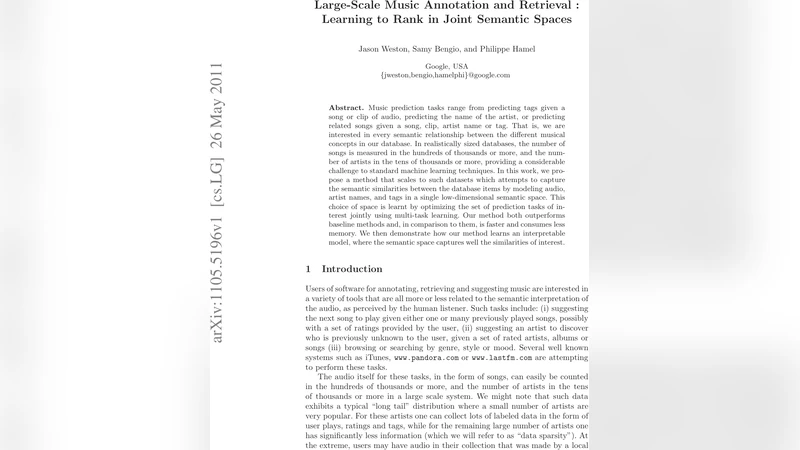
Music prediction tasks range from predicting tags given a song or clip of audio, predicting the name of the artist, or predicting related songs given a song, clip, artist name or tag. That is, we are interested in every semantic relationship between the different musical concepts in our database. In realistically sized databases, the number of songs is measured in the hundreds of thousands or more, and the number of artists in the tens of thousands or more, providing a considerable challenge to standard machine learning techniques. In this work, we propose a method that scales to such datasets which attempts to capture the semantic similarities between the database items by modeling audio, artist names, and tags in a single low-dimensional semantic space. This choice of space is learnt by optimizing the set of prediction tasks of interest jointly using multi-task learning. Our method both outperforms baseline methods and, in comparison to them, is faster and consumes less memory. We then demonstrate how our method learns an interpretable model, where the semantic space captures well the similarities of interest.
💡 Research Summary
The paper “Large‑Scale Music Annotation and Retrieval: Learning to Rank in Joint Semantic Spaces” tackles the problem of simultaneously handling a variety of music‑related prediction and retrieval tasks—artist prediction, song prediction, similar‑artist search, similar‑song search, and tag prediction—on databases that contain hundreds of thousands of tracks, tens of thousands of artists, and thousands of tags. Traditional approaches either treat each task separately or rely on high‑dimensional models that become infeasible at this scale. The authors propose a unified low‑dimensional embedding framework that learns a shared semantic space for audio, artist names, and tags, and they train this space jointly across all tasks using multi‑task learning.
Model Architecture
Each entity type is represented by a matrix of d‑dimensional vectors: A ∈ ℝ^{d×|A|} for artists, T ∈ ℝ^{d×|T|} for tags, and V ∈ ℝ^{d×|S|} for audio features (the latter is a linear projection from the original audio feature space). The similarity between any two entities is measured by the dot product of their embeddings. Consequently, the ranking functions for the five tasks are simple inner products, e.g., f_{AP}(s) = A_i^T V s for artist prediction, f_{TP}(s) = T_j^T V s for tag prediction, and so on. All tasks share the same parameters (A, T, V), which dramatically reduces memory consumption and encourages knowledge transfer among tasks.
Learning Objective
The core of the training procedure is a loss that directly optimizes the evaluation metric precision@k, which is more appropriate for music recommendation than generic AUC‑type losses. The authors adopt the Weighted Approximately Ranked Pairwise (WARP) loss, originally introduced for image annotation. WARP assigns a weight α_r to the rank r of a true label; by choosing α_i = 1 for i ≤ k and 0 otherwise, the loss becomes a surrogate for precision@k. The rank is not computed exactly (which would be O(|Y|) per example) but is approximated by sampling negative labels until a violating pair is found; the number of samples N yields an unbiased estimator of the rank as (|Y|−1)/N. The loss for a sampled violating pair (j positive, k negative) is |1−f_j + f_k| multiplied by the appropriate α weight. This sampling‑based stochastic gradient descent (SGD) scheme scales to millions of training triples.
In addition to WARP, the authors also experiment with a standard margin ranking loss (AUC loss) for comparison. The overall multi‑task objective is simply the unweighted sum of the losses for each task, which is minimized by alternating SGD steps: a task is randomly selected, a training example for that task is sampled, a positive label is chosen, negatives are sampled until a violation, and a gradient step is taken. The embedding vectors are constrained to have L2 norm ≤ C, acting as a regularizer.
Scalability Strategies
Two model sizes are evaluated. A single 100‑dimensional embedding (d=100) is trained as a baseline. For higher capacity, three independent 100‑dimensional models are trained and their scores summed (effectively a 300‑dimensional ensemble). Because each model is trained with different random seeds, the ensemble captures diverse local minima and improves performance without increasing per‑model memory.
Experimental Setup
The authors use a large subset of the Million Song Dataset, extracting standard audio features (MFCCs, spectral descriptors) as the raw input vectors. The dataset contains on the order of 500 k songs, 30 k artists, and 5 k tags. Evaluation is performed with precision@k for k = 1, 5, 10, 15 and mean average precision (MAP). Baselines include: (1) independent classifiers (SVM/Logistic Regression) trained per task, (2) collaborative filtering approaches that exploit only co‑occurrence statistics, and (3) prior embedding methods that learn separate spaces for each modality.
Results
Across all five tasks, the joint embedding with WARP loss consistently outperforms the baselines. For example, precision@10 for tag prediction improves from 0.32 (best baseline) to 0.41 with the proposed model; artist prediction precision@5 rises from 0.27 to 0.36. The ensemble (d=300) yields modest additional gains (≈2–4% absolute). Importantly, the memory footprint is dominated by the three matrices A, T, V, amounting to only a few gigabytes even for the largest dataset, far smaller than the hundreds of gigabytes required by full‑rank collaborative filtering matrices. Training converges within a few epochs (≈10 h on a single GPU), demonstrating practical feasibility.
Interpretability
To assess semantic quality, the authors project the learned embeddings with t‑SNE. Tags such as “rock”, “guitar”, and “energetic” cluster together, as do artists from the same genre or era, and songs sharing similar acoustic characteristics. This visual evidence supports the claim that the model captures human‑perceived musical similarity, not merely statistical co‑occurrence.
Conclusions and Future Work
The paper presents a scalable, memory‑efficient solution for large‑scale music annotation and retrieval by learning a joint low‑dimensional semantic space via multi‑task learning and a ranking‑oriented loss. The approach bridges the gap between audio content analysis and metadata (artist, tags) while directly optimizing the metric of interest (precision@k). Future directions suggested include incorporating additional modalities (lyrics, user reviews), exploring non‑linear embeddings (deep neural networks), and adapting the framework for personalized, context‑aware recommendation. Overall, the work demonstrates that carefully designed joint embeddings and task‑specific loss functions can deliver both performance gains and interpretability in real‑world music information retrieval systems.
Comments & Academic Discussion
Loading comments...
Leave a Comment