Some considerations on the present-day results for the detection of frame-dragging after the final outcome of GP-B
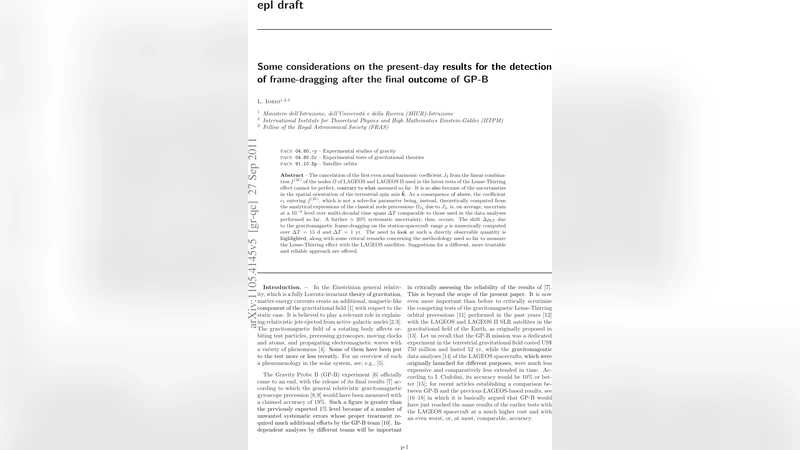
The cancelation of the first even zonal harmonic coefficient J2 of the multipolar expansion of the Newtonian part of the Earth’s gravitational potential from the linear combination f(2L) of the nodes of LAGEOS and LAGEOS II used in the latest tests of the general relativistic Lense-Thirring effect cannot be perfect, as assumed so far. It is so, among other things, because of the uncertainties in the spatial orientation of the terrestrial spin axis as well. As a consequence, the coefficient c1 entering f(2L), which is not a solve-for parameter being theoretically computed from the analytical expressions of the classical node precessions due to J2, is, on average, uncertain at a 10-8 level over multi-decadal time spans DT comparable to those used in the data analyses performed so far. A further \simeq 20% systematic uncertainty in the theoretically predicted gravitomagnetic signal, thus, occurs. The shift due to the gravitomagnetic frame-dragging on the station-spacecraft range is numerically computed over DT = 15 d and DT = 1 yr. The need of looking at such a directly observable quantity is pointed out, along with some critical remarks concerning the methodology used so far to measure the Lense-Thirring effect with the LAGEOS satellites. Suggestions for a different, more trustable and reliable approach are offered.
💡 Research Summary
The paper revisits the measurement of the gravitomagnetic frame‑dragging (Lense‑Thirring) effect using the LAGEOS and LAGEOS II satellites, focusing on the linear combination of their nodal longitudes f(2L)=Ω_L + c₁Ω_{II}. This combination has been employed in recent analyses to cancel the dominant classical precession caused by the Earth’s quadrupole moment (the J₂ term) and isolate the much smaller relativistic signal. The coefficient c₁ is traditionally computed analytically from the ratio of the classical J₂‑induced nodal rates of the two satellites, assuming perfect knowledge of the orbital elements and of the Earth’s spin axis orientation.
The author points out two overlooked sources of systematic error that render the cancellation imperfect. First, the orbital elements (semi‑major axis a and inclination I) are known only to limited precision (σ_a≈2 cm, σ_I≈0.5 mas). Propagating these uncertainties through the analytical expression for c₁ yields a variation Δc₁≈10⁻⁸, which translates into roughly a 20 % systematic uncertainty on the Lense‑Thirring signal (≈50 mas yr⁻¹). Second, the Earth’s spin axis unit vector \hat{k} is not perfectly aligned with the Z‑axis of the inertial reference frame used in the analysis. Polar motion and other geophysical processes cause \hat{k} to wander by about 10 mas over a year. By deriving a generalized expression for the J₂‑induced nodal rate that includes the full orientation of \hat{k} (equations (6)–(7) in the paper), the author shows that this misalignment introduces an additional Δc₁ of order 4×10⁻⁸ on average, with peak‑to‑peak excursions up to 7.7×10⁻⁸ over a 19‑year interval. This again contributes an extra ≈20 % uncertainty to the relativistic precession.
Beyond the node‑based analysis, the paper emphasizes that the directly observable quantity in satellite laser ranging (SLR) is the range ρ between a ground station and the satellite. The author numerically integrates the Lense‑Thirring perturbation to the range, finding a peak‑to‑peak amplitude of about 0.5 cm over 15 days and an RMS of ≈18 cm over a full year. Current post‑fit range residuals for LAGEOS are typically at the 1 cm level or smaller, suggesting that the relativistic signal, if present, would be clearly visible. However, in all published LAGEOS analyses the Lense‑Thirring acceleration has never been modeled; consequently, its effect may have been absorbed by the estimation of other parameters or cancelled by unmodeled forces. The absence of any published range‑time series displaying the characteristic Lense‑Thirring signature is highlighted as a serious inconsistency.
To address these issues, the author proposes two methodological improvements. (1) Treat c₁ as an empirical parameter to be estimated from the data rather than a fixed theoretical value, thereby directly testing the effectiveness of the J₂ cancellation. (2) Include the Lense‑Thirring acceleration as a dedicated solve‑for parameter in the orbit determination process, allowing its magnitude and uncertainty to be extracted from the covariance matrix and its correlations with other parameters to be examined. This “direct measurement” approach would provide a more transparent and reliable assessment of frame‑dragging.
In summary, the paper argues that the current LAGEOS‑based tests of frame‑dragging suffer from (i) incomplete cancellation of the J₂ term due to realistic uncertainties in orbital elements, (ii) neglect of the Earth’s spin‑axis orientation errors, and (iii) the omission of an explicit gravitomagnetic model in the data reduction. These factors together can introduce a systematic bias of order 20 % on the claimed detection of the Lense‑Thirring effect. Implementing the suggested methodological changes would significantly improve the robustness of future measurements and help resolve the lingering discrepancy between the GP‑B results and the satellite‑based determinations.
Comments & Academic Discussion
Loading comments...
Leave a Comment