Opportunities for Network Coding: To Wait or Not to Wait
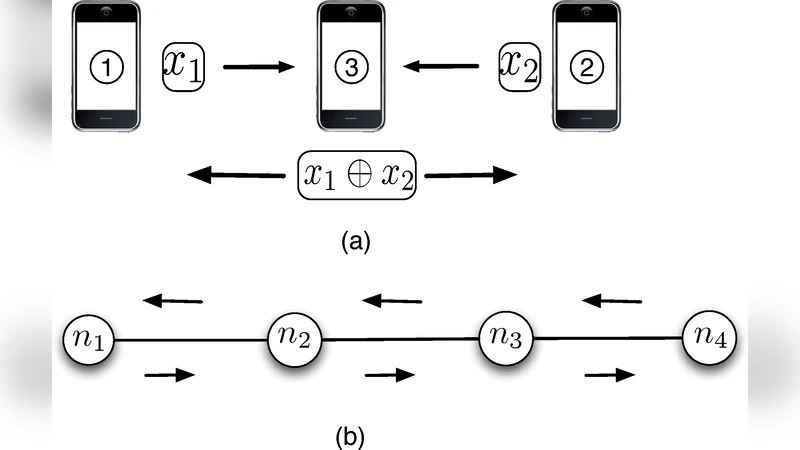
It has been well established that wireless network coding can significantly improve the efficiency of multi-hop wireless networks. However, in a stochastic environment some of the packets might not have coding pairs, which limits the number of available coding opportunities. In this context, an important decision is whether to delay packet transmission in hope that a coding pair will be available in the future or transmit a packet without coding. The paper addresses this problem by formulating a stochastic dynamic program whose objective is to minimize the long-run average cost per unit time incurred due to transmissions and delays. In particular, we identify optimal control actions that would balance between costs of transmission against the costs incurred due to the delays. Moreover, we seek to address a crucial question: what should be observed as the state of the system? We analytically show that observing queue lengths suffices if the system can be modeled as a Markov decision process. We also show that a stationary threshold type policy based on queue lengths is optimal. We further substantiate our results with simulation experiments for more generalized settings.
💡 Research Summary
The paper tackles a fundamental scheduling dilemma in wireless network coding: when a relay node that serves two opposite‑direction flows has a packet in only one of its queues, should it wait for a coding partner or transmit the packet uncoded immediately? To answer this, the authors model the system as a discrete‑time Markov decision process (MDP). The state consists of the two queue lengths (Q₁, Q₂); arrivals to each queue are independent, identically distributed (i.i.d.) random variables with known probability mass functions. In each time slot the relay can either stay idle (action 0) or transmit (action 1). A transmission incurs a cost C_T, while each packet that remains in a queue for one slot incurs a holding cost C_H. The instantaneous cost is therefore C(Q,a)=C_H·(
Comments & Academic Discussion
Loading comments...
Leave a Comment