Link prediction in complex networks: a local na"{i}ve Bayes model
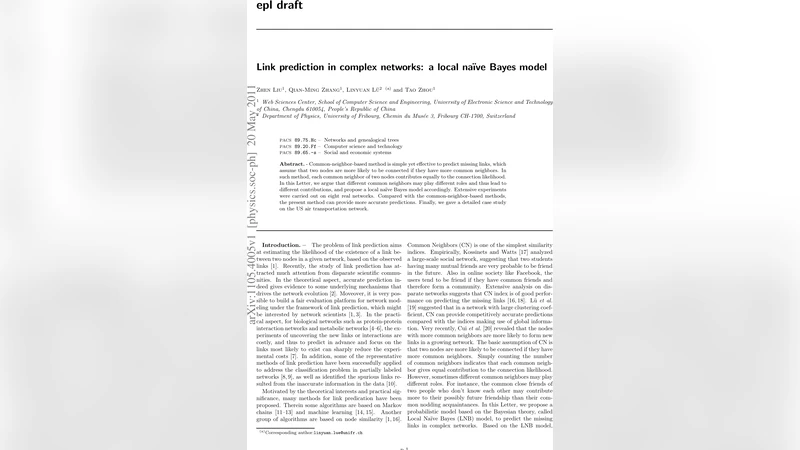
Common-neighbor-based method is simple yet effective to predict missing links, which assume that two nodes are more likely to be connected if they have more common neighbors. In such method, each common neighbor of two nodes contributes equally to the connection likelihood. In this Letter, we argue that different common neighbors may play different roles and thus lead to different contributions, and propose a local na"{\i}ve Bayes model accordingly. Extensive experiments were carried out on eight real networks. Compared with the common-neighbor-based methods, the present method can provide more accurate predictions. Finally, we gave a detailed case study on the US air transportation network.
💡 Research Summary
Link prediction is a fundamental task in the study of complex networks, aiming to infer which pairs of nodes are likely to become connected in the future. The most widely used local approaches, such as Common Neighbors (CN), Jaccard, Adamic‑Adar, and Resource Allocation, rely on the simple intuition that the more shared neighbors two nodes have, the higher the probability of a link. However, these methods treat every common neighbor as equally informative, ignoring the fact that some neighbors play a far more decisive role in facilitating connections than others.
The paper introduces a Local Naïve Bayes (LNB) model that augments the traditional CN framework with a probabilistic weighting scheme derived from Bayes’ theorem. For any pair of nodes (u) and (v), the model first identifies their set of common neighbors (\Gamma(u)\cap\Gamma(v)). For each common neighbor (w) it computes two conditional probabilities: (P(L_{uv}=1\mid w)), the likelihood that a link exists given that (w) is a shared neighbor, and (P(L_{uv}=0\mid w)), the complementary likelihood. These probabilities are estimated from the global network by counting how often (w) participates in closed triads (triangles) versus open triads (two‑step paths that do not close). A small smoothing constant (\epsilon) is added to avoid zero counts.
The contribution of each common neighbor is then expressed as a log‑odds ratio:
\
Comments & Academic Discussion
Loading comments...
Leave a Comment