Rigid components in fixed-lattice and cone frameworks
We study the fundamental algorithmic rigidity problems for generic frameworks periodic with respect to a fixed lattice or a finite-order rotation in the plane. For fixed-lattice frameworks we give an $O(n^2)$ algorithm for deciding generic rigidity a…
Authors: ** - Matthew Berardi (Temple University) - Brent Heeringa (Williams College) - Justin Malestein (Temple University) - Louis Theran (Temple University) **
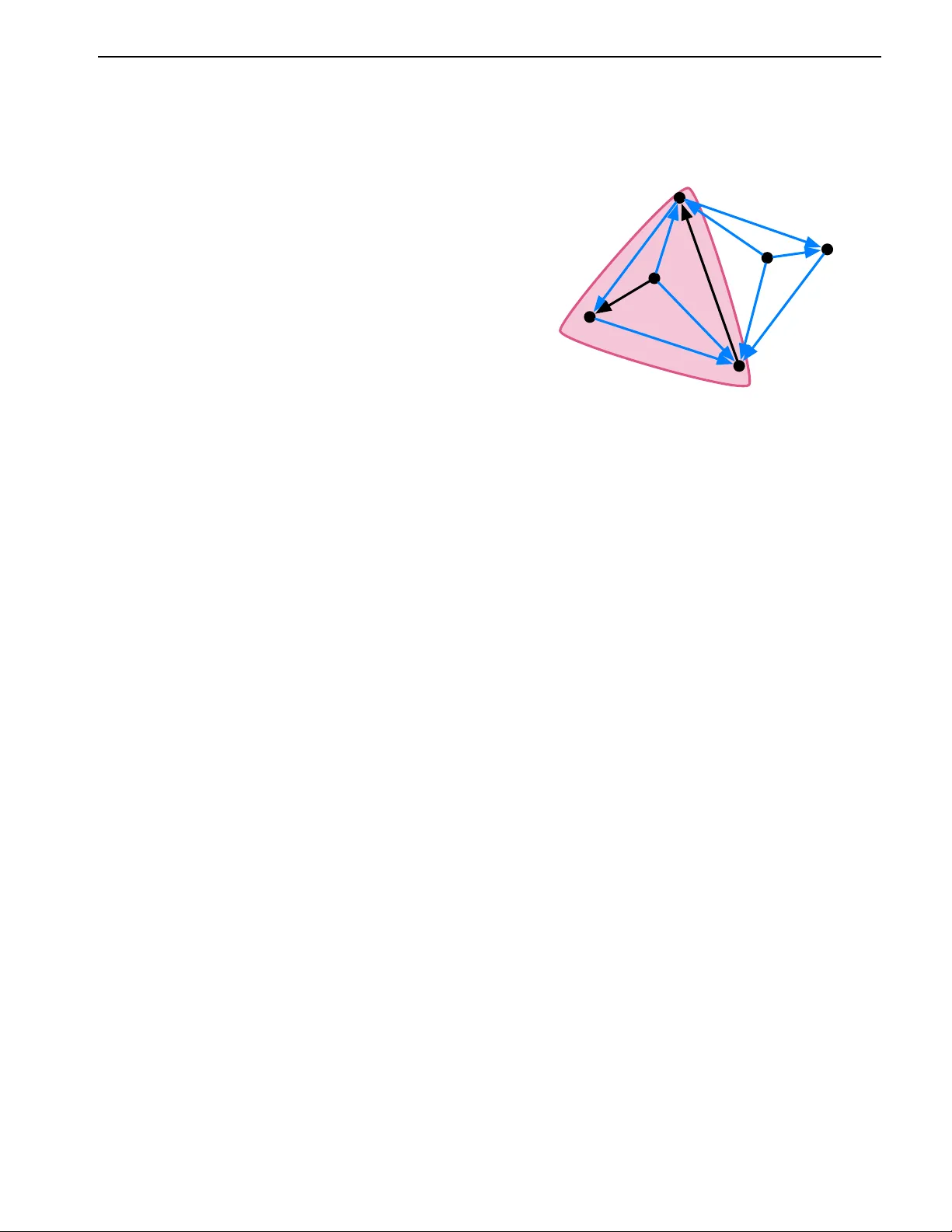
Rigid comp onents in fixed-lattice and cone framew o rks Matthew Berardi ∗ Bren t Heeringa † Justin Malestein ∗ Louis Theran ∗ Abstract W e study the fundamen tal algorithmic rigidity problems for generic framew orks perio dic with resp ect to a fixed lattice or a finite-order rotation in the plane. F or fixed- lattice frameworks w e give an O ( n 2 ) algorithm for de- ciding generic rigidit y and an O ( n 3 ) algorithm for com- puting rigid comp onen ts. If the order of rotation is part of the input, w e give an O ( n 4 ) algorithm for deciding rigidit y; in the case where the rotation’s order is 3, a more specialized algorithm solves all the fundamen tal algorithmic rigidit y problems in O ( n 2 ) time. 1 Intro duction The geometric setting for this pap er inv olves tw o v aria- tions on the well-studied planar b ar-joint rigidity model: fixe d-lattic e p erio dic fr ameworks and c one fr ameworks . A fixe d-lattic e p erio dic fr amework is an infinite struc- ture, p erio dic with resp ect to a lattice, where the al- lo wed contin uous motions preserv e, the lengths and con- nectivit y of the bars, as well as the p eriodicity with re- sp ect to a fixed lattice. See Figure 1(a) for an example. A c one fr amework is also made of fixed-length bars con- nected by universal joints, but it is finite and symmet- ric with resp ect to a finite order rotation; the allo wed con tinuous motions preserve the bars’ lengths and con- nectivit y and symmetry with resp ect to a fixed rotation cen ter. Cone frameworks get their name from the fact that the quotient of the plane by a finite order rotation is a flat cone with op ening angle 2 π /k and the quotien t framew ork, embedded in the cone with geo desic “bars”, captures all the geometric information [12]. Figure 2(a) sho ws an example. A fixed-lattice framew ork is rigid if the only allo wed motions are translations and flexible otherwise. A cone- framew ork is rigid if the only allow ed motions are rota- tions around the center and flexible otherwise. The al- ternate form ulation for cone frameworks says that rigid- it y means the only allow ed motions are isometries of the cone, which is just rotation around the cone p oin t. A framew ork is minimal ly rigid if it is rigid, but ceases to b e so if any of the bars are remov ed. ∗ Department of Mathematics, T emple Universit y , { mberardi,justmale,theran } @temple.edu † Department of Computer Science, Williams College, heeringa@cs.williams.edu Generic rigidit y The com binatorial mo del for the fixed-lattice and cone framew orks introduced ab o ve is giv en by a c olor e d gr aph ( G, γ ): G = ( V , E ) is a finite directed graph and γ = ( γ ij ) ij ∈ E is an assignment of a group element γ ij ∈ Γ (the “color”) to eac h edge ij for a group Γ. F or fixed-lattice frameworks, the group Γ is Z 2 , represen ting translations; for cone frameworks it is Z /k Z with k ≥ 2 a natural n umber. See Figure 1(b) and Figure 2(b). The colors can b e seen as efficiently encoding a map ρ from the orien ted cycle space of G in to Γ; ρ is defined, in detail, in Section 2. If the image of ρ restricted to a sub- graph G 0 con tains only the iden tity elemen t, we define the Γ -image of ρ to b e trivial otherwise it is non-trivial . The generic rigidity theory of planar frameworks with, (a) (0,1) (0,-1) (1,0) (0,0) (0,0) (0,0) (b) Figure 1: P erio dic frameworks and colored graphs: (a) part of a perio dic framework, with the representation of the in teger lattice Z 2 sho wn in gray and the bars sho wn in blac k; (b) one p ossibilit y for the the associated colored graph with Z 2 colors on the edges. (Graphics from [11].) more generally , crystallographic symmetry has seen a lot of progress recently [3, 11, 12, 14]. Elissa Ross [14] announced the follo wing theorem: Theorem 1 ([11, 14]) A generic fixe d-lattic e p erio dic fr amework with asso ciate d c olor e d gr aph ( G, γ ) is min- imal ly rigid if and only if: (1) G has n vertic es and 2 n − 2 e dges; (2) al l non-empty sub gr aphs G 0 of G with m 0 e dges and n 0 vertic es and trivial Z 2 -image satisfy m 0 ≤ 2 n 0 − 3 ; (3) al l non-empty sub gr aphs G 0 with non- trivial Z 2 -image satisfy m 0 ≤ 2 n 0 − 2 . The colored graphs app earing in the statement of The- orem 1 are defined to b e R oss gr aphs ; if only condi- (a) 1 1 (b) (c) Figure 2: Cone-Laman graphs: (a) a realization of the framew ork on a cone with op ening angle 2 π / 3 (graphic from Chris Thompson); (b) a Z / 3 Z -colored graph (edges without colors hav e color 0); (c) the dev elop ed graph with Z / 3 Z -symmetry (dashed edges are lifts of dashed edges in (b)). tions (2) and (3) are met, ( G, γ ) is R oss-sp arse . Ross graphs generalize the well-kno wn L aman gr aphs whic h are uncolored, hav e m = 2 n − 3 edges, and satisfy (2). By Theorem 1 the maximal rigid sub-frameworks of a generic fixed-lattice framew ork on a Ross-sparse colored graph ( G, γ ) corresp ond to maximal subgraphs of G with m 0 = 2 n 0 − 2; we define these to b e the rigid c om- p onents of ( G, γ ). In the sequel, w e will also refer to graphs with the Ross prop erty for Γ = Z /k Z as simply “Ross graphs”. Malestein and Theran [12] prov ed a similar statement for cone framew orks: Theorem 2 ([12]) A generic c one fr amework with as- so ciate d c olor e d gr aph ( G, γ ) is minimal ly rigid if and only if: (1) G has n vertic es and 2 n − 1 e dges; (2) al l non-empty sub gr aphs G 0 of G with m 0 e dges and n 0 vertic es and trivial Z /k Z -image satisfy m 0 ≤ 2 n 0 − 3 ; (3) al l non-empty sub gr aphs G 0 with non-trivial Z /k Z - image satisfy m 0 ≤ 2 n 0 − 1 . The graphs app earing in the statement of Theorem 2 are called c one-L aman gr aphs . W e define c one-L aman- sp arse colored graphs and their rigid comp onents simi- larly to the analogous definitions for Ross-sparse graphs, with 2 n 0 − 1 replacing 2 n 0 − 2. Ross and cone-Laman graphs are examples of the “Γ- graded-sparse” colored graphs introduced in [11, 12]. They are all matroidal families [11, 12], whic h guar- an tees that greedy algorithms work correctly on them. Main results In this pap er w e b egin the inv estigation of the algorithmic theory of crystallographic rigidity by addressing the fixed-lattice and cone framew orks. Given a colored graph ( G, γ ), we are interested in the rigidity prop erties of an asso ciated generic framework. Lee and Strein u [8] define three fundamen tal algorithmic rigidity questions: Decision Is the input rigid? ; Extraction Find a maximum sub gr aph of the input c orr esp onding to indep endent length c onstr aints ; Comp onen ts Find the maximal rigid sub-fr ameworks of a flexible input . W e giv e algorithms for these problems with running times sho wn in the following table Decision Extraction Comp onen ts Fixed-lattice O ( n 2 ) O ( n 3 ) O ( n 3 ) Cone k 6 = 3 O ( n 4 ) O ( n 5 ) O ( n 5 ) Cone k = 3 O ( n 2 ) O ( n 2 ) O ( n 2 ) Novelt y Previously , the only known efficien t combina- torial algorithms for any of these problems w ere p oin ted out in [11, 12]: the Edmonds Matroid Union algorithm yields an algorithm with running times O ( n 4 ) for De- cision and O ( n 5 ) Extraction . A folklore random- ized algorithm based on Gaussian elimination gives an O ( n 3 p olylog( n )) algorithm for Decision and Extrac- tion of most rigidit y problems, but this do esn’t easily generalize to Comp onen ts . The O ( n 2 ) running time for Decision for fixed-lattice framew orks equals that from the p ebble game [2, 7, 8] for the corresp onding problem in finite frameworks. Al- though there are faster Decision algorithms [4] for fi- nite framew orks, the p ebble game is the standard tool in the field due to its elegance and ease of implementa- tion. Our algorithms for cone framew orks with order 3 rotation are a reduction to the p ebble games of [2, 7, 8]. The O ( n 3 ) running time for Extraction and Com- p onen ts in fixed-lattice framew orks is worse by a factor of O ( n ) than the pebble games for finite frameworks. Ho wev er, it is equal to the O ( n 3 ) running time from [8] for the “redundant rigidit y” problem. Computing fun- damental L aman cir cuits (definition in Section 2) pla ys an imp ortan t role (though for differen t reasons) in b oth of these algorithms. Roadmap and k ey ideas Our main contribution is a p ebble game algorithm for Ross graphs, from which w e can deduce the corresp onding results for general cone-Laman graphs. Intuitiv ely , the algorithmic rigid- it y problems should b e harder for Ross graphs than for Laman graphs, since the n umber of edges allow ed in a subgraph dep ends on whether the Z 2 -image of the sub- graph is trivial or not. T o deriv e an efficien t algorithm w e use three key ideas (detailed definitions are given in Section 2): • The Lee-Streinu-Theran [10] approac h of pla ying sev eral copies of the p ebble game for ( k , ` )-graphs [8] with different parameters to handle different sparsit y counts for different types of subgraphs. • A new structural characterization of the edge-wise minimal colored graphs whic h violate the Ross coun ts (Section 3). • A line ar time algorithm for computing the Γ image of a giv en subgraph (Section 4). Our algorithms for general cone-Laman graphs then use the Ross graph Decision algorithm as a subroutine. When the order of the rotation is 3, w e can reduce the cone-Laman rigidity questions to Laman graph rigidity questions directly , resulting in b etter running times. Motivation Periodic framew orks, in which the lattice c an flex, arise in the study of ze olites , a class of micro- p orous crystals with a wide v ariety of industrial appli- cations, notably in p etroleum refining. Because zeolites exhibit flexibility [15], computing the degrees of freedom in p otential [13, 17] zeolite structures is a well-motiv ated algorithmic problem. Other related wo rk The general sub ject of p eriodic and crystallographic rigidity has seen a lot of progress recen tly , see [6] for a list of announcements. Bernd Sc hulze [16] has studied Laman graphs with a free Z / 3 Z action in a differen t context. 2 Prelimina ries In this section, w e introduce the required bac kground in colored graphs, hereditary sparsit y , and in tro duce a data structure for least common ancestor queries in trees that is an essen tial to ol for us. Colo red graphs and the map ρ A pair ( G, γ ) is defined to b e a c olor e d gr aph with Γ a group, G = ( V , E ) a finite, directed graph on n vertices and m edges, and γ = ( γ ij ) ij ∈ E is an assignment of a group elemen t γ ∈ Γ to eac h edge. Let ( G, γ ) b e a colored graph, and let C b e a cycle in G with a fixed tra versal order. W e define ρ ( C ) to b e ρ ( C ) = X ij ∈ C ij trav ersed forwards γ ij − X ij ∈ C ij trav ersed backw ards γ ij Since Γ is alwa ys ab elian in this pap er, we need not b e concerned with the particular order of summation; our notation do esn’t capture the sp ecific trav ersal of C , but this is not imp ortan t here since we are interested in whether ρ ( C ) is trivial or not, whic h do esn’t dep end on sign. F or a subgraph G 0 of G , we define ρ ( G 0 ) to b e trivial if its image on cycles spanned by G 0 con tains only the identit y and non-trivial otherwise. W e need the follo wing fact ab out ρ . Lemma 3 ([11, Lemma 2.2]) L et ( G, γ ) b e a c olor e d gr aph. Then ρ ( G ) is trivial if and only if, for any sp an- ning for est T of G , ρ is trivial on every fundamental cycle induc e d by T . ( k , ` ) -sparsit y and p ebble games The hereditary spar- sit y coun ts defining Ross and cone-Laman graphs gener- alize to ( k , ` ) -sp arse gr aphs whic h satisfy “ m 0 ≤ k n 0 − ` ” for all subgraphs; if in addition the total n umber of edges is m = k n − ` , the graph is a ( k, ` ) -gr aph . W e also need the notion of a ( k , ` ) -cir cuit , which is an edge- minimal graph that is not ( k , ` )-sparse; these are alw a ys ( k , ` − 1)-graphs [8]. If G is any graph, a ( k , ` ) -b asis of G is a maximal subgraph that is ( k , ` )-sparse; if G 0 is a ( k , ` )-basis of G and ij ∈ E ( G ) − E ( G 0 ), the fundamen- tal ( k , ` ) -cir cuit of ij with r esp e ct to G 0 is the unique (see [8]) ( k, ` )-circuit in G 0 + ij . See [8] for a detailed dev elopment of this theory . As is standard in the field, w e use “(2 , 3)-” and “Laman” interc hangeably . Although ( k , ` )-sparsity is defined by exp onen tially man y inequalities on subgraphs, it can b e chec k ed in quadratic time using the p ebble game [8], an elegant incremen tal approach that builds a ( k , ` )-sparse graph G one edge at a time. Here, we will use the p ebble game as a “black b ox” to: (1) Check if an edge ij is in the span of any ( k , ` )-comp onen t of G in O (1) time [8, 9]; (2) Assuming that G plus a new edge ij is ( k , ` )-sparse, add the edge ij to G and update the comp onen ts in amortized O ( n 2 ) time [8]; (3) Compute the fundamen tal circuit with resp ect to a given ( k , ` )-sparse graph G in O ( n ) time [8]. Least common ancesto rs in trees Let T b e a rooted tree with root r and i and j b e any vertices in T . The le ast c ommon anc estor (shortly , LCA) of i and j is de- fined to b e the vertex where the (unique, since T is a tree) paths from i to r and j to r first con verge. If either i or j is r , then this is just r . A fundamental result of Harel and T arjan [5] is that LCA queries can b e answered in O (1) time after O ( n ) prepro cessing. 3 Combinato rial lemmas In this section w e pro ve structural prop erties of Ross and cone-Laman graphs that are required by our algo- rithms. Ross graphs Let ( G, γ ) b e a colored graph and sup- p ose that G is a (2 , 2)-graph. W e can verify that ( G, γ ) is Ross by chec king the Z 2 -images of a relativ ely small set of subgraphs. Lemma 4 L et ( G, γ ) b e a c olor e d gr aph and supp ose that G is a (2 , 2) -gr aph. Then ( G, γ ) is a R oss gr aph if and only if for any L aman b asis L of G , the fundamental L aman cir cuit with r esp e ct to L of every e dge ij ∈ E − E ( L ) has non-trivial Z 2 -image. Figure 3 sho ws tw o examples. The imp ortan t p oint is that we can pick any Laman basis L of G . The pro of is deferred to App endix A. The main idea is that G b eing a (2 , 2)-graph forces all Laman circuits to b e edge-disjoint, from which we can deduce all of them are fundamental Laman circuits of ev ery Laman basis. (1,0) (a) (1,0) (b) Figure 3: Examples of Ross and non-Ross graphs (edges without colors ha v e color (0 , 0)): (a) a Ross graph; the underlying graph is itself a Laman circuit; (b) the un- derlying graph is a (2 , 2)-graph, but the uncolored K 4 subgraph has trivial image, so this is not a Ross graph. Note that K 4 is a Laman circuit, illustrating Lemma 4 Cone-Laman graphs Because cone-Laman graphs ha ve an underlying (2 , 1)-graph, the statemen t of Lemma 4, with (2 , 1)- replacing (2 , 2)- do es not hold for cone-Laman graphs. Figure 4 shows a counterexam- ple. The analogous statemen t, pro ven in App endix B is: Lemma 5 L et ( G, γ ) b e a c olor e d gr aph. Then ( G, γ ) is a c one-L aman gr aph if and only if: (1) G is a (2 , 1) - gr aph; (2) for any (2 , 2) -b asis R of G , the fundamental (2 , 2) -cir cuit G 0 with r esp e ct to R of ij ∈ E ( G ) − E ( R ) b e c omes a R oss gr aph after r emoving any e dge fr om G 0 ; (3) for any L aman-b asis L of G , the fundamen- tal L aman-cir cuits with r esp e ct to L have non-trivial Γ - image. Order three rotations In the sp ecial case where the group Γ = Z / 3 Z , whic h corresp onds to a cone with op ening angle 2 π/ 3, we can give a simpler characteri- zation of cone-Laman graphs in terms of their develop- ment . The developmen t ˜ G is defined by the following construction: ˜ G has three copies of each vertex i : i 0 , i 1 and i 2 ; a directed edge ij with color γ then generates three undirected edges i k j k + γ (addition is mo dulo 3). See Figure 2(c)) for an example. The dev elopment has a free Z / 3 Z -action; a subgraph of ˜ G is defined to b e symmetric if it is fixed b y this action. In App endix C w e prov e. Lemma 6 L et ( G, γ ) b e a c olor e d gr aph with Γ = Z / 3 Z . Then ( G, γ ) is a c one-L aman gr aph if and only if its development ˜ G is a L aman gr aph. Mor e over, the rigid c omp onents of ( G, γ ) c orr esp ond to the symmetric rigid c omp onents of ˜ G . 4 Computing the Γ -image of ρ W e no w fo cus on the problem of deciding whether the Γ-image of the map ρ , defined in Section 2, is trivial on a colored graph ( G, γ ). The case in whic h G is not connected follo ws easily by considering connected com- p onen ts one at a time, so we assume from now on that G is connected. Let ( G, γ ) b e a colored graph and T be a spanning tree of G with ro ot r . F or a vertex i , there is a unique path P i in T from r to i . W e define σ ri to b e σ ri = X j k ∈ P i j k tra versed forwards γ j k − X j k ∈ P i j k tra versed backwards γ j k The notation σ ri extends in a natural wa y: for a a vertex j on P i , w e define σ ij to be σ ri − σ rj ; if σ j i is defined, w e define σ ij = − σ j i . The key observ ation is the following lemma. Lemma 7 L et ( G, γ ) b e a c onne cte d c olor e d gr aph, let T b e a r o ote d sp anning tr e e of G , let ij b e an e dge of G not in T , and let a b e the le ast c ommon anc estor of i and j . Then, if C is the fundamental cycle of ij with r esp e ct to T , ρ ( C ) = σ ai + γ ij − σ j a . Pro of. T rav ersing the fundamen tal cycle of ij so that ij is crossed from i to j means: going from i to j , from j to the LCA a of i and j tow ards the ro ot, and then from a to i a wa y from the ro ot. W e no w show ho w to compute whether the Γ-image of a colored graph is trivial in linear time. The idea used here is closely related to a folklore O ( n 2 ) algorithm for all-pairs-shortest paths in trees. 1 Lemma 8 L et ( G, γ ) b e a c onne cte d c olor e d gr aph with n vertic es and m e dges. Ther e is an O ( n + m ) time algo- rithm to de cide whether the Γ -image of ρ ( G ) is trivial. The rest of this section gives the pro of of Lemma 8. W e first presen t the algorithm. Input: A colored graph ( G, γ ) Question: Is ρ ( G ) trivial? Metho d: 1 W e thank David Eppstein for clarifying the tree APSP trick’s origins on MathOverflo w. • Pick a spanning tree T of G and ro ot it. • Compute σ ri for eac h vertex i of G . • F or each edge ij not in T , compute the image of its fundamen tal cycle in T . • Say ‘yes’ if any of these images are not the identit y and ‘no’ otherwise. Co rrectness This is an immediate consequence of Lemma 3, since the algorithm chec ks all the fundamen- tal cycles with resp ect to a spanning tree. Running time Finding the spanning tree with BFS is O ( m ) time, and once the tree is computed, the σ ri can b e computed with a single pass ov er it in O ( n ) time. Lemma 7 says that the image of any fundamental cycle with resp ect to T can b e computed in O (1) time once the LCA of the endpoints of the non-tree edge is known. Using the Harel-T arjan data structure, the total cost of LCA queries is O ( n + m ), and the running time follows. The p ebble game for Ross graphs W e hav e all the pieces in place to describ e our algorithm for the rigidit y problems in Ross graphs. Algo rithm: Rigid comp onents in Ross graphs Input: A colored graph ( G, γ ) with n vertices and m edges. Output: The rigid comp onents of ( G, γ ). Metho d: W e will pla y the pebble game for (2 , 3)-sparse graphs and the pebble game for (2 , 2)-sparse graphs in parallel. T o start, we initialize each of these separately , including data structures for main taining the (2 , 2)- and (2 , 3)-comp onents. Then, for eac h colored edge ij ∈ E : (A) If ij is in the span of a (2 , 2)-comp onent in the (2 , 2)-sparse graph w e are maintaining, we discard ij and pro ceed to the next edge. (B) If ij is not in the span of an y (2 , 3)-component, we add ij to b oth the (2 , 2)-sparse and (2 , 3)-sparse graphs we are building, and up date the comp onen ts of eac h. (C) Otherwise, w e use the (2 , 3)-p ebble gam e to iden tify the smallest (2 , 3)-blo ck G 0 spanning ij . W e add ij to this subgraph G 0 and compute its Z 2 -image. If this is trivial, we d iscard ij and pro ceed to the next edge. (D) If the image of G 0 w as non-trivial, add ij to the (2 , 2)-sparse graph we are maintaining and update its rigid comp onen ts. The output is the (2,2)-comp onen ts in the (2 , 2)- sparse graph w e built. Co rrectness By definition, the rigid comp onen ts of a Ross graph are its (2 , 2)-comp onen ts. Step (A) ensures that we maintain a (2 , 2)-sparse graph; steps (B) and (C) , b y Lemma 4 imply that when new (2 , 2)-blo c ks are formed al l of them ha ve non-trivial Z 2 -image, which is what is required for Ross-sparsity . Step (D) ensures that the rigid comp onen ts are updated at ev ery step. The matroidal property implies that a greedy algorithm is correct. Running time By [8, 9], steps (A) , (B) , and (D) re- quire O ( n 2 ) time ov er the en tire run of the algorithm (the analysis of the time taken to up date comp onen ts is amortized). Step (C) , by [8] and Lemma 7 requires O ( n ) time. Since Ω( m ) iterations may enter step (C) , this becomes the b ottlenec k, resulting in an O ( nm ) run- ning time, whic h is O ( n 3 ). Mo difications for other rigidity problems W e hav e presen ted and analyzed an algorithm for computing the rigid components in Ross graphs. Minor mo difications giv e solutions to the Decision and Extraction prob- lems. F or Extraction , w e just return the (2 , 2)-sparse graph we built; the running time remains O ( n 3 ). F or Decision , we simply stop and say ‘no’ if any edge is ev er discarded. Since we pro cess at most O ( n ) edges, the running time b ecomes O ( n 2 ). 5 P ebble games fo r cone-Laman graphs W e now describ e our algorithms for cone-Laman graphs. Order-three rotations W e start with the special case when the group Γ = Z / 3 Z . In this case, the follo w- ing algorithm’s correctness is immediate from Lemma 6. The running time follo ws from [2, 8, 9] and the fact that the dev elopment can b e computed in linear time. Input: A colored graph ( G, γ ) with n vertices and m edges. Output: The rigid comp onents of ( G, γ ). Metho d: (A) Compute the developmen t ˜ G of ( G, γ ). (B) Use the (2 , 3)-p ebble game to compute the rigid comp onen ts of ˜ G . (C) Return the subgraphs of G corresponding to the symmetric rigid comp onen ts in ˜ G . General cone-Laman graphs F or colored graphs with Γ = Z /k Z , we don’t hav e an analogue of Lemma 6, and the dev elopment ma y not b e polynomial size. Ho w- ev er, w e can mo dify our p ebble game for Ross graphs to compute the rigid comp onen ts. Here is the algorithm: Input: A colored graph ( G, γ ) with n vertices and m edges, and an in teger k . Output: The rigid comp onents of ( G, γ ). Metho d: W e initialize a (2 , 1)-p ebble game, a (2 , 2)- p ebble game, and a (2 , 3)-p ebble game. Then, for each edge ij ∈ E ( G ): (A) If ij is in the span of a (2 , 1)-comp onent in the (2 , 1)-sparse graph w e are maintaining, we discard ij and pro ceed to the next edge. (B) If ij is not in the span of an y (2 , 3)-component, we add ij to all three sparse graphs we are building, up date the components of eac h, and pro ceed to the next edge. (C) If ij is not in the span of any (2 , 2)-comp onen t, w e chec k that its fundamental Laman circuit in the (2 , 3)-sparse graph has non-trivial Z /k Z -image. If not, discard ij . Otherwise, add ij to the (2 , 1)- and (2 , 2)-sparse graphs and up date comp onents. (D) Otherwise ij is not in the span of any (2 , 1)- comp onen t. W e find the minimal (2 , 2)-blo ck G 0 spanning ij and chec k if G 0 + ij b ecomes a Ross graph after removing any edge. If so, add ij to the (2 , 1)-graph we are building. Otherwise discard ij . The output is the (2 , 1)-comp onen ts in the (2 , 1)- sparse graph w e built. Analysis The proof of correctness follo ws from Lemma 5 and an argument similar to the one used to show that the pebble game for Ross graphs is correct. Each lo op iteration tak es O ( n 3 ) time, from whic h the claimed run- ning times follo w. 6 Conclusions and remarks W e studied the three main algorithmic rigidit y ques- tions for generic fixed-lattice perio dic frameworks and cone frameworks. W e gav e algorithms based on the peb- ble game for each of them. Along the w ay we introduced sev eral new ideas: a linear time algorithm for comput- ing the Γ-image of a colored graph, a c haracterization of Ross graphs in terms of Laman circuits, and a c har- acterization of cone-Laman graphs in terms of the de- v elopment for k = 3 and Ross graphs for general k . Implementation issues The pebble gam e has b ecome the standard algorithm in the rigidity modeling com- m unity b ecause of its elegance, ease of implemen tation, and reasonable implicit constants. The original data structure of Harel and T arjan [5], unfortunately , is to o complicated to b e of muc h use except as a theoretical to ol. More recent work of Bender and F arach-Colton [1] giv es a v astly simpler data structure for O (1)-time LCA that is not m uc h more complicated than the union p air-find data structure of [9] used in the p ebble game. This means that the algorithm presented here is imple- men table as well. References [1] M. A. Bender and M. F arach-Colton. The LCA problem revisited. In Pr o c. LA TIN’00 , pages 88–94, 2000. [2] A. R. Berg and T. Jord´ an. Algorithms for graph rigidity and scene analysis. In ESA 2003 , v olume 2832 of LNCS , pages 78–89. 2003. [3] Ciprian Borcea and Ileana Strein u. Periodic framew orks and flexibility . Pr o c. of the R oyal So c. A , 466:2633– 2649, 2010. [4] H. N. Gab ow and H. H. W estermann. F orests, frames, and games: algorithms for matroid sums and applica- tions. Algorithmic a , 7(5-6):465–497, 1992. [5] D. Harel and R. E. T arjan. F ast algorithms for finding nearest common ancestors. SIAM J. Comput. , 13:338– 355, May 1984. [6] B. Jackson, J. Ow en, and S. Po wer. London mathemat- ical so ciet y workshop : Rigidity of framew orks and ap- plications. http://www.maths.lancs.ac.uk/ ~ power/ LancRigidFrameworks.htm , 2010. [7] D. J. Jacobs and B. Hendric kson. An algorithm for tw o- dimensional rigidit y p ercolation: the pebble game. J. Comput. Phys. , 137(2):346–365, 1997. [8] A. Lee and I. Streinu. P ebble game algorithms and sparse graphs. Discr ete Math. , 308(8):1425–1437, 2008. [9] A. Lee, I. Strein u, and L. Theran. Finding and main- taining rigid comp onen ts. In Pr o c. CCCG’05 , 2005. [10] A. Lee, I. Strein u, and L. Theran. Graded sparse graphs and matroids. Journal of Universal Computer Scienc e , 13(11):1671–1679, 2007. [11] J. Malestein and L. Theran. Generic combina- torial rigidity of p eriodic frameworks. Preprint, arXiv:1008.1837, 2010. [12] J. Malestein and L. Theran. Generic com binatorial rigidit y of crystallographic frameworks. Preprint, 2011. [13] I. Rivin. Geometric sim ulations - a lesson from virtual zeolites. Natur e Materials , 5(12):931–932, Dec 2006. [14] E. Ross. Priv ate communication, 2009. [15] A. Sartbaev a, S. W ells, M. T reacy , and M. Thorp e. The flexibilit y window in zeolites. Natur e Materials , Jan 2006. [16] B. Sch ulze. Symmetric versions of Laman’s theorem. Discr ete Comput. Geom. , 44(4):946–972, 2010. [17] M. T reacy , I. Rivin, E. Balko vsky , and K. Randall. En u- meration of perio dic tetrahedral framew orks. I I. Polyn- o dal graphs. Micr op or ous and Mesop or ous Materials , 74:121–132, 2004. A Details fo r Lemma 4 In this app endix, w e pro ve Lemma 4. W e start off with some additional facts about Laman graphs and circuits that are needed. Additional facts about Laman graphs The matroidal prop ert y [8, Theorem 2] of Laman graphs implies that if G is a graph with Laman basis L , any Laman circuit in G can be generated by a sequence of “circuit elimination” steps start- ing from the fundamen tal Laman circuits with respect to L ; circuit elimination generates a new Laman circuit from tw o that ov erlap by discarding some edges from the intersection. The matroidal property implies that when all the Laman circuits in a graph are disjoint, they are all fundamen tal circuits, indep enden t of any c hoice of Laman basis. Lemma 9 L et G b e a gr aph and supp ose that the L aman cir cuits in G ar e al l e dge disjoint. Then, al l L aman b ases of G have the same fundamental cir cuits, and every L aman cir cuit in G is a fundamental cir cuit. Pro of. Let L b e a Laman basis of G . The matroidal prop- ert y implies that all the Laman circuits in G are either funda- men tal Laman circuits with resp ect to L or can be generated b y circuit elimination mov es. By h yp othesis, all the Laman circuits in G , and therefore all the fundamen tal circuits with resp ect to L , are edge disjoin t. This means that there are no circuit elimination steps p ossible, forcing ev ery Laman circuit in G to be a fundamental circuit with resp ect to L . This prov es the second part of the Lemma. Since L was arbitrary , the first part follows at once. Pro of of Lemma 4 Let ( G, γ ) satisfy the assumptions of the lemma. W e start with the observ ation that ev ery (2 , 2)- blo c k G 0 in G must contain a Laman circuit: a Laman basis for G 0 cannot con tain ev ery edge of G 0 (it has one too man y), so there is a fundamental Laman circuit with resp ect to this basis. But then if any (2 , 2)-blo c k G 0 in G has trivial Z 2 - image, then so do all its subgraphs, whic h must include a Laman circuit. This implies that ( G, γ ) is Ross if and only if every Laman circuit has non-trivial Z 2 -image. T o complete the pro of, we need to sho w that it is suffi- cien t to restrict ourselv es to the fundamen tal Laman circuits of any Laman basis L of G . T o do this, we note that Laman circuits are (2 , 2)-blo c ks in G that, by definition, do not con- tain any strictly smaller (2 , 2)-blo c ks. Now we make use of the h yp othesis that G is a (2 , 2)-graph: the structure the- orem for ( k, ` )-graphs [8, Theorem 5] sa ys that any pair of (2 , 2)-blo c ks in G either has no edge intersection or in tersects on a (2 , 2)-blo ck. It then follows, since they can’t contain smaller (2 , 2)-blocks that the Laman circuits in G are all edge disjoint. Lemma 9 now applies, completing the pro of. B Details fo r Lemma 5 This appendix pro vides the proof of Lemma 5. Analogously to the case of Ross graphs, ( G, γ ) will turn out to b e cone- Laman if and only if G is a (2 , 1)-graph and all Laman cir- cuits hav e non-trivial Γ-image. The difficulty , as illustrated in Figure 4, is that b ecause G is not (2 , 2)-sparse, w e c an ’t pic k a Laman basis arbitrarily and then lo ok only at funda- men tal Laman circuits. (1,0) Figure 4: A colored graph that is not cone-Laman: the underlying graph is a (2 , 1)-graph, but there is a K 4 sub- graph (indicated in pink) with trivial Z 2 -image. With resp ect to the Laman basis indicated b y blue edges, it is not a fundamental circuit. T o get around this problem, we will reduce to the case when G is a (2 , 2)-circuit; i.e., a (2 , 1)-graph suc h that after remo ving any edge from G , the result is a (2 , 2)-graph. Lemma 10 L et ( G, γ ) b e a c olor e d gr aph with Γ = Z /k Z , and G a (2 , 2) -cir cuit. Then ( G, γ ) is c one-L aman if and only if removing any e dge fr om G r esults in a R oss-gr aph. Pro of. One direction is straightforw ard: if there is some edge ij suc h that removing from G it leav es a graph that is not Ross, then G − ij must hav e some subgraph with trivial Γ-image that is not Laman-sparse. Since this subgraph is also a subgraph of G , this shows that G is not cone-Laman. F or the other direction, we start by noting again that ( G, γ ) is cone-Laman if and only if ev ery Laman circuit in G has non-trivial Γ-image. Laman circuits are a subset of the (2 , 2)-blo c ks in G , and we will sho w that ev ery (2 , 2)-blo c k in G 0 has non-trivial Γ-image when the hypothesis of the Lemma are met. Let G 0 b e a (2 , 2)-block in G . Since G has one edge too man y to be a (2 , 2)-graph, G 0 is not all of G . Remo ving an edge ij not in G 0 lea ves a subgraph G − ij that is, by hypothesis, Ross, so G 0 has non-trivial Γ-image. Since G 0 w as arbitrary , w e are done. In addition to the key Lemma 10, we also need tw o other additional facts ab out (2 , 1)-graphs. Lemma 11 L et G b e a (2 , 1) -gr aph. Then the (2 , 2) -cir cuits in G are e dge disjoint. Pro of. This is a simple application of minimalit y of circuits, and the ( k , ` )-graph structure theorem [8, Theorem 5], sim- ilar to the case of Laman-circuits in a (2 , 2)-graph. Lemma 12 L et G b e a (2 , 1) -gr aph, and let G 0 b e a L aman cir cuit in G . Then either G 0 is containe d in a (2 , 2) -cir cuit, or G 0 is a fundamental L aman cir cuit with r esp e ct to any L aman-b asis of G . Pro of. Let L b e an arbitrary Laman basis and extend it to a (2 , 2)-basis R . If G 0 is edge disjoin t from all (2 , 2)-circuits, then G 0 ⊂ R . By the proof of Lemma 4, an y such Laman circuit is a fundamental circuit of L . Supp ose instead that G 0 instersects a (2 , 2)-circuit G 00 in at least one edge. Let n 0 and n 00 b e the num b er of vertices spanned by each subgraph, and let m 0 and m 00 b e the num b er of edges. W e define n ∪ , n ∩ , m ∪ , and m ∩ similarly for the in tersection and union of G 0 and G 00 . Because G 0 is a (2 , 2)- graph, we get the sequence of inequalities 2 n ∩ − 2 ≥ m ∩ = 2 n 0 − 2 + 2 n 00 − 1 − m ∪ (1) ≥ 2 n 0 − 2 + 2 n 00 − 1 − 2 n ∪ + 1 (2) = 2 n ∩ − 2 (3) Since any prop er subgraph of G 0 is Laman-sparse, we must ha ve G 0 ∩ G 00 = G 0 . Pro of of Lemma 5 It is enough to prov e that every Laman circuit in G has non-trivial Γ-image. Lemma 12 sa ys that there are tw o types: those that don’t intersect any other Laman circuits, which are fundamen tal Laman circuits for an y Laman basis; the other type are all subgraphs of (2 , 2)- circuits, all of which are edge-disjoin t by Lemma 11. The Lemma then follows b y Lemma 10. C Details fo r Lemma 6 In this app endix we prov e Lemma 6. First we start with some preliminaries, including a formal definition of the de- v elopment and some facts ab out Z / 3 Z -rank. The development and covering map Let ( G, γ ) b e a colored graph with colors in Z / 3 Z . W e define the de- velopment ˜ G of ( G, γ ) to b e the undirected graph result- ing from the following construction. F or every vertex i ∈ V ( G ), V ( ˜ G ) has three elements, i 0 , i 1 , i 2 and for every edge ij ∈ E ( G ) (where j is the head), E ( ˜ G ) has three elements, i 0 j 0+ γ ij , i 1 j 1+ γ ij , i 2 j 2+ γ ij where γ ij is the color of edge ij . Arithmetic is p erformed mo dulo 3. W e observe that ˜ G has exactly three times as many edges and v ertices as G . Giv en a Z / 3 Z -colored graph ( G, γ ) and its developmen t ˜ G , there is a natural cov ering map π : ˜ G → G that sends i γ ∈ V ( ˜ G ) to i ∈ V ( G ) and an edge i γ i j γ j ∈ E ( ˜ G ) to ij ∈ E ( G ). The pre-image π − 1 ( i ) is defined to b e the fib er over i ; the fib er o ver an edge ij is defined similarly . Graphs with a free Z / 3 Z -action A gr aph automorphism α of a graph G = ( V , E ) is a bijection b et ween V and itself that preserv es edges; i.e., α : V → V is an automorphism if and only if α is a p erm utation and ij ∈ E implies that α ( i ) α ( j ) is also in E . The automorphisms of G naturally form a group. A graph G is defined to admit a fr e e Z / 3 Z -action if there is a faithful representation of Z / 3 Z by automorphisms α i , i ∈ { 0 , 1 , 2 } of G that act without fixed p oin ts, except for the iden tity . If G has a free Z / 3 Z -action and G 0 is a subgraph of G then the orbit O ( G 0 ) is defined to be O ( G 0 ) = G 0 ∪ α 1 ( G 0 ) ∪ α 2 ( G 0 ). A subgraph G 0 of G is defined to b e symmetric if it coincides with its orbit. Lemma 13 L et ( G, γ ) b e a Z / 3 Z -color e d gr aph and let ˜ G b e the development. Then ˜ G has a fr e e Z / 3 Z -action. Pro of. Define α z : V ( ˜ G ) → V ( ˜ G ) to b e i γ 7→ i γ + z for z ∈ 0 , 1 , 2. These functions are clearly permutations of V ( ˜ G ) that hav e no fixed p oin ts, except for α 0 . Since α 0 ( i ) = α 1 ( i ) + α 2 ( i ) they represen t Z / 3 Z . T o see that they are automorphisms, w e note that the the fibers of any v ertex or edge of G are closed under the action of the α i b y the definition of the developing map: this is clear for vertices and for edges, if i γ j γ + γ ij is an edge of ˜ G , then ˜ G also has an edge i γ + z j γ + γ ij + z , which is also in the fiber ov er ij . F acts ab out the development The essence of Lemma 6 is that w e can read out sparsity properties and the Γ-image of subgraphs of the colored graph ( G, γ ) by lo oking at the de- v elopment. The next few lemmas make the corresp ondence precise. Lemma 14 L et ( G, γ ) b e a Z / 3 Z -c olor e d gr aph, and let G 0 b e a sub gr aph of G . Then G 0 has non-trivial Z / 3 Z -image if and only if the lift π − 1 ( G 0 ) has a p ath fr om some vertex i γ in the fib er over i ∈ V ( ˜ G ) to another vertex i γ 0 in the same fib er. This follows from the fact that π is a cov ering map, but we giv e a proof for completeness. Pro of. Assume, w.l.o.g. that G is connected. Let C b e a cycle in G . By Lemma 3, the map ρ is defined completely b y its image on the fundamental cycles of a spanning tree T of G . Thus, b y picking a spanning tree for which C is a fundamental cycle (one alw ays exists), we can recolor G suc h that all but at most one of the edges of C has a zero color without changing ρ . With this coloring, it is easy to see that if ρ ( C ) = 0 then π − 1 ( C ) is three disjoint copies of C : eac h of them contains only v ertices i γ for a fixed γ ∈ { 0 , 1 , 2 } . On the other hand, if ρ ( C ) 6 = 0, let i ∈ V ( G ) b e a vertex on C and i 0 b e in the fib er o ver i . F ollowing the lift of C in ˜ G , it will stay on v ertices j 0 un til, when C crosses the (single) edge with non-zero color, it will leav e for a vertex j γ , γ 6 = 0 and then end at i γ . Since C w as arbitrary , the proof is complete. An immediate corollary is Corollary 15 L et ( G, γ ) b e a Z / 3 Z -c olor e d gr aph, G 0 a sub- gr aph of G and ˜ G the development. Then: • If G 0 has trivial image, its lift π − 1 ( G 0 ) is thr e e disc on- ne cte d copies of G 0 . • If G 0 has non-trivial image, its lift π − 1 ( G 0 ) is c on- ne cte d. Pro of of Lemma 6 The pro of of Lemma 6 is immediate from Lemma 16, Lemma 17, and Lemma 18, whic h we pro ve b elo w. The pro of sk etch is: • Lemma 16 says that if the dev elopment is a Laman graph, then the colored graph is a cone-Laman graph. • Lemma 17 says that if the dev elopment is not Laman- sparse, then the colored graph is not cone-Laman sparse. This is the more difficult implication, since a violation of Laman-sparsity in ˜ G need not coincide with its orbit. • Lemma 18 establishes the corresp ondence betw een (2 , 3)-comp onen ts in the developmen t that coincide with their orbits and cone-Laman comp onents of the colored graph. W e now state and pro ve the k ey lemmas. Lemma 16 L et G b e a Z / 3 Z -c olor e d graph and ˜ G b e the de- velopment. If ˜ G is L aman-sp arse then ( G, γ ) is c one-L aman- sp arse. Pro of. W e pro ve the contrapositive. Assume that ( G, γ ) is not cone-Laman sparse. There are t w o wa ys this can happ en, and we c heck both cases. Case I: The first case is when G has a subgraph G 0 with trivial image, n 0 v ertices, and m 0 ≥ 2 n 0 − 2 edges. By Corol- lary 15, π − 1 ( G 0 ) is three copies of G 0 , eac h of whic h violates Laman sparsity in ˜ G . Case I I: Otherwise, G has a subgraph G 0 with non-trivial image, n 0 v ertices and at least 2 n 0 edges. Corollary 15 im- plies that π − 1 ( G 0 ) is connected and coincides with its orbit. Th us, π − 1 ( G 0 ) has 3 n 0 v ertices and at least 6 n 0 edges, again violating Laman sparsity in ˜ G . Lemma 17 L et G b e a Z / 3 Z -c olor e d gr aph and ˜ G b e the development. If ˜ G is not L aman-sp arse then G is not c one- L aman-sp arse. Pro of. W e pro v e the contrapositive. Supp ose that ˜ G is not Laman-sparse. Then it con tains a Laman circuit ˜ G 0 ; let O b e its orbit. W e will sho w that π ( O ) violates cone-Laman sparsit y in ( G, γ ). There are tw o cases to consider, by Corollary 15. Case I: If O is three copies of ˜ G 0 , then π ( O ) is also a cop y of ˜ G , with trivial image. This violates cone-Laman sparsity . Case II: Otherwise, O is connected, and thus α γ ( ˜ G 0 ) and α γ +1 ( ˜ G ) hav e non-empty intersection for all γ ∈ { 0 , 1 , 2 } . W e define A to b e ˜ G ∩ α 1 ( ˜ G 0 ), and note that all the pair- wise intersections are isomorphic to A . Define B to b e ˜ G 0 ∩ α 1 ( ˜ G 0 ) ∩ α 2 ( ˜ G 0 ). Inclusion-exclusion shows that | E ( O ) | = 3 | E ( ˜ G 0 ) | − 3 | E ( A ) | + | E ( B ) | (4) Here is the k ey step: since ˜ G 0 is a Laman circuit, A and B are both Laman-sparse. Th us, the righ t-hand-side is mini- mized when A , and B , if non-empty , are (2 , 3)-tight: B is a subgraph of A , so adding edges to A or B contributes a negativ e amount to the r.h.s. of (4). In this case, plugging in to (4) sho ws that, if O has n 0 v ertices, it has exactly 2 n 0 edges. Finally , Corollary 15 says that π ( O ) has non-trivial image, and we show ed ab o ve that it violates (2 , 1)-sparsit y . This concludes the second case and the pro of. Lemma 18 L et ( G, γ ) b e a Z / 3 Z -c olor e d gr aph. A sub gr aph G 0 of G is a c one-L aman rigid c omp onent if and only if π − 1 ( G 0 ) is a symmetric (2 , 3) -c omp onent of ˜ G . Pro of. By Lemma 16 and Lemma 17, a subgraph G 0 of G is a cone-Laman block if and only if its lift π − 1 ( G 0 ) is symmet- ric and a Laman block in the developmen t ˜ G . Maximality of rigid comp onen ts now implies the statemen t. With these lemmas, the proof of Lemma 6 is complete.
Original Paper
Loading high-quality paper...
Comments & Academic Discussion
Loading comments...
Leave a Comment