Diffusion in Social Networks with Competing Products
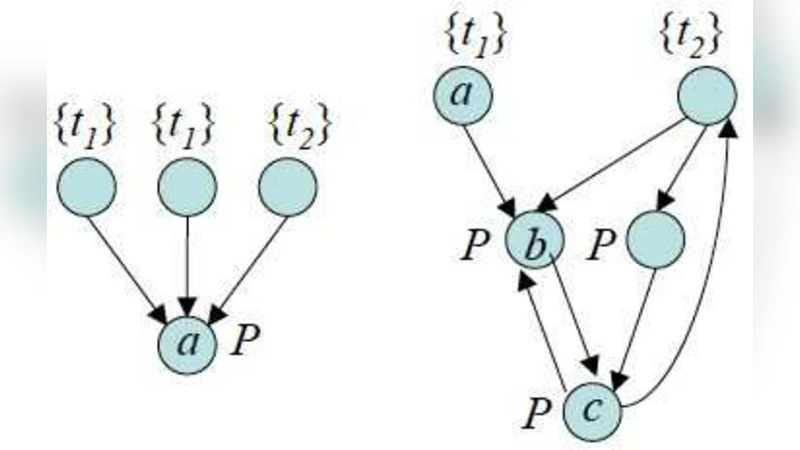
We introduce a new threshold model of social networks, in which the nodes influenced by their neighbours can adopt one out of several alternatives. We characterize the graphs for which adoption of a product by the whole network is possible (respectively necessary) and the ones for which a unique outcome is guaranteed. These characterizations directly yield polynomial time algorithms that allow us to determine whether a given social network satisfies one of the above properties. We also study algorithmic questions for networks without unique outcomes. We show that the problem of computing the minimum possible spread of a product is NP-hard to approximate with an approximation ratio better than $\Omega(n)$, in contrast to the maximum spread, which is efficiently computable. We then move on to questions regarding the behavior of a node with respect to adopting some (resp. a given) product. We show that the problem of determining whether a given node has to adopt some (resp. a given) product in all final networks is co-NP-complete.
💡 Research Summary
The paper introduces a novel threshold model for diffusion in social networks where multiple competing products vie for adoption. In this “multiple‑product threshold model,” each node v has a fixed threshold θ(v). The influence from each neighbor is product‑specific: if the sum of the weighted influences for a product exceeds θ(v) and v has not yet adopted any product, v chooses one of the still‑available products. This formulation captures realistic scenarios such as competing brands, political candidates, or technologies that spread through peer pressure.
The authors first address three fundamental questions about the global outcome of the diffusion process: (1) Existence – does there exist any sequence of initial adopters and activation order that leads the whole network to adopt a single product? (2) Necessity – is it unavoidable that the entire network ends up with a single product, regardless of the initial configuration and order? (3) Uniqueness – does every possible evolution converge to the same final state?
For existence, they define the product propagation closure: starting from a set of initially seeded nodes for a product p, repeatedly add any node whose incoming weighted influence for p meets its threshold. The network admits a global adoption of p iff the closure of some seed set equals the whole vertex set V. This condition can be checked in polynomial time by iterating the closure operation for each product.
Necessity is linked to two structural properties: strong connectivity of the underlying graph and threshold uniformity (all nodes share the same threshold). When both hold, any activation sequence inevitably spreads a product to every node, guaranteeing a global adoption. The paper provides a linear‑time algorithm that tests these properties and thus decides necessity.
Uniqueness is more subtle. The authors prove that if the graph can be decomposed into a single propagation tree—i.e., each node has at most one “first influencer” and the total weight from that influencer never exceeds the node’s threshold—then the diffusion process is deterministic: regardless of which seeds are chosen or in which order nodes update, the final set of adopters is identical. Conversely, if the graph contains a cycle where two different products can simultaneously satisfy a node’s threshold, multiple final outcomes are possible. The uniqueness test runs in O(n + m) time.
Having characterized when the outcome is predictable, the paper turns to optimization problems that arise when outcomes are not unique. Two complementary objectives are studied:
-
Minimum spread – given a product p, find an initial seed set and an activation order that yields the smallest possible number of nodes adopting p in any final network. By reduction from the Minimum Set Cover problem, the authors show that approximating this quantity within any factor better than Ω(n) is NP‑hard. Hence, even coarse approximations are computationally infeasible.
-
Maximum spread – the opposite problem of maximizing the number of adopters of p. Here the authors demonstrate that a greedy construction that always activates a node as soon as its threshold for p is met yields the optimal result. Consequently, the maximum spread can be computed exactly in polynomial time by a simple breadth‑first search that respects the product‑specific influence weights.
Finally, the paper investigates forced adoption at the node level. Two decision problems are defined: (i) does a particular node v necessarily adopt some product in every possible final network? (ii) does v necessarily adopt a specific product q? Both problems are shown to be co‑NP‑complete. The hardness proofs involve reductions from the complement of SAT, establishing that while a counterexample (a final network where v does not adopt the product) can be verified efficiently, determining that no such counterexample exists is computationally intractable.
In summary, the work provides a rigorous theoretical framework for diffusion with competing alternatives. It delivers polynomial‑time algorithms for structural tests (existence, necessity, uniqueness), establishes a stark contrast between the tractability of maximum versus minimum spread, and pinpoints the co‑NP‑completeness of node‑level forced‑adoption queries. These results have direct implications for viral marketing, political campaigning, and technology diffusion, where practitioners must decide whether to aim for guaranteed full market capture, settle for maximal reach, or identify indispensable influencers under uncertainty.
Comments & Academic Discussion
Loading comments...
Leave a Comment