A Real-Time Model-Based Reinforcement Learning Architecture for Robot Control
Reinforcement Learning (RL) is a method for learning decision-making tasks that could enable robots to learn and adapt to their situation on-line. For an RL algorithm to be practical for robotic control tasks, it must learn in very few actions, while continually taking those actions in real-time. Existing model-based RL methods learn in relatively few actions, but typically take too much time between each action for practical on-line learning. In this paper, we present a novel parallel architecture for model-based RL that runs in real-time by 1) taking advantage of sample-based approximate planning methods and 2) parallelizing the acting, model learning, and planning processes such that the acting process is sufficiently fast for typical robot control cycles. We demonstrate that algorithms using this architecture perform nearly as well as methods using the typical sequential architecture when both are given unlimited time, and greatly out-perform these methods on tasks that require real-time actions such as controlling an autonomous vehicle.
💡 Research Summary
The paper addresses a fundamental dilemma in applying model‑based reinforcement learning (RL) to robotic control: the need for both sample efficiency (learning from as few real‑world actions as possible) and real‑time action selection (producing an action at every control cycle). Traditional model‑based methods such as R‑MAX or value iteration achieve sample efficiency by learning a model of the environment and planning on it, but the model update and planning phases often require substantial wall‑clock time. Consequently, the robot must wait between actions, which is unacceptable for online control. Model‑free approaches can act quickly but typically need thousands of potentially unsafe interactions, sacrificing sample efficiency.
To resolve this, the authors propose the Real‑Time Model‑Based Architecture (RT‑MBA), a parallel framework that decouples the three core components of a model‑based RL agent—acting, model learning, and planning—into separate threads. The key innovations are:
-
Sample‑based approximate planning – Instead of exact value iteration, RT‑MBA employs Monte‑Carlo Tree Search (MCTS) variants such as UCT or Sparse Sampling. These planners perform rollouts from the current state, focusing computation on states that are likely to be visited soon. The more rollouts that can be performed within a given time budget, the better the value estimates become.
-
Parallelization of heavy computation – Model learning and planning run continuously in the background on their own threads, while an “action thread” interacts with the environment. When a new transition (s, a, s′, r) is observed, the action thread quickly appends it to an update list, updates the shared current‑state variable, and returns the action dictated by the latest policy. Model learning consumes the update list asynchronously, creates a copy of the model, incorporates the new experiences, and swaps the copy back atomically. Planning repeatedly draws the current state and performs rollouts on the (possibly slightly stale) model, updating a per‑state policy table protected by fine‑grained mutexes.
-
Fine‑grained mutex design – Shared data structures (update list, current state, per‑state policy entries) are each guarded by separate locks. This minimizes contention: only the specific state being accessed is locked, allowing other states to be read or updated concurrently. Model swapping requires a brief lock on the whole model pointer, but the planner can continue using the previous copy during the update.
The architecture thus guarantees that the action thread can meet any predefined control frequency (e.g., 10 Hz, 25 Hz, 100 Hz) regardless of how long model learning or planning takes. The trade‑off is that model updates are batched; the agent may not incorporate every single transition immediately, which can slightly reduce sample efficiency compared with fully sequential methods.
Experimental Evaluation
Mountain Car: A classic benchmark with continuous position and velocity discretized into a 100 × 100 grid. The authors compare RT‑MBA (at 10 Hz, 25 Hz, 100 Hz) against Q‑Learning, Dyna, a sequential exact‑value‑iteration method, and a sequential MCTS method. Results show that the sequential methods achieve higher reward per episode early on, but require significantly more wall‑clock time (hundreds of seconds) because they must wait for a full model update and planning step after each action. RT‑MBA at 10 Hz performs comparably to the sequential MCTS method in terms of sample efficiency, while the higher‑frequency versions converge more slowly initially but finish learning much faster in real time. This demonstrates that the loss in sample efficiency is offset by a large gain in overall learning speed.
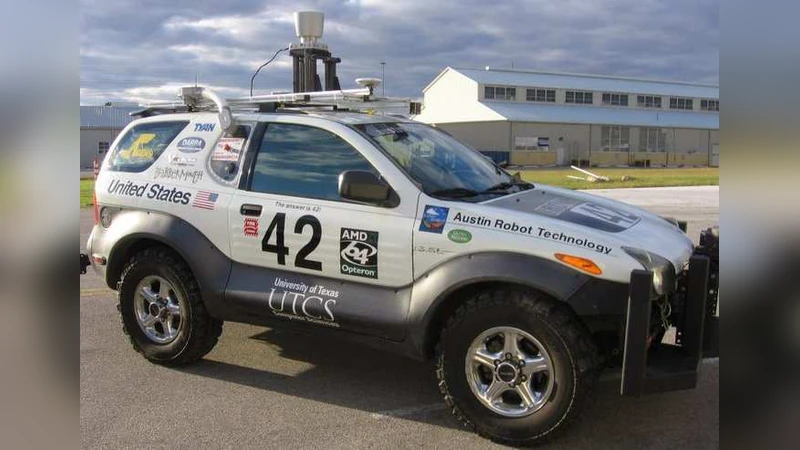
Autonomous Vehicle: The second set of experiments involves a real robot vehicle that must produce steering commands at least every 20 ms. Sequential model‑based approaches cannot keep up; the vehicle stalls or behaves erratically because the planner is still computing. RT‑MBA, running on a multi‑core processor, delivers actions at the required frequency while continuously improving its policy. The vehicle successfully navigates the track, illustrating that the architecture enables truly online learning on hardware with strict timing constraints.
Discussion and Limitations
- Sample‑efficiency vs. real‑time trade‑off: Batching updates can degrade the amount of information extracted per real‑world step. However, for tasks where timing is critical, this degradation is acceptable.
- Scalability of mutexes: In very high‑dimensional state spaces, contention on per‑state locks could become a bottleneck. Future work could explore lock‑free data structures or hierarchical locking.
- Model representation: The paper uses random‑forest models; more expressive models (e.g., deep neural networks) could improve accuracy but increase update cost. Integrating such models asynchronously is an open research direction.
- Multi‑robot extensions: The architecture naturally maps to multi‑core systems, but extending it to distributed multi‑robot settings would require additional synchronization mechanisms.
Future Directions
The authors suggest incorporating deep learning‑based dynamics models, improving lock granularity, and testing the framework on collaborative robot teams. They also propose adaptive allocation of computational resources (e.g., dynamically adjusting planning time based on current performance) to further balance sample efficiency and real‑time constraints.
Conclusion
RT‑MBA provides a practical solution for real‑time, sample‑efficient reinforcement learning on robots. By leveraging sample‑based approximate planners and fully parallelizing model learning and planning, the architecture decouples heavy computation from the control loop, allowing the agent to act at any required frequency while still benefiting from the data‑efficiency of model‑based RL. The experimental results on both simulated benchmarks and a real autonomous vehicle confirm that RT‑MBA outperforms traditional sequential model‑based methods in real‑time scenarios, making it a promising foundation for lifelong learning robots operating in dynamic, safety‑critical environments.
Comments & Academic Discussion
Loading comments...
Leave a Comment