A Computational Model for the Direct Execution of General Specifications with Multi-way Constraints
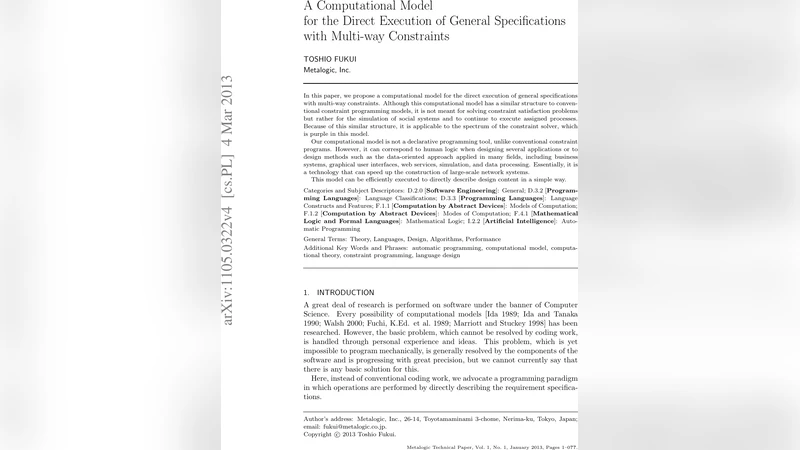
In this paper, we propose a computational model for the direct execution of general specifications with multi-way constraints. Although this computational model has a similar structure to existing constraint programming models, it is not meant for solving constraint satisfaction problems but rather for the simulation of social systems and to continue to execute assigned processes. Because of this similar structure, it is applicable to the spectrum of the constraint solver, which is purple in this model. Essentially, it is a technology that can speed up the construction of large-scale network systems. This model can be efficiently executed to directly describe design content in a simple way.
💡 Research Summary
The paper introduces a novel computational model that directly executes general specifications using multi‑way constraints, distinguishing itself from traditional constraint programming whose primary goal is to solve constraint satisfaction problems (CSPs). The authors argue that many real‑world applications—particularly social and business system simulations—do not require exhaustive search for a solution but rather need a mechanism that continuously enforces the relationships defined in the specification as the system state evolves.
To situate their contribution, the authors first review the history of constraint programming, noting that classic approaches (e.g., local propagation, blue‑algorithm) rely on solving large systems of algebraic equations, back‑tracking, and heuristic search. These methods incur significant computational overhead, struggle with non‑algebraic functions, and often face termination issues. In contrast, the proposed model treats each constraint as an executable rule that updates the data directly whenever any of its involved variables change. The constraints are multi‑way: a single constraint may simultaneously affect several variables, and the direction of data flow is determined at runtime based on which variables have been modified.
The authors introduce a color‑coded taxonomy of constraint solvers: red (problem definition), orange (strategy selection), yellow (simple propagation), blue (local propagation), and their newly defined “purple” stage. The purple stage represents a solver that does no search; it simply executes the pre‑specified constraint network in the order dictated by the dependency graph. Because the solver never explores alternative solution paths, its computational complexity is linear in the number of active constraints (O(n)), and there is no separate termination analysis—the system continues to run as long as data changes occur.
A concrete example is provided using a simplified banking system. The specification defines four data structures (deposit information, debit/credit history, usage status check, etc.) and seven constraints (C1‑C7) linking them. For instance, the total amount in a deposit record is defined as the sum of the corresponding debit/credit entries. When a new transaction is recorded, the relevant arrays grow, and the dependent constraints are automatically re‑evaluated, updating totals and usage‑status flags (e.g., “more than 100 times”). This illustrates how multi‑way constraints propagate changes without explicit control flow statements such as loops or conditionals.
A key claim is that the constraint language can embed arbitrary procedural functions (e.g., currentdate(), vsize()) and non‑algebraic operations, effectively allowing the specification to contain “programming logic” inside constraints. Consequently, the model is described as “non‑declarative constraint programming” or a “purple constraint solver.” The authors emphasize that the execution order is not predetermined by the designer; instead, it emerges from the network of constraints and the data that triggers them, which they term the “data flow.”
The paper contrasts this approach with related paradigms: one‑way/two‑way spreadsheet calculations, data‑flow machines, and languages such as Comet that embed constraint solvers within procedural code. While those systems either limit directionality or require a compilation step, the proposed model executes the specification directly, with no separate compilation phase.
Limitations are acknowledged. The model assumes that the constraint graph is acyclic or that cycles are deliberately avoided during design, because cycles could cause infinite re‑evaluation. Moreover, the approach does not support dynamic decision‑making where the system must choose among alternative execution paths at runtime; all possible paths must be encoded explicitly in the constraints. Debugging complex constraint networks can also become difficult as the number of variables and constraints grows.
Future work suggested includes developing cycle‑detection and resolution techniques, extending the model to handle dynamic path selection, and optimizing performance for large‑scale systems.
In conclusion, the authors present a computational framework that reinterprets constraints as executable specifications rather than as equations to be solved. By eliminating the search phase and treating constraints as direct data‑transformation rules, the model promises rapid prototyping and simulation of large business or social systems, allowing designers and domain experts to validate system behavior directly from high‑level specifications. This “purple” constraint solver thus offers a pragmatic alternative to traditional CSP‑oriented constraint programming for domains where continuous execution of predefined relationships is the primary requirement.
Comments & Academic Discussion
Loading comments...
Leave a Comment