Coding the Beams: Improving Beamforming Training in mmWave Communication System
The mmWave communication system is operating at a regime with high number of antennas and very limited number of RF analog chains. Large number of antennas are used to extend the communication range for recovering the high path loss while fewer RF analog chains are designed to reduce transmit and processing power and hardware complexity. In this regime, typical MIMO algorithms are not applicable. Before any communication starts, devices are needed to align their beam pointing angles towards each other. An efficient searching protocol to obtain the best beam angle pair is therefore needed. It is called BeamForming (BF) training protocol. This paper presents a new BF training technique called beam coding. Each beam angle is assigned unique signature code. By coding multiple beam angles and steering at their angles simultaneously in a training packet, the best beam angle pair can be obtained in a few packets. The proposed BF training technique not only shows the robustness in non-line-of-sight environment, but also provides very flat power variations within a packet in contrast to the IEEE 802.11ad standard whose scheme may lead to large dynamic range of signals due to beam angles varying across a training packet.
💡 Research Summary
The paper addresses a fundamental challenge in millimeter‑wave (mmWave) communication systems: the coexistence of a large antenna array with only a single RF analog chain. While many antennas are required to compensate for the severe path loss at 60 GHz, the cost and power consumption of multiple RF chains make a single‑chain architecture the norm in current mmWave RFIC designs. In such a regime, conventional MIMO beamforming (BF) training methods, which assume one RF chain per antenna, cannot be applied.
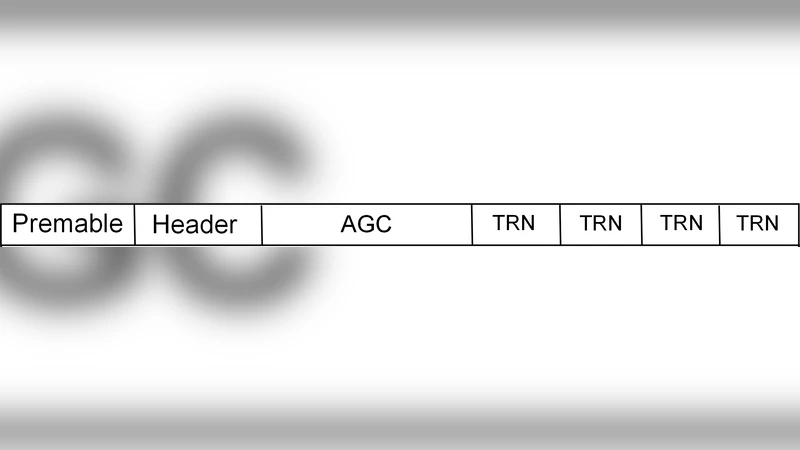
In IEEE 802.11ad, BF training is performed in two stages. First, low‑resolution (L‑Re) beams cover a wide angular sector, followed by a high‑resolution (H‑Re) refinement that can be executed “in‑packet” – i.e., multiple beams are switched within a single training packet. The in‑packet approach reduces overhead compared with packet‑by‑packet (PbP) training, but it introduces a serious practical problem: each beam switch changes the received signal power dramatically. Automatic Gain Control (AGC) must be re‑set for every beam, and the timing reference can drift, leading to large dynamic range across the packet and degraded channel estimation. Consequently, the standard limits in‑packet training to the final refinement stage only.
The authors propose a novel “beam coding” technique that eliminates the need to change beam direction within a packet. The key idea is to transmit several H‑Re beams simultaneously, assigning each beam a unique signature sequence (derived from a 4‑point Walsh code). The antenna weights are formed as a linear superposition of the individual beam weights, each multiplied by its signature. Mathematically, for N antennas the weight on antenna n at CE field t is
wₙ
Comments & Academic Discussion
Loading comments...
Leave a Comment