Oscillators and relaxation phenomena in Pleistocene climate theory
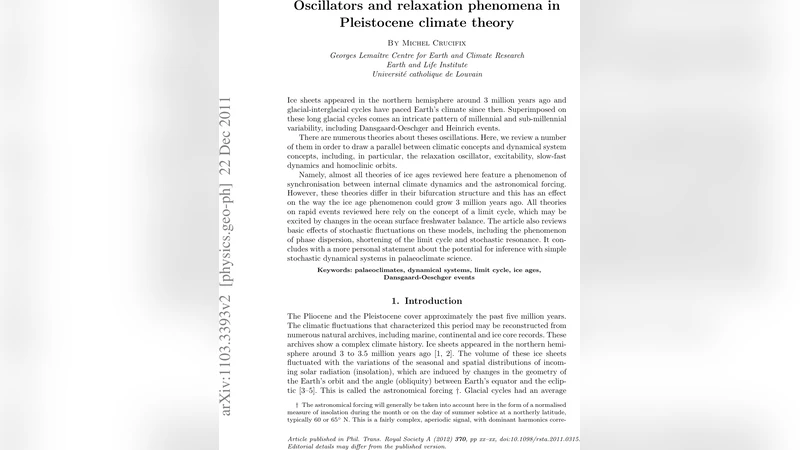
Ice sheets appeared in the northern hemisphere around 3 million years ago and glacial-interglacial cycles have paced Earth’s climate since then. Superimposed on these long glacial cycles comes an intricate pattern of millennial and sub-millennial variability, including Dansgaard-Oeschger and Heinrich events. There are numerous theories about theses oscillations. Here, we review a number of them in order to draw a parallel between climatic concepts and dynamical system concepts, including, in particular, the relaxation oscillator, excitability, slow-fast dynamics and homoclinic orbits. Namely, almost all theories of ice ages reviewed here feature a phenomenon of synchronisation between internal climate dynamics and the astronomical forcing. However, these theories differ in their bifurcation structure and this has an effect on the way the ice age phenomenon could grow 3 million years ago. All theories on rapid events reviewed here rely on the concept of a limit cycle in the ocean circulation, which may be excited by changes in the surface freshwater surface balance. The article also reviews basic effects of stochastic fluctuations on these models, including the phenomenon of phase dispersion, shortening of the limit cycle and stochastic resonance. It concludes with a more personal statement about the potential for inference with simple stochastic dynamical systems in palaeoclimate science. Keywords: palaeoclimates, dynamical systems, limit cycle, ice ages, Dansgaard-Oeschger events
💡 Research Summary
The paper provides a comprehensive review of how concepts from dynamical systems theory—particularly oscillators, relaxation oscillators, excitability, synchronization, homoclinic orbits, and stochastic effects—can be used to understand the major climate phenomena of the Pleistocene, namely the long glacial‑interglacial cycles and the rapid millennial‑scale events such as Dansgaard‑Oeschger (DO) and Heinrich events.
The authors begin by summarising the paleoclimate record: ice sheets first appeared in the Northern Hemisphere about 3–3.5 Myr ago, leading to glacial‑interglacial cycles with an average period of ~40 kyr that later shifted to ~100 kyr during the Middle Pleistocene Transition. Superimposed on this “saw‑tooth” glacial rhythm are abrupt millennial events recorded in Greenland ice cores (DO) and in North Atlantic sediment cores (Heinrich).
Section 2 introduces the essential mathematical vocabulary. An oscillator is defined as a system possessing a globally attracting limit cycle; a relaxation oscillator combines fast “jump” dynamics with a slow destabilisation phase, often organised around a slow manifold or a saddle‑node structure. Excitability describes systems with a stable fixed point that can be temporarily driven far from equilibrium by a perturbation, after which they return to the fixed point. The authors stress that small parameter changes can convert a relaxation oscillator into an excitable system because the geometric skeleton (slow manifold, saddle points, homoclinic orbit) remains in phase space even after the limit cycle disappears.
In Section 3 the authors map these abstract ideas onto concrete palaeoclimate models.
(a) Ice‑age models (Saltzman‑Maasch SM90 and SM91).
Both models consist of three coupled ordinary differential equations for continental ice mass (I), atmospheric CO₂ (µ), and deep‑ocean temperature (θ). The astronomical forcing enters through an insolation term F_I(t), while a slowly varying tectonic forcing F_µ acts as a control parameter. Bifurcation analysis shows that as F_µ is varied the system undergoes Hopf bifurcations: SM90 exhibits a subcritical Hopf, producing a region of bistability (coexistence of a stable fixed point and a large‑amplitude limit cycle), whereas SM91 displays a supercritical Hopf with a smooth emergence of the limit cycle. These bifurcations provide a mechanistic explanation for the emergence of glacial cycles around 3 Myr ago and for the later shift in period during the Middle Pleistocene Transition. Synchronization (phase‑locking) of the internally generated limit cycle to the external Milankovitch forcing is demonstrated, reproducing the observed “locked‑in” behaviour of glacial terminations.
(b) Rapid events (DO and Heinrich).
The authors argue that these events are best described by relaxation oscillators embedded in ocean‑circulation models. A slow‑fast structure is typical: the slow manifold represents the gradual build‑up of freshwater or heat in the North Atlantic, while a saddle‑node or homoclinic orbit provides the fast “jump” to a different circulation state. When freshwater input exceeds a threshold, the Atlantic Meridional Overturning Circulation (AMOC) collapses, producing a rapid temperature rise (the DO “onset”) followed by a slower recovery as the system drifts back along the slow manifold. The homoclinic scenario explains the long, almost infinite period observed near the bifurcation point, accounting for the irregular spacing of DO events.
Section 4 examines stochastic influences. Adding white noise to the deterministic skeleton leads to phase dispersion, weakening the synchronization between the limit cycle and Milankovitch forcing; this manifests as “skidding” of glacial terminations. Moreover, stochastic resonance can amplify a weak periodic astronomical signal when the noise intensity matches the system’s intrinsic time scale, thereby triggering abrupt events even when the deterministic forcing alone would be insufficient. The authors illustrate how noise‑induced transitions between coexisting attractors can reproduce the observed irregularity of DO event timing.
Finally, Section 5 discusses the prospects for inference using low‑dimensional stochastic models. By coupling these models with Bayesian parameter estimation and data assimilation techniques, one can quantify uncertainties in model parameters and assess the proximity of the climate system to critical bifurcations (“predictability of the third kind”). The authors suggest that such an approach, when integrated with high‑resolution Earth system models, could improve our ability to reconstruct past climate dynamics and to anticipate future abrupt transitions.
Overall, the paper bridges palaeoclimate observations with modern dynamical‑systems theory, showing that a small set of generic mechanisms—limit cycles, relaxation oscillations, excitability, synchronization, and stochastic forcing—can capture the essential features of both the long glacial cycles and the rapid millennial events of the Pleistocene.
Comments & Academic Discussion
Loading comments...
Leave a Comment