A note on active learning for smooth problems
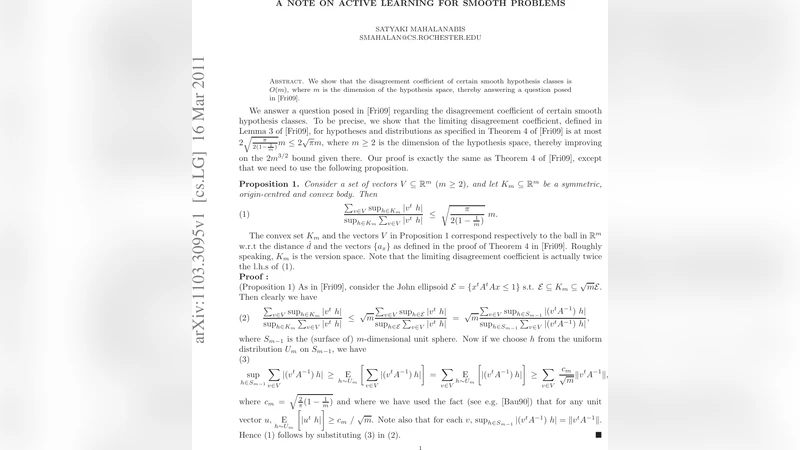
We show that the disagreement coefficient of certain smooth hypothesis classes is $O(m)$, where $m$ is the dimension of the hypothesis space, thereby answering a question posed in \cite{friedman09}.
💡 Research Summary
The paper addresses an open question raised by Friedman (2009) concerning the disagreement coefficient for smooth hypothesis classes in active learning. The disagreement coefficient measures how much the region of uncertainty (where the learner’s current hypothesis set disagrees) overlaps with the distribution of unlabeled examples. Friedman’s original analysis yielded an upper bound of order $O(m^{3/2})$, where $m$ denotes the dimensionality of the hypothesis space. This bound becomes overly pessimistic in high‑dimensional settings, inflating the theoretical sample‑complexity guarantees for active learning algorithms.
The authors revisit the same setting as Friedman: a smooth hypothesis class defined over $\mathbb{R}^m$, a distance function $\hat d$ that induces a symmetric, origin‑centered convex body $K_m$, and a finite set of vectors $V$ (derived from the data distribution). The disagreement coefficient is expressed as the ratio \
Comments & Academic Discussion
Loading comments...
Leave a Comment