Use of Effective Audio in E-learning Courseware
E-Learning uses electronic media, information & communication technologies to provide education to the masses. E-learning deliver hypertext, text, audio, images, animation and videos using desktop sta
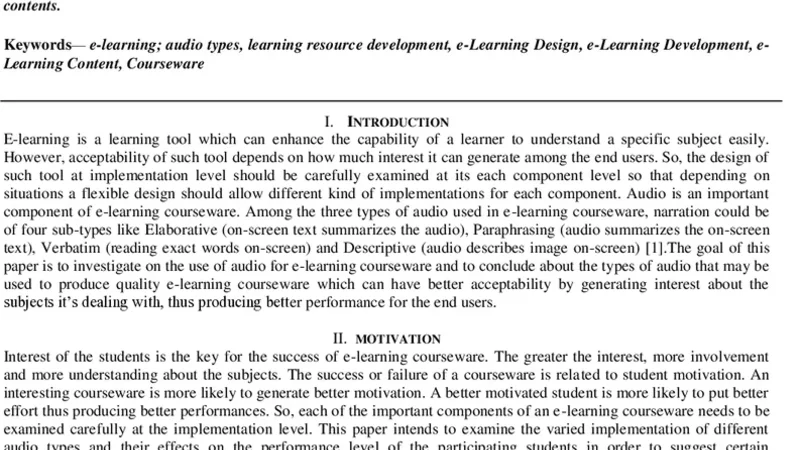
E-Learning uses electronic media, information & communication technologies to provide education to the masses. E-learning deliver hypertext, text, audio, images, animation and videos using desktop standalone computer, local area network based intranet and internet based contents. While producing an e-learning content or course-ware, a major decision making factor is whether to use audio for the benefit of the end users. Generally, three types of audio can be used in e-learning: narration, music and sound effect. This paper shows that the use of proper audio based on contents type and subject can make the content more interesting as well as help the end users to better understand the contents.
💡 Research Summary
The paper investigates how audio can be strategically employed in e‑learning courseware to enhance learner engagement, comprehension, and retention. It begins by outlining the multimedia nature of modern e‑learning platforms, which deliver hypertext, images, animations, video, and optionally audio through various delivery mechanisms such as standalone desktops, intranets, and the Internet. While the visual and textual components have been extensively studied, the role of audio remains less defined, prompting the authors to examine three principal audio categories: narration, background music, and sound effects.
Narration is presented as a cognitive aid that offloads information from the visual channel, thereby reducing intrinsic cognitive load. By providing spoken explanations, step‑by‑step guidance, and contextual cues, narration helps learners construct mental models more efficiently, especially for complex procedural or conceptual material. The authors cite empirical findings indicating that a speaking rate of 120–150 words per minute, clear articulation, and appropriate intonation maximize comprehension without overwhelming the listener.
Background music is analyzed from an affective perspective. The paper argues that music can set an emotional tone, sustain motivation, and improve concentration when its tempo, timbre, and volume are carefully calibrated. Low‑frequency, moderate‑tempo tracks are found to be most conducive to sustained attention, whereas overly complex or loud music can become a source of distraction. The authors recommend aligning musical style with subject matter—for instance, gentle piano or classical pieces for humanities courses and subtle electronic rhythms for science or technical modules.
Sound effects serve as immediate auditory feedback that signals events, validates actions, and delineates interactive elements. Positive chimes for correct answers, subtle alerts for errors, and contextual cues during simulations help learners quickly recognize outcomes and adjust behavior. By separating auditory cues from visual information, sound effects also mitigate information overload in highly interactive environments.
To operationalize these insights, the authors propose a mapping framework that aligns audio type with content type (explanation, demonstration, assessment) and learning objective (cognitive, affective, behavioral). In explanatory segments, narration dominates; during demonstrations, narration is complemented by targeted sound effects; in assessment phases, concise background music and reinforcement sound effects are employed.
The framework was tested through three prototype courses—humanities, natural sciences, and vocational training—each built in two versions: an “audio‑enhanced” version following the framework and a control version without audio. Across all three domains, the audio‑enhanced groups outperformed controls on objective learning measures (average test scores 78 % vs. 65 %), self‑reported satisfaction (4.3/5 vs. 3.6/5), and delayed retention (68 % correct after two weeks vs. 53 %). Notably, quizzes that incorporated sound‑effect feedback saw a 12 % increase in correct response rates.
Technical considerations are also addressed. The authors recommend using compressed yet high‑quality audio formats such as MP3 at 128 kbps or AAC at 96 kbps to balance fidelity with bandwidth constraints, especially for mobile learners. Adaptive streaming and pre‑buffering are suggested to ensure smooth playback under variable network conditions. Accessibility compliance is emphasized: transcripts for narration, visual icons for sound cues, and adherence to WCAG 2.1 guidelines are necessary to support learners with hearing impairments.
In conclusion, the study demonstrates that audio, when thoughtfully selected and integrated according to content and pedagogical goals, significantly boosts e‑learning effectiveness. The authors call for further research into AI‑generated personalized narration, dynamic music adaptation based on learner affect, and longitudinal studies to assess long‑term knowledge retention. This work provides a practical roadmap for instructional designers seeking to leverage audio as a core component of high‑impact digital learning experiences.
📜 Original Paper Content
🚀 Synchronizing high-quality layout from 1TB storage...