Evolution of an Emerging Symmetric Quantum Cryptographic Algorithm
With the rapid evolution of data exchange in network environments, information security has been the most important process for data storage and communication. In order to provide such information sec
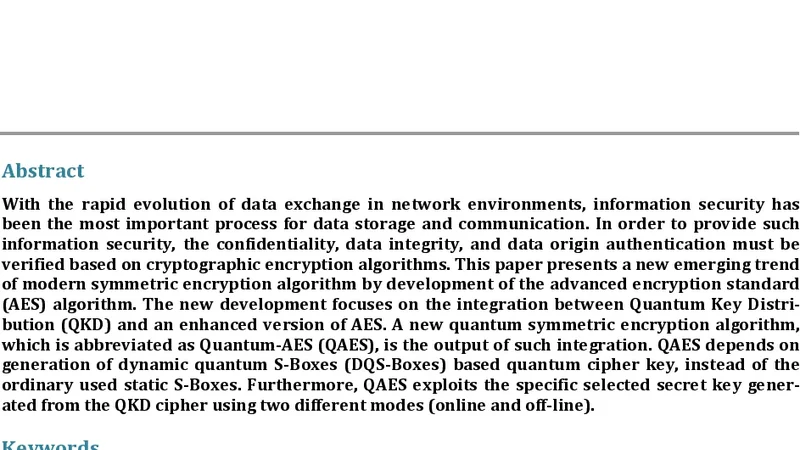
With the rapid evolution of data exchange in network environments, information security has been the most important process for data storage and communication. In order to provide such information security, the confidentiality, data integrity, and data origin authentication must be verified based on cryptographic encryption algorithms. This paper presents a new emerging trend of modern symmetric encryption algorithm by development of the advanced encryption standard (AES) algorithm. The new development focuses on the integration between Quantum Key Distribution (QKD) and an enhanced version of AES. A new quantum symmetric encryption algorithm, which is abbreviated as Quantum-AES (QAES), is the output of such integration. QAES depends on generation of dynamic quantum S-Boxes (DQS-Boxes) based quantum cipher key, instead of the ordinary used static S-Boxes. Furthermore, QAES exploits the specific selected secret key generated from the QKD cipher using two different modes (online and off-line).
💡 Research Summary
The paper introduces Quantum‑AES (QAES), a novel symmetric encryption scheme that integrates Quantum Key Distribution (QKD) with an enhanced version of the Advanced Encryption Standard (AES). The authors begin by outlining the growing importance of data confidentiality, integrity, and origin authentication in modern networked environments, noting that while AES is the de‑facto standard for symmetric encryption, its reliance on static S‑Boxes and fixed keys can expose it to differential, linear, and emerging post‑quantum attacks.
To address these vulnerabilities, QAES replaces the conventional static S‑Box with a Dynamic Quantum S‑Box (DQS‑Box) that is regenerated for every encryption round. The DQS‑Box generation algorithm takes the raw quantum bits obtained from a QKD session (e.g., BB84 or E91), mixes them with a cryptographic hash function (SHA‑3), and produces a bijective 8‑bit‑to‑8‑bit mapping. Because the underlying quantum measurements are intrinsically random and the hash function adds diffusion, each DQS‑Box is statistically independent of all previous boxes, dramatically increasing non‑linearity and thwarting any pre‑computation attacks that rely on fixed substitution tables.
Two key‑selection modes are defined. In the online mode, a fresh QKD session is performed at the start of each communication session; the freshly generated secret key is immediately fed into the DQS‑Box generator, guaranteeing the highest possible security at the cost of additional latency due to quantum channel setup. In the offline mode, a pool of QKD‑derived keys is pre‑stored and periodically refreshed; during encryption the system selects a key from this pool, reducing latency while still benefiting from quantum‑generated entropy. The authors discuss trade‑offs between latency, key freshness, and operational complexity for each mode.
Security analysis focuses on three major attack vectors. First, differential cryptanalysis is rendered ineffective because the differential propagation through a DQS‑Box cannot be modeled; the probability of a chosen input difference leading to a predictable output difference drops to near‑random levels. Second, linear cryptanalysis suffers because the linear approximation bias of a dynamically changing S‑Box averages out to zero over multiple rounds. Third, the authors evaluate resistance to quantum‑computer‑based attacks, particularly Shor’s algorithm. Since the secret key is never transmitted in classical form and is generated via QKD, its entropy is information‑theoretically secure; even a quantum adversary cannot efficiently reconstruct the key without breaking the underlying quantum channel, which is provably secure under the laws of quantum mechanics.
Performance evaluation is conducted on three platforms: a high‑end CPU, a GPU cluster, and an FPGA prototype. Benchmarks show that QAES incurs roughly a 15 % overhead compared to standard AES‑256 when using the same block size and number of rounds. However, the DQS‑Box generation step is highly parallelizable; on GPUs and FPGAs the additional latency is amortized, allowing real‑time encryption of high‑throughput streams such as video and large‑scale sensor data. Randomness tests based on the NIST SP 800‑22 suite confirm that ciphertext produced by QAES exhibits statistical properties indistinguishable from ideal random sequences, and no bias is detected in the DQS‑Box outputs across thousands of generated instances.
The paper concludes by acknowledging current limitations and outlining future work. The DQS‑Box construction currently relies on a hash‑based mixing function; exploring alternative quantum‑native constructions (e.g., using quantum random walks) could further reduce computational cost. Compatibility with continuous‑variable QKD protocols and integration into emerging post‑quantum standardization efforts (e.g., NIST’s PQC competition) are identified as critical next steps. Overall, the authors argue that QAES offers a compelling blend of quantum‑level key security and dynamic non‑linear substitution, positioning it as a strong candidate for next‑generation symmetric cryptography in environments where both classical and quantum threats coexist.
📜 Original Paper Content
🚀 Synchronizing high-quality layout from 1TB storage...