Nonlinear dynamo action in a precessing cylindrical container
It is numerically demonstrated by means of a magnetohydrodynamics (MHD) code that precession can trigger the dynamo effect in a cylindrical container. This result adds credit to the hypothesis that precession can be strong enough to be one of the sources of the dynamo action in some astrophysical bodies.
💡 Research Summary
The paper presents a comprehensive numerical investigation of dynamo action driven by precession in a cylindrical container filled with an electrically conducting fluid. Using the spectral/finite‑element MHD code SFEMaNS, the authors solve the full set of non‑dimensional Navier‑Stokes and induction equations in the frame rotating with the cylinder while it precesses about a second axis. The geometry is a cylinder of radius R and length L (aspect ratio L/R = 2) rotating at angular velocity Ω_r about its symmetry axis and precessing at angular velocity Ω_p about an axis inclined by α = π/2, with a precession rate ε = Ω_p/Ω_r = 0.15. The governing parameters are the Ekman number E = ν/(R²Ω_r), the magnetic Prandtl number Pm = νμ₀σ₀, the Reynolds number Re = 1/E, and the magnetic Reynolds number Rm = Pm Re. The study focuses on Re = 1000 and 1200 and on Rm ranging from 600 to 2400.
First, pure hydrodynamic (Navier‑Stokes) simulations are performed to characterize the flow generated by precession. Starting from solid‑body rotation, the precessional Coriolis force excites an axial (m = 1) mode. For Re = 1200 the kinetic energy exhibits a superposition of a long period (~8 rotation periods) and a short period (~1 rotation period) oscillation, the latter corresponding to an energy exchange between the northern and southern halves of the cylinder. After a transient of about five rotation periods the axial kinetic energy settles at K_z ≈ 0.1 while the total kinetic energy stabilises at K ≈ 0.42.
These velocity fields are then used as inputs for magnetic induction calculations. In the “Maxwell” mode only the induction equation is solved with a prescribed velocity; in the full MHD mode the Lorentz force is included and the velocity field evolves self‑consistently. Small seed magnetic fields are introduced, primarily in the m = 0 and m = 1 Fourier modes, to trigger the dynamo instability. For magnetic Prandtl numbers Pm = 2, 1, 2/3, 1/2 the magnetic energy M(t) either grows or decays. Growth is observed for Pm ≥ 2/3, while Pm = 1/2 leads to decay. Linear interpolation of the growth rates yields a critical magnetic Prandtl number Pm* ≈ 0.625, corresponding to a critical magnetic Reynolds number Rm* ≈ 750.
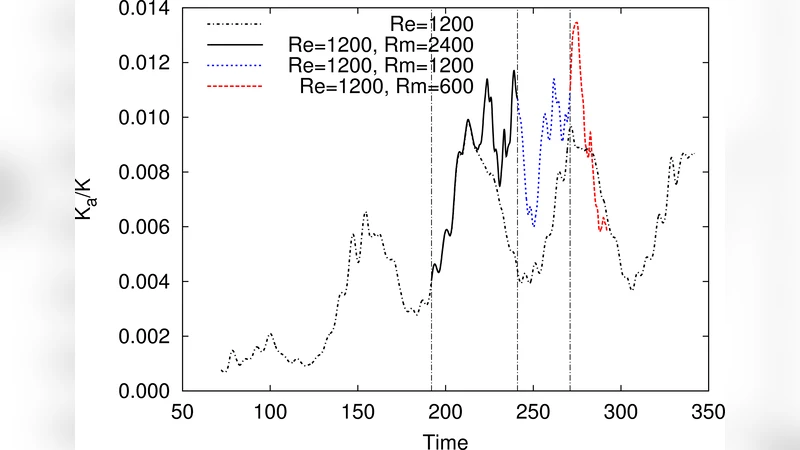
To explore the nonlinear saturation, the magnetic field obtained at t = 217 (Pm = 2, Rm = 2400) is amplified by a factor of 300 and the MHD simulation is continued. The magnetic energy rises smoothly until t ≈ 222, after which it oscillates around a saturated level with M/K ≈ 10⁻². Subsequent runs at lower Pm (1 and 1/2) show that the dynamo persists at Pm = 1 (Rm = 1200) but dies out at Pm = 1/2 (Rm = 600), confirming the critical range 0.625 < Pm* < 0.667 found in the linear regime. The bifurcation therefore appears to be supercritical.
A key part of the analysis concerns flow symmetry. The velocity field is decomposed into symmetric (u_s) and antisymmetric (u_a) components with respect to the cylinder’s mid‑plane, and the asymmetry ratio r_a = K_a/K is monitored. In pure hydrodynamic runs r_a remains low (0.004–0.01). When the magnetic field becomes strong, r_a rises to 0.09–0.11, indicating that the Lorentz force enhances the flow’s departure from centro‑symmetry. However, two kinematic Maxwell experiments—one with the full velocity field frozen at t = 211 and another with only its symmetric part retained—both exhibit magnetic energy growth rates comparable to the fully coupled MHD run at Rm = 1200. This demonstrates that neither temporal oscillations nor flow asymmetry are strictly required for dynamo action in this configuration.
Visualization of the saturated state reveals a central S‑shaped vortex that is twisted by precession and reconnects with the walls through thin viscous boundary layers. The magnetic field is dominated by azimuthal Fourier modes (m = 1, 2, 3) and displays a quadrupolar pattern in the surrounding vacuum, consistent with previous studies of precession‑driven dynamos in spherical and spheroidal geometries.
In conclusion, the authors provide the first numerical evidence that precession can drive a self‑sustained dynamo in a cylindrical container. The critical magnetic Reynolds number (≈ 750) is comparable to values reported for precessing spheres, and the dynamo persists despite the presence or absence of flow asymmetry. The study highlights the importance of achieving sufficiently high Rm, while noting that the simulated Ekman and magnetic Prandtl numbers (E ≈ 10⁻³, Pm ≈ 10⁻⁵) are still far from those in laboratory experiments and planetary interiors. Future work is suggested to explore a broader range of precession angles and rates, to investigate parity‑breaking transitions, and to develop scaling laws that bridge the gap between numerical, experimental, and astrophysical regimes.
Comments & Academic Discussion
Loading comments...
Leave a Comment