Detecting hidden spatial and spatio-temporal structures in glasses and complex physical systems by multiresolution network clustering
We elaborate on a general method that we recently introduced for characterizing the “natural” structures in complex physical systems via a multiscale network based approach for the data mining of such structures. The approach is based on “community detection” wherein interacting particles are partitioned into “an ideal gas” of optimally decoupled groups of particles. Specifically, we construct a set of network representations (“replicas”) of the physical system based on interatomic potentials and apply a multiscale clustering (“multiresolution community detection”) analysis using information-based correlations among the replicas. Replicas may be (i) different representations of an identical static system or (ii) embody dynamics by when considering replicas to be time separated snapshots of the system (with a tunable time separation) or (iii) encode general correlations when different replicas correspond to different representations of the entire history of the system as it evolves in space-time. We apply our method to computer simulations of a binary Kob-Andersen Lennard-Jones system, a ternary model system, and to atomic coordinates in a ZrPt system as gleaned by reverse Monte Carlo analysis of experimentally determined structure factors. We identify the dominant structures (disjoint or overlapping) and general length scales by analyzing extrema of the information theory measures. We speculate on possible links between (i) physical transitions or crossovers and (ii) changes in structures found by this method as well as phase transitions associated with the computational complexity of the community detection problem. We briefly also consider continuum approaches and discuss the shear penetration depth in elastic media; this length scale increases as the system becomes increasingly rigid.
💡 Research Summary
The paper introduces a novel, fully data‑driven framework for uncovering hidden spatial and spatio‑temporal structures in amorphous materials by casting the atomic configuration into a weighted network and applying multiresolution community detection. Nodes represent atoms (or other elementary units) while edges carry weights derived from inter‑atomic potentials or experimentally measured pair‑ and higher‑order correlation functions. The core of the method is a Potts‑model‑based community‑detection energy functional that includes a resolution parameter γ; varying γ continuously yields a hierarchy of partitions from a single giant community (low γ) to each atom as its own community (high γ).
To identify the most “natural” partitions, the authors generate multiple replicas of the same physical system. Replicas may differ in initial conditions, time‑separated snapshots, or in the choice of weight definition, and each is solved independently by stochastic optimization (e.g., greedy hill climbing, simulated annealing). The resulting community assignments are compared using information‑theoretic similarity measures: Normalized Mutual Information (NMI) and Variation of Information (VI). Extrema in NMI (maxima) or VI (minima) as a function of γ pinpoint scales at which the replicas strongly agree, indicating robust structural motifs. Multiple extrema imply the presence of several relevant length or time scales.
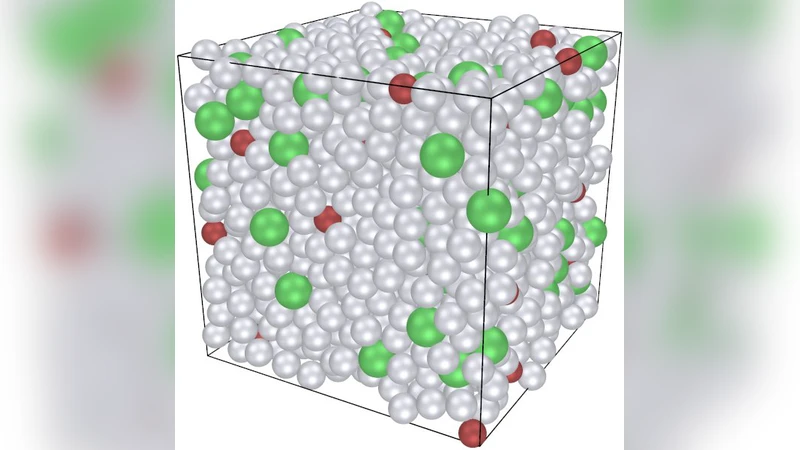
The methodology is applied to three distinct testbeds: (i) the classic Kob‑Andersen 80:20 binary Lennard‑Jones glass former, (ii) a ternary metallic‑glass model mimicking Al‑Y‑Fe with composition 88:7:5, and (iii) an experimentally derived Zr‑80Pt‑20 structure obtained via reverse Monte‑Carlo reconstruction of measured structure factors. For each case, a suite of replicas is generated, the NMI/VI curves are computed, and the γ values at the extrema are extracted. The analysis reveals well‑defined clusters that correspond to known medium‑range order (MRO) motifs such as icosahedral‑like arrangements, mixed‑species polyhedra, and more complex overlapping clusters that cannot be captured by traditional Voronoi or Honeycutt‑Andersen descriptors. Overlapping community detection is explicitly incorporated, allowing atoms to belong simultaneously to several clusters, thereby exposing hierarchical and inter‑connected structural motifs.
Beyond structural identification, the authors explore the relationship between the computational difficulty of the community‑detection problem and physical transitions. As temperature is lowered toward the glass transition, the optimization landscape becomes increasingly rugged, leading to a sharp rise in the number of iterations required for convergence and in the variance of the energy functional. This “computational phase transition” mirrors the growth of static correlation lengths and suggests that algorithmic hardness may serve as an indirect probe of dynamical slowing down.
The paper also connects the network‑based findings to a continuum description by introducing the shear‑penetration depth, a length scale that quantifies how far a shear perturbation can propagate before being screened. The authors show that this depth grows as the system stiffens, providing a macroscopic counterpart to the microscopic clusters uncovered by the network analysis.
Supplementary material details the mathematical definitions of NMI and VI, the handling of overlapping nodes, the role of pre‑peaks in the structure factor (and why they are not a necessary condition for MRO), and additional test cases (including 2‑D models and alternative potentials).
In summary, the work presents a powerful, unbiased multiscale clustering framework that translates complex physical systems into networks, exploits replica‑based information theory to locate optimal resolutions, and successfully extracts both known and novel structural motifs in glasses. It bridges microscopic network partitions with macroscopic mechanical response, offering a fresh perspective on the interplay between structure, dynamics, and computational complexity in disordered materials.
Comments & Academic Discussion
Loading comments...
Leave a Comment