Large Scale Correlation Screening
This paper treats the problem of screening for variables with high correlations in high dimensional data in which there can be many fewer samples than variables. We focus on threshold-based correlation screening methods for three related applications: screening for variables with large correlations within a single treatment (autocorrelation screening); screening for variables with large cross-correlations over two treatments (cross-correlation screening); screening for variables that have persistently large auto-correlations over two treatments (persistent-correlation screening). The novelty of correlation screening is that it identifies a smaller number of variables which are highly correlated with others, as compared to identifying a number of correlation parameters. Correlation screening suffers from a phase transition phenomenon: as the correlation threshold decreases the number of discoveries increases abruptly. We obtain asymptotic expressions for the mean number of discoveries and the phase transition thresholds as a function of the number of samples, the number of variables, and the joint sample distribution. We also show that under a weak dependency condition the number of discoveries is dominated by a Poisson random variable giving an asymptotic expression for the false positive rate. The correlation screening approach bears tremendous dividends in terms of the type and strength of the asymptotic results that can be obtained. It also overcomes some of the major hurdles faced by existing methods in the literature as correlation screening is naturally scalable to high dimension. Numerical results strongly validate the theory that is presented in this paper. We illustrate the application of the correlation screening methodology on a large scale gene-expression dataset, revealing a few influential variables that exhibit a significant amount of correlation over multiple treatments.
💡 Research Summary
The manuscript addresses the fundamental problem of identifying a small subset of variables that exhibit unusually large pairwise correlations in ultra‑high‑dimensional data sets where the number of observations n is far smaller than the number of variables p. The authors focus on a simple yet powerful screening paradigm: compute the sample correlation matrix, threshold its absolute entries at a level ρ, and retain only those variables that belong to at least one pair whose correlation exceeds the threshold. Three closely related screening tasks are distinguished: (i) auto‑correlation screening (high correlation among variables measured under the same experimental condition), (ii) cross‑correlation screening (high correlation between variables measured under two different conditions), and (iii) persistent‑correlation screening (variables that are highly auto‑correlated in both conditions).
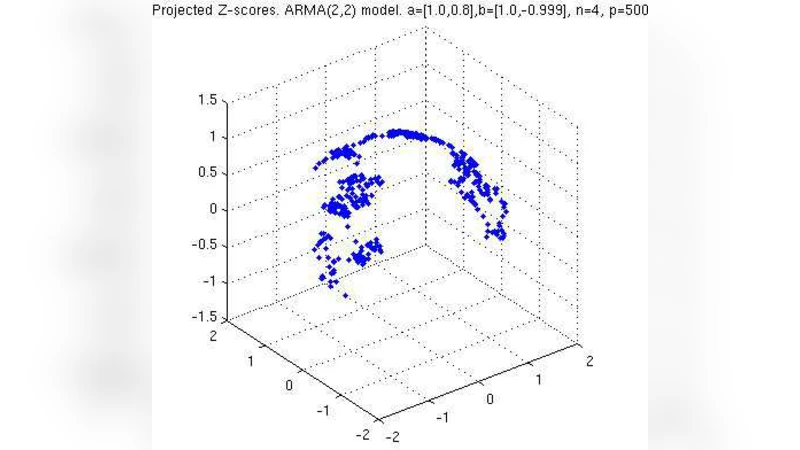
A central phenomenon uncovered in the analysis is a phase‑transition in the number of discoveries as the threshold ρ is lowered. Below a critical value ρc the number of retained variable pairs explodes, even when the underlying variables are independent. The paper derives explicit asymptotic formulas for ρc as a function of (n, p) and of the joint distribution of the data. The derivations rely on a geometric representation of the sample correlations in terms of “U‑scores”, which are (n‑2)‑dimensional unit vectors lying on the sphere S^{n‑2}. The inner product of two U‑scores equals the sample correlation, and the probability that a random pair of U‑scores falls within a spherical cap of angular radius arccos ρ is given by a closed‑form integral P0(ρ,n). Using this geometric probability the expected number of discoveries is shown to be
E
Comments & Academic Discussion
Loading comments...
Leave a Comment