The GeV-TeV Galactic gamma-ray diffuse emission I. Uncertainties in the predictions of the hadronic component
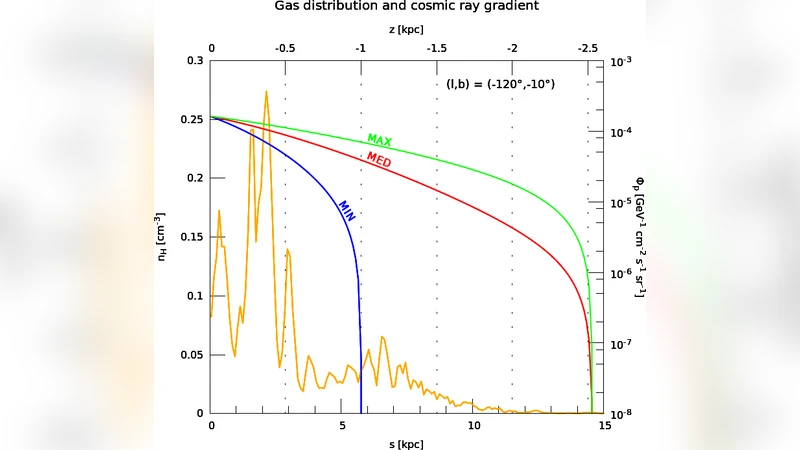
The Galactic gamma-ray diffuse emission is currently observed in the GeV-TeV energy range with unprecedented accuracy by the Fermi satellite. Understanding this component is crucial as it provides a background to many different signals such as extragalactic sources or annihilating dark matter. It is timely to reinvestigate how it is calculated and to assess the various uncertainties which are likely to affect the accuracy of the predictions. The Galactic gamma-ray diffuse emission is mostly produced above a few GeV by the interactions of cosmic ray primaries impinging on the interstellar material. The theoretical error on that component is derived by exploring various potential sources of uncertainty. Particular attention is paid to cosmic ray propagation. Nuclear cross sections, the proton and helium fluxes at the Earth, the Galactic radial profile of supernova remnants and the hydrogen distribution can also severely affect the signal. The propagation of cosmic ray species throughout the Galaxy is described in the framework of a semi-analytic two-zone diffusion/convection model. This allows to convert the constraints set by the boron-to-carbon data into a theoretical uncertainty on the diffuse emission. New deconvolutions of the HI and CO sky maps are also used to get the hydrogen distribution within the Galaxy. The thickness of the cosmic ray diffusive halo is found to have a significant effect on the Galactic gamma-ray diffuse emission while the interplay between diffusion and convection has little influence on the signal. The uncertainties related to nuclear cross sections and to the primary cosmic ray fluxes at the Earth are significant. The radial distribution of supernova remnants along the Galactic plane turns out to be a key ingredient. As expected, the predictions are extremely sensitive to the spatial distribution of hydrogen within the Milky Way.
💡 Research Summary
The paper presents a comprehensive assessment of the uncertainties affecting theoretical predictions of the hadronic component of the Galactic diffuse gamma‑ray emission, a background that is crucial for interpreting Fermi‑LAT observations, extragalactic gamma‑ray studies, and indirect dark‑matter searches. The authors adopt a semi‑analytic two‑zone diffusion‑convection model for cosmic‑ray (CR) transport, which allows rapid calculation of the gamma‑ray flux once the CR spectra throughout the Galactic halo are known. By fitting the boron‑to‑carbon (B/C) ratio, they constrain the propagation parameter space (diffusion coefficient normalization K₀, spectral index δ, convection speed V_c, and halo half‑height L) and then propagate these uncertainties into the predicted gamma‑ray intensity.
Key findings include:
-
Diffusion Parameters (K₀, δ): Variations within the B/C‑allowed range modify the overall gamma‑ray spectrum only modestly (≤10 %). The diffusion coefficient primarily sets the energy dependence of CR propagation but does not dominate the flux uncertainty at energies above a few GeV.
-
Convection (V_c): Convection influences the low‑energy (<5 GeV) regime where it competes with diffusion, yet its impact on the integrated diffuse emission is limited to ≈5 %. Consequently, uncertainties in V_c are sub‑dominant for the GeV–TeV band of interest.
-
Halo Height (L): The half‑thickness of the diffusive halo emerges as the most critical propagation parameter. Increasing L from 1 kpc to 4 kpc raises the gamma‑ray intensity by up to 30 % along lines of sight toward the Galactic centre, because a larger volume of interstellar gas is illuminated by CR protons and helium nuclei.
-
Nuclear Production Cross Sections: The authors compare several parametrizations (Kamae et al., DPMJET‑III, Huang et al.) and quantify the resulting uncertainty. At 1 GeV the cross‑section uncertainty is ≈33 %, peaks at ≈54 % near 4.5 GeV, and falls to 20‑30 % above 100 GeV. This reflects the scarcity of accelerator data at low energies and the model dependence of pion‑production physics.
-
Primary CR Spectra at Earth: Using recent measurements (e.g., Shikaze et al. 2007) as boundary conditions, the authors propagate the uncertainties in the local proton and helium spectra through the transport model. The resulting uncertainty grows with energy, reaching ±37 % at 1 TeV, indicating that precise knowledge of the local CR flux is essential for accurate gamma‑ray background modeling.
-
Supernova Remnant (SNR) Radial Distribution: Since SNRs are assumed to be the dominant CR accelerators, the adopted radial source profile strongly affects the gamma‑ray sky. Different SNR distribution models produce variations up to 50 % toward the Galactic centre and 70 % in the opposite direction, underscoring the need for better observational constraints on the Galactic SNR population.
-
Interstellar Gas Distribution: The gamma‑ray emissivity is directly proportional to the line‑of‑sight integral of the hydrogen density. The authors employ newly deconvolved HI and CO three‑dimensional maps (Pohl et al. 2008) and compare them with the traditional GALPROP gas models. Differences in the gas maps and in the CO‑to‑H₂ conversion factor X_CO lead to 40‑60 % variations in the predicted diffuse emission, confirming that the gas distribution is a dominant source of systematic uncertainty.
Overall, the study identifies the halo height L and the SNR radial profile as the two most pressing ingredients to improve. Reducing the uncertainty on L will likely come from future measurements of radioactive secondary isotopes (e.g., ^10Be/^9Be) and from refined modeling of CR anisotropies. Better mapping of SNRs through high‑resolution radio, X‑ray, and gamma‑ray surveys will tighten the source term in propagation calculations.
By quantifying each contribution, the paper provides a clear roadmap for the community: prioritize precise determinations of the CR propagation volume and the Galactic source distribution, while simultaneously refining nuclear cross‑section data and gas‑map reconstructions. Achieving these goals will sharpen the Galactic diffuse gamma‑ray background model, thereby enhancing the sensitivity of indirect dark‑matter searches, axion‑like particle investigations, and studies of extragalactic gamma‑ray sources.
Comments & Academic Discussion
Loading comments...
Leave a Comment