Determinantal Correlations of Brownian Paths in the Plane with Nonintersection Condition on their Loop-Erased Parts
As an image of the many-to-one map of loop-erasing operation $\LE$ of random walks, a self-avoiding walk (SAW) is obtained. The loop-erased random walk (LERW) model is the statistical ensemble of SAWs such that the weight of each SAW $\zeta$ is given…
Authors: Makiko Sato, Makoto Katori
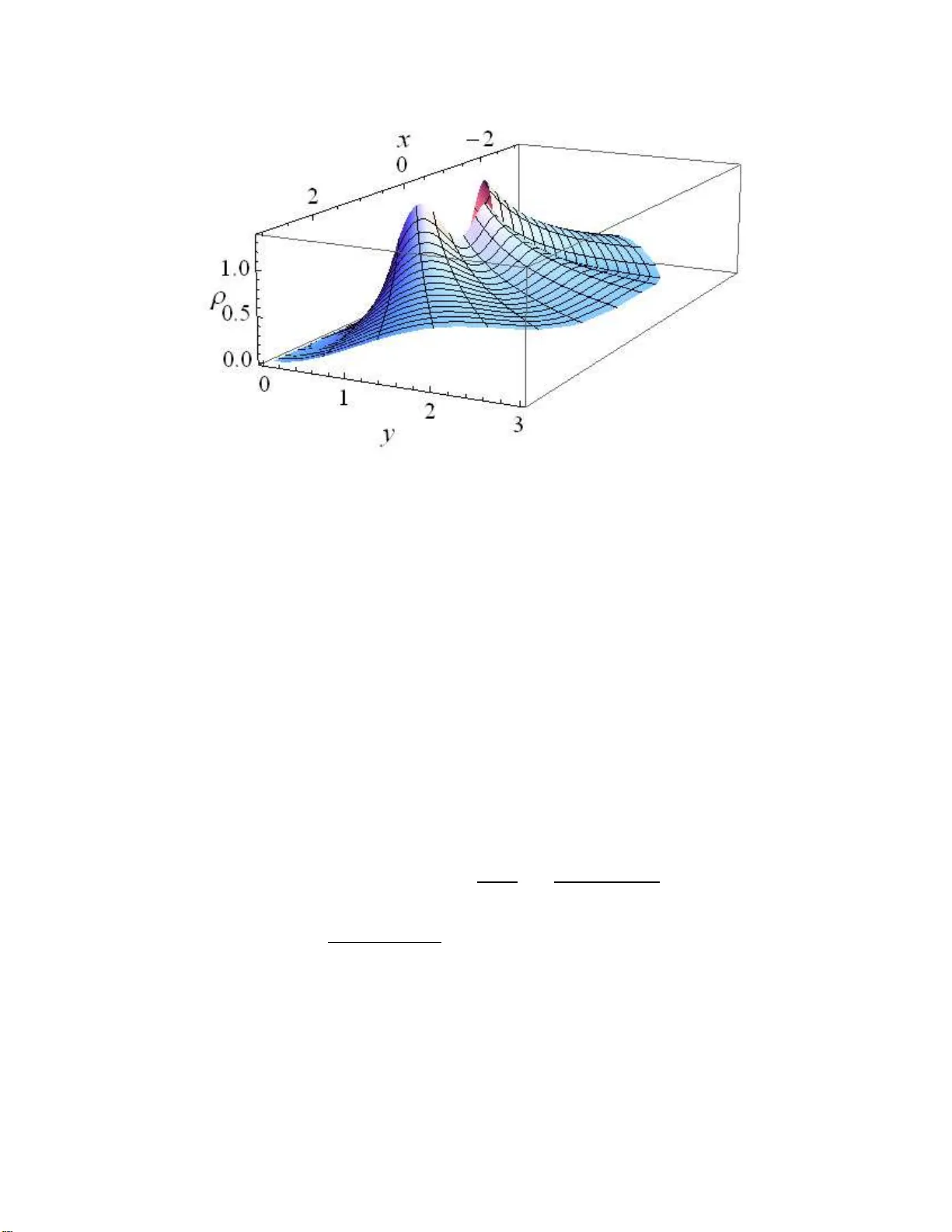
Determinan tal Correlations of Bro wnian P aths in the Plane with Nonin tersection Condition on their Lo op-Erased P arts Makik o Sato and Mak oto Katori ∗ Dep artment of Physics, F aculty of Scienc e and Engine eri n g, Chuo University, Kasuga, Bunkyo-ku, T okyo 112-8551, Jap an (Dated: 9 Marc h 2011) Abstract As an image of the many-to- one map of lo op-erasing op eration L of random walks, a self-a voiding w alk (SA W) is obtained. The loop-erased r andom w alk (LER W) mo d el is the statistical ensem ble of SA Ws such that the we igh t of eac h SA W ζ is give n b y the total we igh t of all random wal ks π wh ic h are inv erse images of ζ , { π : L ( π ) = ζ } . W e regard the Bro w nian paths as the con tinuum limits of random walks and consider the statistical ensem ble of lo op-erased Brownian paths (LEBPs) as the con tinuum limits of the LER W mo d el. F ollo wing th e theory of F omin on nonint ersecting LER Ws, w e introdu ce a nonint ersecting system of N -tuples of LEBPs in a domain D in the complex plane, where the total weigh t of n onin tersecting LEBPs is giv en b y F omin’s determinan t of an N × N matrix whose en tr ies are b oundary Po isson k ernels in D . W e set a sequence of c ham b ers in a planar domain and observe the fir s t p assage p oints at whic h N Bro wnian p aths ( γ 1 , . . . , γ N ) first enter eac h cham b er, und er the condition that th e lo op -erased parts ( L ( γ 1 ) , . . . , L ( γ N )) mak e a system of n onin tersecting L EBPs in the d omain in the sense of F omin. W e prov e that th e correlation functions of first passage p oin ts of the Bro wnian paths of the p resen t system are generally giv en b y d etermin ants sp ecified by a con tinuous fu nction called the correlation ke rnel. The correlatio n k ern el is of Eynard-Meh ta t yp e, wh ic h has app eared in tw o-matrix mo dels and time-dep enden t matrix mo d els studied in rand om matrix theory . Conformal co v ariance of correlation f u nctions is demonstrated. P ACS num b ers: 05.40 .-a,02.5 0.-r,0 2 .30.Fn ∗ Electronic addres s: k atori@phys.ch uo-u.a c.jp 1 I. INTR ODUCTION The vicious walk er mo del introduced b y Fisher [1] is a one-dimensional system of simple symmetric random w a lks conditioned so t hat an y pairs of tra jectories of w alkers in the 1+1 dimensional spatio-temp or a l lattice are nonin tersecting. The transition pro babilit y of N vi- cious w alk ers can b e described by using a determinant of an N × N matrix, whose en tries are transition pro babilities of a single random walk er with differen t initial and final p ositions. This determinan tal expression for nonin tersecting paths is called the Ka rlin-McGregor for- m ula in probabilit y theory [2] and the Lindstr¨ om-Gessel-Viennot formula in en umerativ e com binato r ics [3, 4]. Preserving the determinantal expression for transition probability den- sities, a contin uum limit (the diffusion scaling limit) of vicious walk ers can b e t a k en and w e hav e the system of one-dimensional Brownian motions conditioned nev er t o collide with eac h other [5–7]. The imp ortan t fact is that the obtained in teracting particle systems de- fined in the con tin uous spatio-temp oral pla ne, whic h can b e called the no ncolliding Brownian motion [8], is iden tified with Dyson’s Brownian motion mo del with β = 2 [9], whic h w a s originally in tro duced as a sto chastic pro cess of eigen v alues of an Hermitian- ma t r ix v a lued Bro wnian motion in the random matr ix theory [10, 11]. The notion of corresp ondence b e- t wee n nonequilibrium particle system s a nd random matrix theories is v ery useful [12] a nd spatio-temp oral correlation functions of noncolliding diffusion pro cesses hav e b een deter- mined explicitly not only for the systems with finite n umbers of part icles but also fo r the systems with infinite n um b ers of particles [8, 13 – 16]. In the presen t pap er, we study a system of contin uous paths not in the 1+1 dimensional spatio-temp oral plane but in the t w o dimensional plane ( i.e . the complex plane C = { z = x + i y } with i = √ − 1), which will b e called the nonin tersecting system o f lo op-erased Bro wnian paths (LEBPs) [17]. A v ersion of nonin tersection condition is imp o sed b et w een the paths ( see Eq.(7) b elo w), and then the t o tal weigh t of LEBPs is given by F omin’s determinan t [18, 19] instead of the determinant of Kar lin- McGregor (and of Lindstr¨ om-Gessel-Viennot). There the entries of matrix whose determinan t is considered ar e the normal deriv ative s at b oundary p oin ts of domain of the Green’s f unctions of the tw o -dimensional P oisson equation (the P oisson k ernels and the b oundar y P oisson k ernels) instead of the transition probability densities [17]. In Section I I, w e define the LER W mo del and briefly review F omin’s theory of noninter- 2 secting LER Ws. As the con tinuum limit of LER W mo del, the statistical ensem ble of LEBPs is in tro duced in Section I I I.A. There the Green’s f unction, the P oisson k ernel, and the b oundary P oisson k ernel are defined f or the Brow nian motion in a domain in the t wo-dimensional plane or the complex plane C . Then fo r an L × π rectangular do ma in R L in C , F omin’s determinan t of the b oundary P oisson k ernels and of the Poiss on k ernels for N -t uples of Brownian paths are studied, and nonin tersecting system o f LEBPs a re constructed in Section I I I.B (see Fig .3). In Section I I I.C, w e set tw o rectangular domains on C adjacen t to eac h other at a v ertical line Re z = x , in which N Brownian paths are running from the left rectangular domain to t he right one through the line Re z = x (see Fig.4). W e imp o se the condition that the lo op-erased parts of Brownian paths are nonin t ersecting in t he sense of F omin as expressed b y Eq.(7). Under this condition, the probability densit y function of the first passage p oin ts on the line Re z = x , at whic h the N Brow nian paths en ter the rig h t rectangula r domain from t he left do main, are giv en as Eqs.(36) f or L < ∞ a nd (39) for L → ∞ , resp ectiv ely . In Section I I I.D, we consider a sequenc e of M + 1 rectangular domains on C , M ∈ N ≡ { 1 , 2 , . . . } , where the m -th domain and the ( m + 1)-th domain are adjacent at t he line Re z = x m , 1 ≤ m ≤ M . N -tuples of Brownian paths are running from the left to the righ t (see Fig.5) under the condition that their lo op-erased part s mak e a nonin tersecting system of LEBPs. The probabilit y densit y function of join t distributions of first passage p oin ts at M lines Re z = x m , 1 ≤ m ≤ M , of the Brownian paths ar e determined as Eqs .(43 ) fo r L < ∞ and (44 ) fo r L → ∞ , resp ectiv ely . In Section IV, a sp ecial initia l condition is a ssumed when the N -tuples of Brow nian paths start fro m the left b oundary of the leftmost do main. In this sp ecial case, we can explicitly obtain all m ultiple correlatio n functions of first passage p oints on the lines Re z = x m , 1 ≤ m ≤ M for an y M ∈ N , in which they are give n by determinan ts (Theorem 1) . The correlation kernel, whic h completely sp ecifies the determinan ts, a r e giv en b y Eqs.(54) and (55). The statistical ensem ble of p oints whose correlation functions are generally expressed b y determinan ts with a correlation k ernel is called a determinantal p oint pr o c ess or a F erm ion p oint pr o c es s in pro babilit y theory [20– 22]. It should b e no t ed that the presen t correlation k ernel is asymmetric K π / 2 N ( x, θ ; x ′ , θ ′ ) 6 = K π / 2 N ( x ′ , θ ′ ; x, θ ) for x 6 = x ′ as shown by Eqs.(54) and (55). This asymmetric correlation k ernel is of Eynar d -Mehta typ e [23], whic h has b een studied in tw o-matrix mo dels and time-dep enden t matrix mo dels in random matrix theory 3 [5, 10 , 11]. Since the Bro wnian motions and their lo op-erased parts on C are c o nformal ly invari- ant [1 7], our correlation k ernel is c onformal ly c ov ariant . In Section V, the determinan tal correlation functions in the half- infinite-strip domain R ≡ lim L →∞ R L = { z ∈ C : Re z > 0 , 0 < Im z < π } giv en b y Theorem 1 is mapp ed to the domain Ω = { z = r e i θ ∈ C : r > 1 , 0 < θ < π } (Corollary 2). There n umerical plots of the densit y f unction and the t w o- p oint corrrelation functions in the domain Ω are sho wn b y figures. Concluding remarks are giv en in Section VI. App endix A is prepared to deriv e the for- m ulas of the Poiss on kernel and the b oundary P oisson k ernel used in the text. I I. LOO P-ERASED RANDOM W ALKS AND FOMIN’S DETERMINANT W e consider an undirected planar lattice consisting of a set of v ertices ( sites) V = { v j } and a set o f edges (b onds) E = { e j } . T ogether with a set of the w eigh t functions of the edges W = { w ( e ) } e ∈ E , a netw ork Γ = ( V , E , W ) is defined. F or a, b ∈ V , let π b e a wa lk given by π : a = v 0 e 1 → v 1 e 2 → v 2 e 3 → · · · e m → v m = b (1) where the length of w a lk is | π | = m ∈ N and, for each 0 ≤ j ≤ m − 1, v j and v j +1 are nearest-neigh b oring ve rtices in V and e j ∈ E is the edge connecting these tw o v ertices. W e will shorten (1 ) to π : a → b , or a π → b . The we igh t of π is giv en b y w ( π ) = Q m j =1 w ( e j ). F o r an y tw o vertice s of a, b ∈ V , the G reen’s function o f walks { π : a → b } is defined b y W ( a, b ) = X m X π : a → b, | π | = m w ( π ) . (2) The matrix W = ( W ( a, b )) a,b ∈ V is called the wa l k ma trix of the net w or k Γ. The lo op- erased part of π , denoted by L ( π ), is defined recursiv ely as f o llo ws. If π do es not hav e self-inte rsections, that is, all vertice s v j , 0 ≤ j ≤ m are distinct, then L ( π ) = π . Otherwise, set L ( π ) = L ( π ′ ), where π ′ is obtained by remo ving the first lo op it makes . In other words , if ( k , ℓ ) , k < ℓ is the smallest pair in the index set { j : 0 ≤ j ≤ m } of { v j } m j =0 in the sequence (1) suc h that v k = v ℓ , then the subsequence v k e k +1 → v k +1 e k +2 → · · · e ℓ → v ℓ is remo v ed from π to obtain π ′ . 4 The lo op-erasing op erator L maps ar bit r a ry w alks to ‘walks without self-in tersections’, whic h are usually called self-avo i d ing walks ( SA Ws). Note that the map is man y-to-one; if ζ is a SA W obtained by applying L , the set of in ve rse images { π : L ( π ) = ζ } has more than one elemen t in general. F or eac h SA W ζ , the w eigh t e w ( ζ ) is given by e w ( ζ ) = X π : L ( π )= ζ w ( π ) . (3) W e consider the statistical ensem ble of SA Ws with the w eight (3) and call it lo op-e r as e d r andom walks (L ER Ws) [19, 24]. Note that the LER W mo del is differen t f r o m the SA W mo del, in the sense tha t, though the configuration space of walks are the same, the w eigh t of each w a lk is differen t from eac h other. In the SA W mo del w e consider a statistical ensem ble of SA Ws with the w eight ˆ w ( ζ ) = e − β | ζ | , where e β is the SA W connectiv e constan t, while the w eight of SA W in the LER W mo del is give n b y the sum of w eights of all w alks, whic h are t he inv erse images of the pro jection L as sho wn b y (3). Assume that A = ( a 1 , a 2 , . . . , a N ) ⊂ V and B = ( b 1 , b 2 , . . . , b N ) ⊂ V are chose n so that an y w alk from a j to b k in tersects any w alk from a j ′ , j ′ > j , to b k ′ , k ′ < k . Th e w eight of N -t uples o f indep endent w alks a 1 π 1 → b 1 , . . . , a N π N → b N is giv en by the pro duct of N w eigh ts Q N ℓ =1 w ( π ℓ ). Then we consider N - tuples of w alks ( π 1 , π 2 , . . . , π N ) conditio ned so that, for an y 1 ≤ j < k ≤ N , the walk π k has no common v ertices with the lo op-erased part of π j ; L ( π j ) ∩ π k = ∅ , 1 ≤ j < k ≤ N . (4) See Fig.1. By definition, L ( π k ) is a part of π k , and th us nonin tersection of any pair of lo op-erased parts is concluded from (4); L ( π j ) ∩ L ( π k ) = ∅ , 1 ≤ j < k ≤ N . (5) F omin prov ed tha t total w eight of N -tuples of w alks satisfying such a v ersion of nonin- tersection condition is giv en by the minor of w alk matrix, det( W A,B ) ≡ det a ∈ A,b ∈ B ( W ( a, b )) [18]. This minor is called F omin ’s determinant in t he presen t pap er and F omin’s formula is expresse d b y the equality [17 – 19] det( W A,B ) = X L ( π j ) ∩ π k = ∅ , j 0. F or a domain D ⊂ C , let p D ( t, a, b ) b e the transition probability density of the complex Bro wnian motion from a ∈ D to b ∈ D with duration t ≥ 0 with the absorbing b oundary condition at ∂ D . The Green’s function for this Brownian motion is defined by G D ( a, b ) = Z ∞ 0 p D ( t, a, b ) dt. (8) 7 (Note that the summation with resp ect to the length of walk m = | π | in (2 ) for the Green’s function of random walk s is here replaced b y the integral with resp ect to duration of time of Bro wnian motion.) It is also the Green’s function for the Pois son equation ∆ a G D ( a, b ) = δ ( a − b ), where ∆ a is the Laplacian with resp ect to the v aria ble a , with the Dir ichlet b oundary condition G D ( a, b ) = 0 on a ∈ ∂ D . The complex Brownian mot ion is conformally in v ariant in the sense tha t the G reen’s function in a domain G D ( a, b ) , a, b ∈ D has the prop erty G D ( a, b ) = G D ′ ( f ( a ) , f ( b )) (9) for a ny conformal transformation f : D → D ′ . Then w e will select a suitable domain D in C suc h that the P oisson equation can b e analytically solv ed a nd explicitly determine the Green’s function G D , and then, t ho ugh the equalit y (9), w e can obta in G D ′ for other domain D ′ b y an appropriate confo rmal transformation. F or a ∈ D and b ∈ ∂ D , t he Po i s son kern el H D ( a, b ) is defined by H D ( a, b ) = 1 2 lim ε → 0 1 ε G D ( a, b + ε n b ) , (10) where n b denotes the in ward unit nor mal v ector at b ∈ ∂ D . By this definition, we see that H D ( a, b ) solve s the Laplace equation ∆ a H D ( a, b ) = 0 f o r a ∈ D , that is, H D ( a, b ) is a harmonic function of a ∈ D , and satisfies the b o undar y condition lim a → α : a ∈ D H D ( a, b ) = δ ( α − b ) for α ∈ ∂ D . (11) Moreo ver, we define the b ounda ry Poisson kernel H ∂ D ( a, b ) f or a, b ∈ ∂ D by H ∂ D ( a, b ) = lim ε → 0 1 ε H D ( a + ε n a , b ) . (12) F rom the conformal in v ariance (9) of the G reen’s function G D , the follo wing c onf o rmal c ovarianc e prop erties are deriv ed; if f : D → D ′ is a conformal transformation, H D ( a, b ) = | f ′ ( b ) | H D ′ ( f ( a ) , f ( b )) , a ∈ D , b ∈ ∂ D , (13) H ∂ D ( a, b ) = | f ′ ( a ) || f ′ ( b ) | H ∂ D ′ ( f ( a ) , f ( b )) , a, b ∈ ∂ D . (14) See Section 2 .6 of [17] and Chapters 2 and 5 of [29] for further information a b out Poiss on k ernels, b oundary P oisson kerne ls a nd their conformal cov ariance. W e will study F omin’s determinan ts of the fo r m det 1 ≤ j,k ≤ N [ H D ( a j , b k )] and det 1 ≤ j,k ≤ N [ H ∂ D ( a j , b k )] in t he follo wing. 8 B. System in a rectangular domain and the crossing exp onen t In order to giv e explicit express ions fo r Pois son k ernel and b oundary P oisson k ernel, now w e fix the domain D as the following rectangular domain R L = n z = x + i y ∈ C : 0 < x < L, 0 < y < π o , L > 0 . (15) As shown in App endix A, fo r 0 < x < L, 0 < θ , ρ, ϕ < π , the P oisson k ernel connecting an inner p oin t x + i θ ∈ D a nd a p oin t L + i ρ at the righ t b oundary of R L , ∂ R R L = { L + i y : 0 < y < π } , is given by H R L ( x + i θ, L + i ρ ) = 2 π ∞ X n =1 sinh( nx ) sin( nθ ) sin( nρ ) sinh( nL ) , (16) and the b oundary P oisson k ernel connecting a b oundary p oin t i ϕ on the left b oundary of R L , ∂ R L L = { i y : 0 < y < π } , and a b oundar y p oint L + i ρ on the righ t b oundar y ∂ R R L is giv en b y H ∂ R L (i ϕ, L + i ρ ) = 2 π ∞ X n =1 n sin ( nϕ ) sin( nρ ) sinh( nL ) . (17) The definitions (8 ), (10) and (12) imply that H R L ( x + i θ , L + i ρ ) d ρ give s the total w eight of t he paths of complex Bro wnian motion starting fr o m the inner p oint x + i θ ∈ R L , whic h mak e first exit from the domain R L at a p o int in the interv al [ L + i ρ, L + i( ρ + dρ )] on the righ t b oundary ∂ R R L , and that H ∂ R L (i ϕ, L + i ρ ) d ϕdρ giv es the total weigh t o f the paths of complex Bro wnian mot io n, whic h enter R L at a p oin t in [i ϕ, i( ϕ + dϕ )] on ∂ R L L , and mak e first exit fr o m R L at a p o in t in [ L + i ρ, L + i( ρ + d ρ )] on ∂ R R L . (See Fig.2.) By the conserv ation of probability , the follo wing equalities should b e satisfied; for 0 < x < x ′ < L , H R L ( x + i θ , L + i ρ ) = Z π 0 dθ ′ H R x ′ ( x + i θ, x ′ + i θ ′ ) H R L ( x ′ + i θ ′ , L + i ρ ) , (18) H ∂ R L (i ϕ, L + i ρ ) = Z π 0 dθ ′′ H ∂ R x (i ϕ, x + i θ ′′ ) H R L ( x + i θ ′′ , L + i ρ ) , (19) 0 < ϕ, ρ < π . As a matter of course, t he v alidit y of t hem can b e directly confirmed by apply- ing the orthogonality relation of the sine functions, R π 0 dθ sin( nθ ) sin( mθ ) = ( π / 2) δ nm , n, m ∈ N , to the expressions (16) and (17). W e note that in Eq.(18) the p o int x ′ + i θ ′ is regarded as the first p assage p oin t on the line Re z = x ′ in R L of the Brown ian path running from x + i θ ∈ R L to L + i ρ ∈ ∂ R R L , and similarly that in Eq.(19 ) x + i θ ′′ is rega r ded as the first 9 FIG. 2: T h e broken curve denotes a path of complex Bro wn ian motion starting fr om an in ner p oin t x + i θ ∈ R L , which m ak es fir st exit fr om R L at L + i ρ ∈ ∂ R R L . The solid curv e do es a path of complex Bro wn ian motion, which enters R L at i ϕ ∈ R L L and mak es first exit fr om R L at L + i ρ ∈ ∂ R R L . T h e former path cont ributes to H R L ( x + i θ , L + i ρ ) and the latter do es to H ∂ R L (i ϕ, L + i ρ ), r esp ectiv ely . The p oin t x ′ + i θ ′ is the fir st p assage p oint on the line R e z = x ′ in R L of the former path, and the p oint x + i θ ′′ is the first p assage p oint on the line Re z = x in R L of the latter path. passage p oin t on the line Re z = x in R L of the Brownian path running from i ϕ ∈ ∂ R L L to L + i ρ ∈ ∂ R R L . See F ig.2. F or N ∈ N , let W π N ≡ { θ = ( θ 1 , θ 2 , . . . , θ N ) : 0 < θ 1 < θ 2 < · · · < θ N < π } . Then, for ϕ = ( ϕ 1 , . . . , ϕ N ) ∈ W π N , ρ = ( ρ 1 , . . . , ρ N ) ∈ W π N , consider F omin’s determinan t f ∂ N ( L, ρ | ϕ ) ≡ det 1 ≤ j,k ≤ N h H ∂ R L (i ϕ j , L + i ρ k ) i . (20) If we write the path o f j -th Bro wnian motio n, 1 ≤ j ≤ N , whic h en ters R L at i ϕ j ∈ ∂ R L L and mak es first exit from R L at L + i ρ j ∈ ∂ R R L as γ j , then (20 ) giv es the t o tal w eight of the N -t uples of paths ( γ 1 , . . . , γ N ) satisfying the noninterse ction condition with the lo op- erased parts (7). W e note aga in that it is a sufficien t condition for L ( γ j ) ∩ L ( γ k ) = ∅ , 1 ≤ j < k ≤ N . (21) See Fig .3. 10 FIG. 3: The condition (7) is illustrated for k = 3 , N = 3. The Bro wnian path γ 3 : i ϕ 3 → L + i ρ 3 in R L can b e self-in tersecting, but it do es not in tersect with L ( γ 1 ) : i ϕ 1 → L + i ρ 1 nor L ( γ 2 ) : i ϕ 2 → L + i ρ 2 . By d efinition L ( γ 3 ) is a p art of γ 3 , and th us L ( γ 1 ) ∩ L ( γ 3 ) = ∅ and L ( γ 2 ) ∩ L ( γ 3 ) = ∅ . By multilinearlit y of the determinan t, w e find that Eq.(20) with Eq.(17) is written as f ∂ N ( L, ρ | ϕ ) = 2 π N X n =( n 1 ,...,n N ) ∈ N N N Y j =1 n j sinh( n j L ) × 1 N ! X σ ∈ S N det 1 ≤ j,k ≤ N h sin( n σ ( j ) ϕ j ) sin( n σ ( j ) ρ k ) i = 2 π N det 1 ≤ j,k ≤ N h sin( j ϕ k ) i det 1 ≤ ℓ,m ≤ N h sin( ℓρ m ) × X λ a λ ˆ s λ ( ϕ ) ˆ s λ ( ρ ) , (22) where S N is a set of all p erm utations { σ } of { 1 , 2 , . . . , N } , λ = ( λ 1 , . . . , λ N ) with λ j = n N − j +1 − ( N − j + 1) , 1 ≤ j ≤ N , and a λ = N Y j =1 λ j + N − j + 1 sinh (( λ j + N − j + 1) L ) , ˆ s λ ( ϕ ) = det 1 ≤ j,k ≤ N h sin (( λ k + N − k + 1) ϕ j ) i det 1 ≤ j,k ≤ N h sin (( N − k + 1) ϕ j ) i . (23) (This is a mo dified version of ‘Sc hur f unction expansion’ used in [8 , 12].) W e note tha t sin( ℓθ ) = sin θ 2 ℓ − 1 (cos θ ) ℓ − 1 + [( ℓ − 1) / 2] X s =1 ( − 1) s ℓ − s − 1 s (2 cos θ ) ℓ − 2 s − 1 , (24) where, fo r r ∈ R , [ r ] denotes the greatest in teger not greater than r . Then for θ = ( θ 1 , . . . , θ N ) ∈ W π N det 1 ≤ ℓ,m ≤ N h sin( ℓθ m ) i = det 1 ≤ ℓ,m ≤ N h 2 ℓ − 1 sin θ m n (cos θ m ) ℓ − 1 + O (( cos θ m ) ℓ − 3 ) oi = 2 N ( N − 1) / 2 ˆ h N ( θ ) (25) 11 with t he f unction ˆ h N ( θ ) = N Y j =1 sin θ j Y 1 ≤ k <ℓ ≤ N (cos θ ℓ − cos θ k ) . (26) Since a λ ≃ 2 N N Y j =1 ( λ j + N − j + 1) e − L P N j =1 ( λ j + N − j +1) as L → ∞ , and in part icular for ∅ = (0 , 0 , . . . , 0) a ∅ ≃ 2 N N ! e − LN ( N +1) / 2 as L → ∞ , w e can conclude from the expansion ( 2 2) t ha t f ∂ N ( L, ρ | ϕ ) ≃ 2 N ( N +1) π − N N ! e − N ( N +1) L/ 2 ˆ h N ( ϕ ) ˆ h N ( ρ ) as L → ∞ . (27) Since the simple N -pro duct of the b oundary P oisson kerne ls Q N j =1 H ∂ R L (i ϕ j , L + i ρ j ) ≃ Q N j =1 2 / { π sinh L } ≃ (4 /π ) N e − N L as L → ∞ , the ratio b ehav es Λ R L ( ϕ , ρ ) ≡ f ∂ N ( L, ρ | ϕ ) Q N j =1 H ∂ R L (i ϕ j , L + i ρ j ) ≃ c N ( ϕ , ρ ) e − ψ N L as L → ∞ (28) with ψ N = 1 2 N ( N − 1) , (29) where c N ( ϕ , ρ ) = 2 N ( N − 1) N ! ˆ h N ( ϕ ) ˆ h N ( ρ ) . The exp onen t (2 9) is called the cr o ssing e xp onent [17]. C. Probabilit y densit y function for first passage p oints of Bro wnian pat hs under- lying in nonintersecting LEBPs W e consider the in tegral of F omin’s determinan t (20) o ver all p ossible ordered sets of exits ρ ∈ W π N at the rig h t b oundary ∂ R R L , N ∂ N ( L, ϕ ) ≡ Z W π N d ρ f ∂ N ( L, ρ | ϕ ) = Z W π N d ρ det 1 ≤ j,k ≤ N h H ∂ R L (i ϕ j , L + i ρ k ) i = Z W π N d ρ det 1 ≤ j,k ≤ N Z π 0 dθ H ∂ R x (i ϕ j , x + i θ ) H R L ( x + i θ, L + i ρ k ) , (30) where d ρ = Q N j =1 dρ j , 0 < x < L , a nd Eq.(19) has b een used in the last equality . Applying the Heine iden tity Z d z det 1 ≤ j,k ≤ N h φ j ( z k ) i det 1 ≤ ℓ,m ≤ N h ψ ℓ ( z m ) = d et 1 ≤ j,k ≤ N h Z dz φ j ( z ) ψ k ( z ) i , (31) 12 whic h is v alid for square integrable functions φ j , ψ j , 1 ≤ j ≤ N , it is written as N ∂ N ( L, ϕ ) = Z W π N d ρ Z W π N d θ det 1 ≤ j,k ≤ N h H ∂ R x (i ϕ j , x + i θ k ) i det 1 ≤ ℓ,m ≤ N h H R L ( x + i θ ℓ , L + i ρ m ) i = Z W π N d θ f ∂ N ( x, θ | ϕ ) Z W π N d ρ det 1 ≤ ℓ,m ≤ N h H R L ( x + i θ ℓ , L + i ρ m ) i . (32) Then, if we introduce the integral N N ( x, L, θ ) = Z W π N d ρ f N ( x, θ ; L, ρ ) , 0 < x < L, (33) of F omin’s determinan t f o r the Poiss on kerne ls f N ( x, θ ; L, ρ ) = de t 1 ≤ j,k ≤ N h H R L ( x + i θ j , L + i ρ k ) i , (34) θ , ρ ∈ W π N , and divide t he b oth sides o f (32 ) by N ∂ N ( L, ϕ ), we obtain the equalit y 1 = Z W π N d θ f ∂ N ( x, θ | ϕ ) N N ( x, L, θ ) N ∂ N ( L, ϕ ) . (35) Then, giv en ϕ ∈ W π N , if we put p L N ( x, θ | ϕ ) = f ∂ N ( x, θ | ϕ ) N N ( x, L, θ ) N ∂ N ( L, ϕ ) , 0 < x < L, (36) for θ ∈ W π N , it can b e regarded as the probability densit y function. As illustrated in Fig.4, here w e consider t he rectangular domain (15) as a union of the tw o rectangular domains R x = { z ∈ C : 0 < Re z < x, 0 < Im z < π } and R { x,L } = { z ∈ C : x ≤ Re z < L, 0 < Im z < π } , whic h are a djacen t to eac h other a t a line Re z = x . W e ha ve considered N -t uples of Br ownian paths ( γ 1 , . . . , γ N ) starting from (i ϕ 1 , . . . , i ϕ N ), all of whic h run inside of the domain R L = R x ∪ R { x,L } un til arriving a t the righ t b o undary ∂ R R L , under the condition that ( L ( γ 1 ) , . . . , L ( γ N )) ma kes a system of nonin tersecting LEBPs in the sense of F omin (7). In an ensem ble of suc h N - tuples of Bro wnian paths, Eq.(36) giv es the probability densit y of the ev en t suc h that the first passage p oints of ( γ 1 , . . . , γ N ) on the line Re z = x are ( x + i θ 1 , . . . , x + i θ N ). That is, for 1 ≤ j ≤ N , γ j mak es a first exit fro m t he left rectangular domain R x and en t ers the righ t rectangular domain R { x,L } at x + i θ j . The path γ j , whic h made a first exit from R x at x + i θ j , can reen ter R x at differen t p oint x + i θ ′ on the line Re z = x . As sho wn b y the path γ 2 starting f r o m i ϕ 2 in Fig.4 , the path γ j can make a lo op passing the line Re z = x , a nd if the first passage p oin t x + i θ j is included in suc h a lo op, that p oin t can not b e included in L ( γ j ). In other w ords, Eq.(36) giv es the probabilit y density for 13 FIG. 4: Thr ee Bro wn ian paths ( γ 1 , γ 2 , γ 3 ) in R L = R x ∪ R { x,L } starting from (i ϕ 1 , i ϕ 2 , i ϕ 3 ) and arriving at ∂ R R L whose lo op-erased parts ( L ( γ 1 ) , L ( γ 2 ) , L ( γ 3 )) are nonintersect ing in the sense of F omin. T he first p assage p oin ts on the line Re z = x are ( x + i θ 1 , x + i θ 2 , x + i θ 3 ). Since x + i θ 2 is in a lo op of γ 2 as s ho w n b y a b rok en cur v e, it is not included in L ( γ 2 ). The p robabilit y densit y of p oints ( x + i θ 1 , x + i θ 2 , x + i θ 3 ) is giv en b y Eq.(36). N noninte rsecting lo op-erased Brownian paths ( L ( γ 1 ) , . . . , L ( γ N )) starting fro m the p oints (i ϕ 1 , . . . , i ϕ N ) and satisfying the condition (7) in R L , suc h that the underlying Bro wnian paths ( γ 1 , . . . , γ N ) are realized so that they first arriv e at the vertical line Re z = x < L at ( x + i θ 1 , . . . , x + i θ N ). No w we consider the system in the limit L → ∞ . By applying the a symptotics (27), w e ha ve N ∂ N ( L, ϕ ) = Z W π N d ρ f ∂ N ( L, ρ | ϕ ) ≃ 2 N ( N +1) π − N N ! e − N ( N +1) L/ 2 ˆ h N ( ϕ ) × Z W π N d ρ ˆ h N ( ρ ) , (37) as L → ∞ . Similarly , w e can obtain the fo llowing asymptotics of (33) N N ( x, L, θ ) = Z W π N d ρ det 1 ≤ j,k ≤ N " 2 π ∞ X n =1 sinh( nx ) sin( nθ j ) sin( nρ k ) sinh( nL ) # ≃ 2 N ( N +1) π − N e − N ( N +1) L/ 2 ˆ h N ( θ ) N Y j =1 sinh( j x ) Z W π N d ρ ˆ h N ( ρ ) , (38) 14 as L → ∞ . Then, g iv en ϕ ∈ W π N , for θ ∈ W π N , p N ( x, θ | ϕ ) ≡ lim L →∞ p L N ( x, θ | ϕ ) = C N ( x ) f ∂ N ( x, θ | ϕ ) ˆ h N ( θ ) ˆ h N ( ϕ ) , 0 < x < ∞ , (39) where C N ( x ) = 1 N ! N Y j =1 sinh( j x ) . (40) D. Join t distribution of first passage p oin ts in a sequence of c ha m b ers Let M ∈ N a nd 0 < x 1 < x 2 < · · · < x M < L < ∞ . Here w e consider M ve rtical lines in R N at Re z = x m , 1 ≤ m ≤ M . F or ( x m , x m +1 ), θ ( m ) = ( θ ( m ) 1 , . . . , θ ( m ) N ) ∈ W π N , θ ( m +1) = ( θ ( m +1) 1 , . . . , θ ( m +1) N ) ∈ W π N , 1 ≤ m ≤ M − 1, w e define q L N ( x m , θ ( m ) ; x m +1 , θ ( m +1) ) = N N ( x m +1 , L, θ ( m +1) ) N N ( x m , L, θ ( m ) ) f N ( x m , θ ( m ) ; x m +1 , θ ( m +1) ) . (41) Then b y definition (36), w e hav e Z W π N d θ (1) p L N ( x 1 , θ (1) | ϕ ) q L N ( x 1 , θ (1) ; x 2 , θ (2) ) = Z W π N d θ (1) f ∂ N ( x 1 , θ (1) | ϕ ) N N ( x 1 , L, θ (1) ) N ∂ N ( L, ϕ ) N N ( x 2 , L, θ (2) ) N N ( x 1 , L, θ (1) ) f N ( x 1 , θ (1) ; x 2 , θ (2) ) = N N ( x 2 , L, θ (2) ) N ∂ N ( L, ϕ ) Z W π N d θ (1) f ∂ N ( x 1 , θ (1) | ϕ ) f N ( x 1 , θ (1) ; x 2 , θ (2) ) . By t he Heine iden tity (31) and the equality (19), Z W π N d θ (1) f ∂ N ( x 1 , θ (1) | ϕ ) f N ( x 1 , θ (1) ; x 2 , θ (2) ) = Z W π N d θ (1) det 1 ≤ j,k ≤ N h H ∂ R x 1 (i ϕ j , x 1 + i θ (1) k ) i det 1 ≤ ℓ,m ≤ N h H R x 2 ( x 1 + i θ (1) ℓ , x 2 + i θ (2) m ) i = det 1 ≤ j,k ≤ N Z π 0 dθ (1) H ∂ R x 1 (i ϕ j , x 1 + i θ (1) ) H R x 2 ( x 1 + i θ (1) , x 2 + i θ (2) k ) = det 1 ≤ j,k ≤ N h H ∂ R x 2 (i ϕ j , x 2 + i θ (2) k ) i = f ∂ N ( x 2 , θ (2) | ϕ ) , and th us we obta in the equalit y p L N ( x 2 , θ (2) | ϕ ) = Z W π N d θ (1) p L N ( x 1 , θ (1) | ϕ ) q L N ( x 1 , θ (1) ; x 2 , θ (2) ) . 15 Ob viously this equalit y can b e generalized as p L N ( x m +1 , θ ( m +1) | ϕ ) = Z W π N d θ ( m ) p L N ( x m , θ ( m ) | ϕ ) q L N ( x m , θ ( m ) ; x m +1 , θ ( m +1) ) (42) for 1 ≤ m ≤ M − 1. Then, giv en ϕ ∈ W π N , if we in tro duce a function of θ ( m ) = ( θ ( m ) 1 , . . . , θ ( m ) N ) ∈ W π N , 1 ≤ m ≤ M by p L N ( x 1 , θ (1) ; x 2 , θ (2) ; . . . ; x M , θ ( M ) | ϕ ) = p L N ( x 1 , θ (1) | ϕ ) M − 1 Y m =1 q L N ( x m , θ ( m ) ; x m +1 , θ ( m +1) ) = N N ( x M , L, θ ( M ) ) N ∂ N ( L, ϕ ) f ∂ N ( x 1 , θ (1) | ϕ ) M − 1 Y m =1 f N ( x m , θ ( m ) ; x m +1 , θ ( m +1) ) , (43) it can b e r ega rded a s the pr o babilit y densit y function, since it is w ell normalized a s M Y m =1 Z W π N d θ ( m ) p L N ( x 1 , θ (1) ; . . . ; x M , θ ( M ) | ϕ ) = Z W π N d θ ( M ) p L N ( x M , θ ( M ) | ϕ ) = 1 b y (42) and (3 5). As show n by Fig .5, here w e think that R L has M + 1 ‘cham b ers’ R { x m − 1 ,x m } , 1 ≤ m ≤ M + 1; R L = S M +1 m =1 R { x m − 1 ,x m } with x 0 ≡ 0 , x M +1 = L , where R { x m − 1 ,x m } and R { x m ,x m +1 } are adjacen t to eac h other at the line Re z = x m , 1 ≤ m ≤ M . Under the initial condition that γ j starts fro m i ϕ j , 1 ≤ j ≤ N and the noninters ection condition of ( L ( γ 1 ) , . . . , L ( γ N )) in the sense of F omin (7), Eq.(43) gives the probabilit y densit y function for joint distributions of the first passage p oin ts ( x m + i θ ( m ) 1 , . . . , x m + i θ ( m ) N ) at whic h γ j ’s first pass from t he m -th c ham b er R { x m − 1 ,x m } to the ( m + 1 )-th ch am b er R { x m ,x m +1 } on the line R e z = x m , 1 ≤ m ≤ M . By t he a symptotics (3 7) a nd (38), the limit L → ∞ is taken as p N ( x 1 , θ (1) ; . . . ; x M , θ ( M ) | ϕ ) ≡ lim L →∞ p L N ( x 1 , θ (1) ; . . . ; x M , θ ( M ) | ϕ ) = C N ( x M ) ˆ h N ( θ ( M ) ) ˆ h N ( ϕ ) f ∂ N ( x 1 , θ (1) | ϕ ) M − 1 Y m =1 f N ( x m , θ ( m ) ; x m +1 , θ ( m +1) ) , (44) θ ( m ) ∈ W π N , 1 ≤ m ≤ M , given the initial conditio n ϕ ∈ W π N . 16 FIG. 5: Eq.(43) giv es the probabilit y densit y fun ction for j oin t d istributions of M sets of first passage p oin ts on the lin es R e z = x m , 1 ≤ m ≤ M , of N -tuples of Brownian p aths un derlying in the noninte rsecting LEBPs. IV. DETERMINANT AL CO RRELA TIO N FUNC T IONS A. Sp ecial initial condition Let A λ ( ϕ ) b e the n umerator of ˆ s λ ( ϕ ) give n by (23). By the expansion form ula (24), we find A λ ( ϕ ) = de t 1 ≤ j,k ≤ N h sin ϕ j n 2 λ k + N − k (cos ϕ j ) λ k + N − k + O (( cos ϕ j ) λ k + N − k − 2 ) oi = 2 P N k =1 ( λ k + N − k ) N Y j =1 sin ϕ j det 1 ≤ j,k ≤ N h (cos ϕ j ) λ k + N − k + O (( cos ϕ j ) λ k + N − k − 2 ) i = 2 P N k =1 ( λ k + N − k ) ˆ h N ( ϕ ) ˜ A λ ( ϕ ) , (45) where ˜ A λ ( ϕ ) is a symme tric function of { cos ϕ j } N j =1 with degree P N k =1 λ k . If w e write ( π / 2 , . . . , π / 2) as π / 2 , lim ϕ → π / 2 ˜ A λ ( ϕ ) = δ λ, ∅ . Then (2 2 ) and ( 2 5) g iv e lim ϕ → π / 2 f ∂ N ( L, ρ | ϕ ) ˆ h N ( ϕ ) = 2 N 2 π N C N ( L ) ˆ h N ( ρ ) (46) with t he f actor (4 0). Applying (4 6) t o (39 ), we obtain t he limit distribution p π / 2 N ( x, θ ) ≡ lim ϕ → π / 2 p N ( x, θ | ϕ ) = 2 N 2 π N ( ˆ h N ( θ ) ) 2 . (47) The fact that it is w ell normalized, i.e. R W π/ 2 N p π / 2 N ( θ ) d θ = 1, is directly confirmed b y using 17 the γ = 1 case of ‘the Tche bic hev ve rsion’ of the Selb erg in tegral Z 1 − 1 · · · Z 1 − 1 Y 1 ≤ ℓ x ′ , (55) 0 < x, x ′ < ∞ , 0 < θ , θ ′ < π . By using the terminology of pro babilit y theory , w e can sa y that the ensem ble of first passage p oin ts { x m + i θ ( m ) j : 1 ≤ j ≤ N , 1 ≤ m ≤ M } is a determinantal p oint pro cess (or a F ermion p oint pro cess) [20 – 22]. Note that t he correlatio n k ernel giv en b y (54) and (55) is asymmetric in the ordering o f x and x ′ ; K π / 2 N ( x, θ ; x ′ , θ ′ ) 6 = K π / 2 N ( x ′ , θ ′ ; x, θ ) for x 6 = x ′ . Suc h kind of asymmetric correlation kerne l w as first deriv ed by Eynard and Meh ta for tw o- matrix mo dels in random matrix theory [10, 23]. See [11, 30, 31] for r ecent study on t he Eynard-Meh ta t yp e determinantal correlations. 19 FIG. 6: Conformal transformation by f ( z ) = e z from the d omain R = { z ∈ C : Re z > 0 , 0 < Im z < π } to the domain Ω = { z ∈ C : | z | > 1 , 0 < arg ( z ) < π } . The N -tuples of Bro wnian paths in R all starting fr om the p oin t i π / 2 are conformally transformed in to the paths in Ω all starting from the p oin t i. V. CONFORMAL T RANSFORMA TION TO OTHER DO MAIN In the previous sec tion, w e considered a noninte rsecting system o f LEBPs in the half - infinite-strip domain, whic h is divided in to M rectangular cham b ers and o ne ha lf -infinite strip b y M stra ig h t lines on Re z = x m , 1 < x 1 < · · · < x M < ∞ . F or the underlying system of N -tuples of Bro wnian paths, whose lo op- erased parts giv e the nonin tersecting LEBPs, Theorem 1 giv es the determinan tal correlatio n functions for first passage p oin ts o n the lines Re z = x m , 1 ≤ m ≤ M . In order to demonstrate that the result can b e conformally mapp ed to other domain consisting of a sequence of c hambers in differen t shap es, here w e sho w a conformal transformation by an en tir e function w = f ( z ) = e z . By this confo rmal transformation, the half - infinite-strip do ma in R = { z ∈ R : R e z > 0 , 0 < Im z < π } is mapp ed to the domain Ω = { z = r e i θ ∈ C : r > 1 , 0 < θ < π } . The rectangular ch am b ers R { x m − 1 ,x m } , 1 ≤ m ≤ M , are mapp ed to the c hambers Ω { r m − 1 ,r m } = { z = r e i θ ∈ Ω : r m − 1 ≤ r < r m } with r m = e x m , 1 ≤ m ≤ M , and the b oundary lines { z ∈ R : Re z = x m } are to the arcs of semicircles { z ∈ Ω : | z | = r m } , 1 ≤ m ≤ M . By this conformal transformation, t he paths o f complex Brow nian mot ions in R all start- ing fro m the p oin t i π / 2 are mapp ed to those in Ω all starting from the p oint i as sho wn by Fig.6. The confo rmal inv ariance of the probabilit y la w o f complex Brownian motions (9) implies 20 the following equality b et w een the m ultiple correlation functions ρ π / 2 N defined on R and ˆ ρ i N defined on Ω, ρ π / 2 N ( x 1 , θ (1) N 1 ; . . . ; x M , θ ( M ) N M ) M Y m =1 d θ ( m ) N m = ˆ ρ i N ( w (1) N 1 ; . . . ; w ( M ) N M ) M Y m =1 d w ( m ) N m , (56) where w ( m ) N m = ( w ( m ) 1 , . . . , w ( m ) N m ) with w ( m ) j = f ( x m + i θ ( m ) j ) = e x m +i θ ( m ) j = r m e i θ ( m ) j , r m ≡ e x m , 1 ≤ m ≤ M . Since 0 < x 1 < · · · < x M < ∞ are fixed, dw ( m ) j = dw ( m ) j dθ ( m ) j dθ ( m ) j = r m dθ ( m ) j , 1 ≤ m ≤ M , 1 ≤ j ≤ N m , w e hav e the fo llo wing determinan tal correlations for first passage p oints on the semicircles in Ω. Corollary 2. An y mu ltiple correlatio n function in Ω is give n by a determinan t ˆ ρ i N ( { r 1 e i θ (1) j } N 1 j =1 ; . . . ; { r M e i θ ( M ) j } N M j =1 ) = det 1 ≤ j ≤ N m , 1 ≤ k ≤ N n , 1 ≤ m,n ≤ M h ˆ K i N ( r m e i θ ( m ) j , r n e i θ ( n ) k ) i (57) with t he corr elation k ernel ˆ K i N ( r e i θ , r ′ e i θ ′ ) = 2 π r N X n =1 ( r ′ ) n − ( r ′ ) − n r n − r − n sin( nθ ) sin( nθ ′ ) , if r ≤ r ′ , ˆ K i N ( r e i θ , r ′ e i θ ′ ) = − 2 π r ∞ X n = N +1 ( r ′ ) n − ( r ′ ) − n r n − r − n sin( nθ ) sin( nθ ′ ) , if r > r ′ , (58) 1 < r , r ′ < ∞ , 0 < θ , θ ′ < π . F rom (58), we find that if w e set r = r ′ > 1 , ˆ K i N ( r e i θ , r e i θ ′ ) = 2 π r N X n =1 sin( nθ ) sin( nθ ′ ) = sin(( N + 1) θ ) sin N θ ′ − sin N θ sin(( N + 1) θ ′ ) π r (cos θ − cos θ ′ ) (59) for θ 6 = θ ′ . F ro m it the densit y function ˆ ρ i N ( r e i θ ) = lim ε → 0 ˆ K i N ( r e i θ , r e i( θ + ε ) ) is giv en as ˆ ρ i N ( r e i θ ) = 1 π r sin θ h N sin θ − cos θ cos( N θ ) sin( N θ ) + sin θ sin 2 ( N θ ) i . (60) F or N = 3 , Fig.7 sho ws the dep endence of ˆ ρ i 3 ( r e i θ ) on x = Re ( r e i θ ) = r cos θ and y = Im ( r e i θ ) = r sin θ . There are N = 3 ridges in the plots. 21 FIG. 7: (Color online) The densit y fu nction ˆ ρ i 3 ( r e i θ ) for N = 3, where x = Re ( r e i θ ) = r cos θ , y = Im ( r e i θ ) = r sin θ . Ther e are three ridges. On an a rc of semicircle | z | = r > 1 , 0 < arg( z ) < π , the t w o -p oint correlation function is giv en b y ˆ ρ i N ( r e i θ , r e i θ ′ ) = ˆ ρ i N ( r e i θ ) ˆ ρ i N ( r e i θ ′ ) − ( ˆ K i N ( r e i θ , r e i θ ′ )) 2 (61) with (59) and (60) for 0 < θ , θ ′ < π . In Fig s.8 and 9, we set r = 4 and θ = π / 2 and plot ( 61) as a function o f θ ′ for N = 5 and N = 20, respectiv ely . Due to t he nonin tersection condition for lo op-erased parts, the tw o-p oint correlation function b ecomes zero as θ ′ → θ = π / 2 . In general, for 1 < r < r ′ , 0 < θ , θ ′ < π , Corollary 2 give s the t w o- p oint correlation function as ˆ ρ i N ( r e i θ , r ′ e i θ ′ ) = ˆ ρ i N ( r e i θ ) ˆ ρ i N ( r ′ e i θ ′ ) + 4 π 2 r r ′ N X n =1 ( r ′ ) n − ( r ′ ) − n r n − r − n sin( nθ ) sin( nθ ′ ) × ∞ X m = N + 1 r m − r − m ( r ′ ) m − ( r ′ ) − m sin( mθ ′ ) sin( mθ ) (62) with (60). F or N = 3 w e set r e i θ = 2 e i π / 2 = 2 i and show b y Fig .10 the dep endence of the tw o- p oin t correlation function (6 2) on x ′ = Re ( r ′ e i θ ′ ) = r ′ cos θ ′ and y ′ = Re ( r ′ e i θ ′ ) = r ′ sin θ ′ . 22 FIG. 8: F or N = 5, the t w o-p oin t correlation function (61) on an arc of semicircle | z | = r = 4 with θ = π / 2 is sho wn as a function of θ ′ . There are N − 1 = 4 p eaks in the plot. FIG. 9: F or N = 20, the tw o-p oint corr elation function (61 ) on an arc of semicircle | z | = r = 4 with θ = π / 2 is sho wn as a function of θ ′ . VI. CONCLUDIN G REMARKS Here we discuss the infinite n umber o f paths limit, N → ∞ . When w e take this limit in (60), w e ha ve lim N →∞ 1 N ˆ ρ i N ( r e i θ ) = 1 π r . (63) 23 FIG. 10: (Color online) Two-point correlation fu nction (62 ) with N = 3 , r = 2 , θ = π / 2 is shown as a f unction of x ′ = Re ( r ′ e i θ ′ ) = r ′ cos θ ′ and y ′ = Re ( r ′ e i θ ′ ) = r ′ sin θ ′ . That is, the distribution of t he first passage p oin t b ecomes unifo r m on an arc of semicircle. If w e set r = N + u, r ′ = N + u ′ , θ = a N , θ ′ = a ′ N , then t he corr elation k ernel con ve rges to the following as N → ∞ , ˆ K i ( u, a ; u ′ , a ′ ) = lim N →∞ ˆ K i N (( N + u ) e i a/ N , ( N + u ′ ) e i a ′ / N )) = 2 π Z 1 0 e − ( u − u ′ ) s sin( as ) sin( as ′ ) ds, if u < u ′ , − 2 π Z ∞ 1 e − ( u − u ′ ) s sin( as ) sin( as ′ ) ds, if u > u ′ . (64) In t he presen t pap er, we hav e imp osed special initial conditions suc h tha t all Bro wnian paths start from a single p oint i π / 2 for the domain R and from i for the domain Ω. Study for general initial condition will b e rep or t ed elsewhere in t he futur e. A t the end of this pap er, w e note the fact that the scaling limit of LER W is describ ed b y the SLE(2) path, a ra ndo m con t in uous simple curv e generated b y the Sch ramm-Lo ewner ev olution with a sp ecial v a lue of parameter κ = 2 [2 9, 32, 33]. Kozdron [28] sho w ed that 2 × 2 F omin’s determinan t represen ting the ev en t L ( γ 1 ) ∩ γ 2 = ∅ for tw o Bro wnian paths ( γ 1 , γ 2 ) is prop ortional to the probability that γ SLE(2) ∩ γ = ∅ , where γ SLE(2) and γ denote the SLE(2) path and a Br ownian path (see also [27 ]) . On the ot her hand, Lawler and W erner ga v e a metho d to correctly add Bro wnian lo ops to a n SLE(2) path to obtain a Bro wnian 24 path [34]. Interpretation of the results rep orted in t he presen t pap er in terms of ‘mutually a v oiding SL E paths’ will b e an in teresting future problem. Ac knowledgmen ts The presen t authors w ould lik e to thank Mic hael Kozdron for careful reading of the man uscript and for useful commen ts on mathematics of lo op-erased random walks, their con tinuum limits and SLE. M.K. is supp orted in part by t he G ran t-in-Aid for Scien tific Researc h (C) (No .2 1540397) of Japan So ciet y f or the Promot io n of Science. App endix A: Deriv ation of H R L and H ∂ R L F or z = x + i y ∈ R L , L > 0, we solve the Laplace equation ∂ 2 ∂ x 2 + ∂ 2 ∂ y 2 H R L ( x + i y , L + i ρ ) = 0 (A1) for 0 < ρ < π , by the metho d of separation of v ariables. W e set H R L ( x + i y , L + i ρ ) = X ( x ) Y ( y ), where description of dep endence on L and ρ is omitted. Then we ha v e a pair of ordinary differen tia l equations X ′′ ( x ) = c X ( x ) , (A2) Y ′′ ( y ) = − cY ( y ) (A3) with a constan t c , whic h do es not dep end o n x nor y . With t he b oundary condition Y (0) = Y ( π ) = 0, Eq.(A3) is solv ed as Y ( y ) = a sin( ny ) , √ c = n, n ∈ N , 0 < y < π (A4) with a constan t a . The n Eq.(A2 ) b ecomes X ′′ ( x ) = n 2 X ( x ), whic h is solv ed under the condition X (0) = 0 a s X ( x ) = b sinh( nx ) , 0 < x < L. (A5) Then w e hav e the form H R L ( x + i y , L + i ρ ) = ∞ X n =1 c n ( L, ρ ) sinh( nx ) sin ( ny ) (A6) 25 with a series of co efficien ts { c n ( L, ρ ) } , where dep endence on L and ρ is no w rev ealed. In this case the b oundary condition for the P o isson k ernel (11) b ecomes lim x → L H R L ( x + i y , L + i ρ ) = δ ( y − ρ ) , (A7) whic h uniquely determines the co efficien ts as c n ( L, ρ ) = 2 π sin( nρ ) sinh( nL ) , (A8) since the F ourier series o f the D irac delta function is known as δ ( y − ρ ) = 2 π ∞ X n =1 sin( ny ) sin( nρ ) for y , ρ > 0. F ollo wing (12), the b o undar y Poiss on kernel is obtain by taking the limit as H ∂ R L (i y , L + i ρ ) = lim ε → 0 1 ε H R L (i y + ε, L + i ρ ) = 2 π ∞ X n =1 n sin ( ny ) sin( nρ ) sinh( nL ) . [1] M. E. Fisher, J. Stat. Phys. 34 , 667 (1984). [2] S. Karlin and J. McGregor, Paci fic J. Math. 9 , 1141 (1959). [3] B. Lind s tr¨ om, Bu ll. L on d on Math. So c. 5 , 85 (1973 ). [4] I. Gessel and G. Viennot, Adv. Math. 58 , 300 (1985). [5] M. Katori and H. T anem ura, Phys. Rev. E 66 , 011105 (2002). [6] M. Katori and H. T anem ura, Sto ch. Sto ch. Rep. 75 , 369 (200 3); arXiv:math.PR/0203286 . [7] J. C ard y and M. K atori, J. Phys. A 36 , 609 (2003). [8] M. Katori and H. T anem ura, J. Stat. Phys. 129 , 1233 (2007). [9] F. J. Dyson, J. Math. Phys. 3 , 1191 (1962). [10] M. L. Meh ta, R andom Matric es , 3rd edn . (Elsevier, Ams terdam, 2004). [11] P . J. F orrester, L o g-g ases and R andom Matric es , Lond on Mathematical So ciet y Monographs, (Princeton Univ ersit y Press, Prin ceton, 2010 ). [12] M. Katori and H. T anem ura, J. Math. Phys. 45 , 3058 (2004 ). [13] T. Nagao, M. Katori and H. T anem ura, Ph ys. Lett. A 307 , 29 (2003 ). 26 [14] M. Katori and H. T anem ura, J. Stat. Phys. 136 , 1177 (2009). [15] M. Katori and H. T anem ura, Commun. Math. Phys. 293 , 469 (2010). [16] M. Katori and H. T anem ura, J. Stat. Phys. 142 , 592 (2011) . [17] M. J. Kozdron and G. F. La w ler, Elect. J. Probab. 10 , 1442 (2005 ). [18] S. F omin, T rans. Amer. Math. So c. 353 , 3563 (2001 ). [19] G. F. La wler and V. Limic, R andom Walk: A Mo dern Intr o duction , (Cambridge Univ ersity Press, Cam b ridge, UK, 2010) . [20] A. Soshn iko v, Russian Math. Sur v eys 55 , 923 (2000). [21] T. Shirai and Y. T ak ahashi, J. F u nct. Anal. 205 , 414 (2003) . [22] J. B. Hough, M. K rishnapu r , Y. Peres, Y., B. Vir´ ag, Zer os of Gaussian Analyt ic F unctions and D eterminantal Point P r o c esses , Univ er s it y Lecture Series, (Amer. Math. So c., Pro vidence, 2009) . [23] B. Eynard and M. L. Meh ta, J. Phys. A 31 , 4449 (1998). [24] R. Keny on, Acta Math. 185 , 239 (2000); arXiv:math-ph/001104 2 . [25] M. J. K ozdron, ALEA Lat.Am.J. Probab. Math.Stat. 2 ,125 (2006); arXiv:math.PR/05063 37 . [26] C. Itzykson and J-M. Drouffe, Statistic al Field The ory , v ol.1, (Cam bridge Universit y Press, Cam b ridge, UK, 1989). [27] M. J . Kozdron and G. F. Lawler, in Universality and R enormalization : F r om Sto chas- tic Evolution to R enormalizatio n of Q uantum Fields , Binder, I., and Kreimer, D. (eds ) (Fields Institute Communicat ions, V ol.50) , Amer. Math. So c., Pro vidence, pp.199-224 (2007 ); arXiv:math.PR/060 5159 . [28] M. J. Kozdron, C. R. Math. Rep. Acad. Sci. Canada 29 , 448 (2009) ; arXiv:math.PR/070 3615 . [29] G. F. La wler, Conformal ly Invariant Pr o c esses in the Plane , (Amer. Math. So c., Pro vidence, 2005) . [30] A. Boro din and E. M. Rains, J. Stat. Phys. 121 , 291 (2005) . [31] M. Katori and H. T anem ura, arXiv:math.PR/1008.2 821. [32] O. Sc hramm, Isr ael J. Math. 118 , 221 (2000). [33] G. F. La wler, O. Schramm and W. W erner, Ann. Probab. 32 , 939 (2004 ). [34] G. F. La wler and W. W erner, Probab. Theory Relat. Fields 128 , 565 (2004 ). 27
Original Paper
Loading high-quality paper...
Comments & Academic Discussion
Loading comments...
Leave a Comment