Rotated multifractal network generator
The recently introduced multifractal network generator (MFNG), has been shown to provide a simple and flexible tool for creating random graphs with very diverse features. The MFNG is based on multifractal measures embedded in 2d, leading also to isol…
Authors: G. Palla, P. Pollner, T. Vicsek
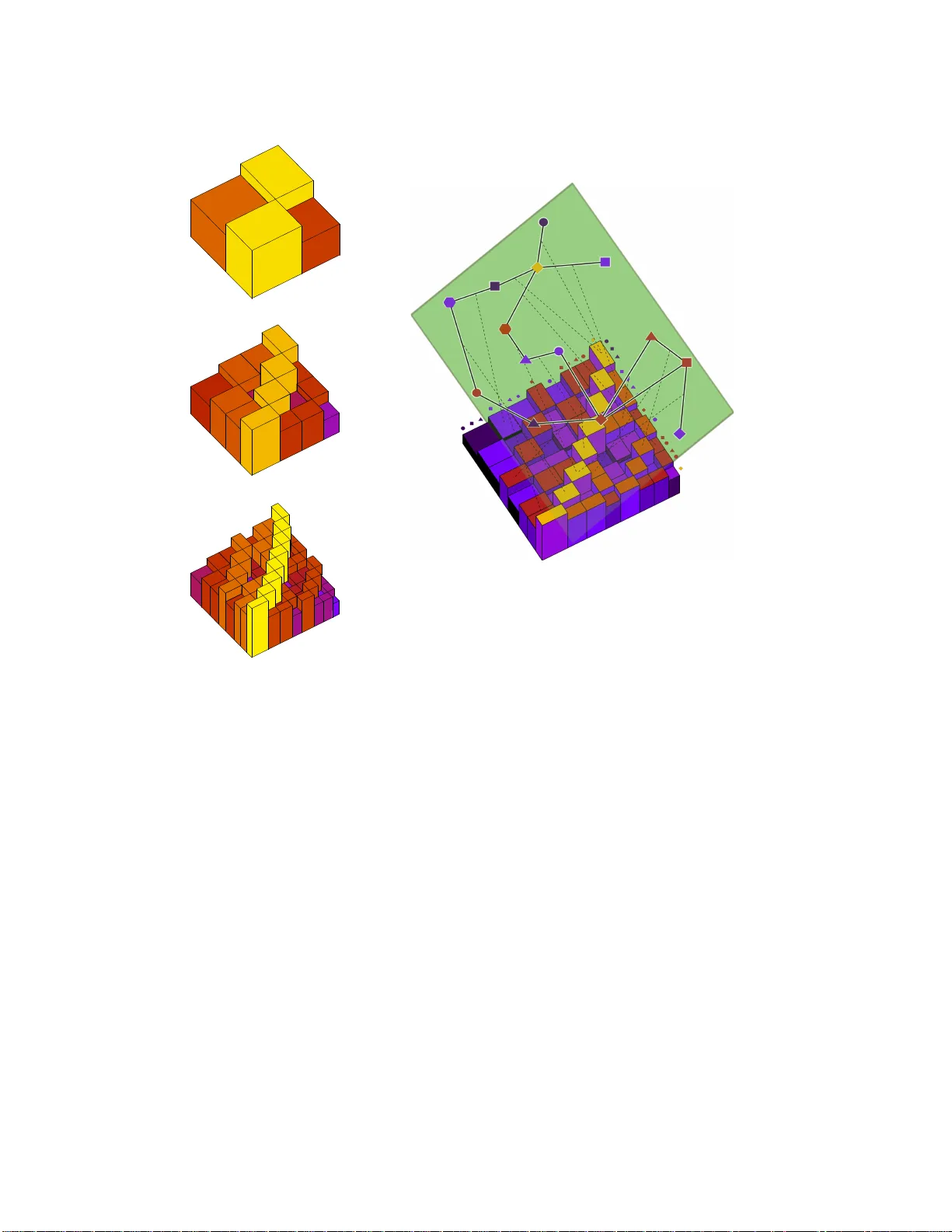
Rotated m ultifractal netw ork generator Gergely P alla 1 , P ´ eter P ollner 1 and T am´ as Vicsek 1 , 2 1 Statistical and Biolog ical Ph ysics Resear ch Group of HAS and 2 Dept. of Biological Physics, E¨ otv¨ os Univ., 1 117 Budap est, P´ azm´ any P . s tn y . 1A Abstract. The recently intro duced multif r actal netw or k generator (MFNG), has bee n shown to pro vide a simple and flexible to ol for creating r andom gra phs with very diverse fea tures. The MFNG is based on multif ractal measures embedded in 2d, leading also to isolated no des, whose num b er is relatively lo w f or re alistic cases , but may b eco me dominant in the limiting case o f infinit ely large netw or k sizes. Here we discuss the relation betw een this effect and the information dimension for the 1d pro jection of the link probability meas ure (LPM), and argue that the no de isola tion can be a voided by a simple transformation of the LPM based on rotation. 1. In tro duction The net w ork approac h for describing complex natura l, so cial and technological phenomena has b ecome v ery popular in the rece n t y ears. This can b e accoun ted for the generalit y of its fundamen t a l concept of represen ting the connections a mong the units (building blo c ks) of the system under study with a gra ph [1, 2]. Ov er the last decade it has turned out that netw orks corresp o nding to realistic systems can b e highly non- trivial, c haracterised b y a lo w a v erage distance com bined with a high a v erage clus tering co efficien t [3], anomalous de gree dis t ributions [4, 5] and an in tricate modular structure [6, 7, 8]. F r o m the b eginning of this new in terdisciplinary field, network mo dels ha ve b een pla ying a crucial role since they enable singling out the simplest asp ects of complex structures and, thus , a re extremely useful in understanding the underlying principles. F urt hermore, models can also help testing hypotheses ab out measured data. In parallel with the discov ery o f the fine struc ture of real net w orks, many imp ortan t and success f ul mo dels ha ve b een in tr o duced o ver the past 10 y ears for in terpreting the differen t asp ects of the studied systems. How ev er, most of these mo dels explain o nly a pa rticular asp ect of the net w ork (clus tering, a give n degree distribution, etc.), a nd for each newly disco ve r ed feature a new mo del had to b e c o nstructed. Due to this proliferation of ne t work mo dels, the concept o f general netw ork models and metho ds for generating graphs with desired prop erties has att r a cted gr eat in terest lately . A num b er of notew ort hy metho ds ha ve b een pro p osed star ting from the exp o nen tial random graph mo del [9, 10, 11 , 12], through the hidden v ariable mo dels [13, 14] (including the sy stematic study of the en trop y of net w ork ensem bles [15]), the R otate d mult ifr actal network gener at or 2 dK series approac h [16] and the use of p -adic randomise d P arisi matrices [17, 18] to t he Kronec k er-graph approac h [19 , 20 ]. A ve ry recen tly introduced approach along this line is the m ultifractal net w ork generator (MFNG) [21], whic h w as shown to b e capable of generating a wide v ariet y of netw ork t yp es with prescrib ed statistical prop erties, (e.g., with degree- or clustering co efficien t distributions of v arious, ve r y differen t forms). At the heart o f this metho d lies a mapping b etw een 2 d measures defined on the unit square and random graphs. The main idea is to itera t e a suitably ch osen self similar m ultif r actal (b ecoming singular in the limiting case) and enlarge the size of the generated g raph (b ec oming infinite in the limiting case ) in parallel. A v ery unique feature of this cons t ruction is that with the increasing system s ize the generated graphs b ecome top ologically more s t ructured. Ho we v er, a slight dra wbac k of the metho d is that when the size of the generated net w orks ( a nd in parallel, the n um b er of iterations in the m ultifractal) g ro w to infinity , isolated no des ov ertak e the ma j orit y of the g raph in most settings, (see the SI o f Ref.[21] for more de tails). Although this effect is usually not an issue when constructing graphs of size s comparable to real net w orks, finding a wa y to circum v en t it w ould still pro vide a notew orthy improv emen t, esp ecially in the lig h t of the non-trivial connections betw een con v ergen t graph sequences in the infinite net work size limit and 2d functions on the unit square [22, 23]. In this article w e study the relation b etw een the no de isolation effect and the 1d pro jection o f the link probabilit y measure (LPM) used in the graph generation pro cess. F urt hermore, w e prop ose a natural method to o v ercome the pro blem by a simp le transformation based on rotation. The paper is organised a s follo ws. In Sect.2. w e ov erview the definition and most imp ortan t pro p erties of the multifractal net w ork generator, while in Sect.3 w e discuss the connection b et w een no de isolation and mu ltifractality . W e contin ue by prop osing a mo dification of the o r iginal metho d a voiding t he node isolation in Sect.4., whic h is tested in practise in Sect.5 . Finally , w e conclude in Sec t.6. 2. The mu lt ifractal net work generator The multifractal netw ork generator was inspired by earlier results from L. Lo v´ asz and co- w orke rs prov ing that in the infinite netw ork size limit, a dense gra ph’s adjacency matrix can b e w ell represen ted b y a con tinuous function W ( x, y ) on the unit square [22, 23]. A similar approac h w as introduced by Bollob´ as et al. in Refs .[24, 25] and w as used to obtain con vergence and phase transition results for inhomogeneous random (including sparse) graphs. This t wo v ariable symmetric function (whic h can ha v e a very simple form fo r a v ariet y of interes t ing graphs, and w as supp osed to b e either contin uous or almost ev erywhere con tin uous) predicts the probabilit y whether tw o no des are connected or not. In case of the MFNG the men tio ned W ( x, y ) is replaced by a self-similar m ultifractal [21]. W e start b y defining a generating measure on the unit square b y dividing identically R otate d mult ifr actal network gener at or 3 b oth the x a nd y axis t o m (not necessarily equal) interv als, splitting it to m 2 rectangles, and assigning a probabilit y p ij to eac h rectangle ( i, j ∈ [1 , m ] denote the ro w and column indices). The probabilities a r e assumed t o b e normalised, P p ij = 1 and symmetric p ij = p j i . (Note that w e normalize the probabilities of the generating measure instead of the integral of the latter b ecause of the adv an ta ges of this c hoice to b e discussed later.) Next, the LPM is obtained b y recursiv ely multiply ing eac h rectangle with the generating measure k times. This is in comple te analogy with the standard pro cess of generating a m ultifractal, resulting in m 2 k rectangles, each asso ciated with a linking probabilit y p ij ( k ) equiv alent to a pro duct of k factors from the original generating p ij giv en as p ij ( k ) = k Y q =1 p i q j q . (1) In our con ven t io n k = 1 stands for the generating measure, thus, an LPM at k = 1 is equiv alen t to the generating measure itself. The indices of the factors in (1) are g iv en b y i q = $ ( i − 1) Q q − 1 r =1 ◦ mo d m k − r m k − q % + 1 , (2) where ⌊ a/b ⌋ denotes the quotien t (in teger pa rt) of a/b , the term Q q − 1 r =1 ◦ mo d m k − r stands for subsequen t calculation of the remainder af t er the division b y m k − r , and an a nalogous form ula can b e written f or t he indices j q as w ell. (F or q = 1 , Eq.(2) simplifies to i q = ⌊ ( i − 1 ) /m k − 1 ⌋ + 1). T o obtain a netw ork from the link probability measure, we distribute N p oints indep enden tly , uniformly at random on the [0 , 1] in terv al, and link eac h pair with a pro babilit y give n b y the p ij ( k ) at the giv en co ordinates. (The ab o v e pro cess is illustrated in Fig.1). The div ersit y of the linking pro babilities p ij ( k ) (and corresp ondingly , the structuredness of the generated graph) is increasing with the n um b er of iterations, just lik e in case of a standa r d m ultifractal. When considering the “thermo dynamic limit” of this construction ( k → ∞ , N → ∞ ) w e w ould lik e to kee p the generated net works sparse, i.e., ensure that the a v erage degree of t he no des, h d i remains constan t. This can b e ac hiev ed by a n appropriate c hoice of the n umber of no des as a function of k , using the following relation: h d i = N ( k ) m k X i =1 m k X j =1 p ij ( k ) a ij ( k ) , (3) where a ij ( k ) denotes the area of the b ox i, j at iteration k . F or simplicit y , let us consider the sp ecial case of equal sized b o xes a ij ( k ) = m − 2 k . Due to the normalisatio n o f the linking probabilities in this case the ab ov e ex pression simplifies to h d i = N m − 2 k , th us, to k eep the a v era g e degree constan t when increasing the num b er of iterations for a given generating measure, the n umber of no des hav e to b e inc reased exp onentially with k . The ab o v e construction could b e made more general by replacing the “standard” m ultifractal with the k -th te nsorial pro duct of a symme tric 2d function 0 ≤ W ( x, y ) ≤ R o tate d multifr actal network gener ator 4 p 24 a) b) p 33 p p l l l l l l l l p p p p p p 1 2 3 4 1 2 3 4 34 44 42 31 21 11 12 13 l l l l p p p p 1 2 1 2 21 22 12 11 p p p p 43 14 23 32 41 p Figure 1. Sc hematic illustration of the m ultifra ctal graph gener ator. a) The construction of the link probability measure. W e start from a symmetric generating measure o n the unit square defined by a s et of probabilities p ij = p j i asso ciated with m × m rectang les (shown on the le ft). The genera ting measure is iterated by recur sively m ultiplying each b ox with the genera ting measure itself as s hown in the centre and o n the r ight. b) Dra wing linking pro babilities fro m the obtained LP M. W e a ssign random co ordinates in the unit in terv a l to the no des in the gr aph and link each no de pa ir I , J with a pro bability given by the proba bilit y measure at the corre spo nding co or dinates, resulting in a graph drawn in the transparent green la yer ab ov e the LPM. 1 defined on the unit square. Although the resulting W k ( x 1 , ..., x k , y 1 , ..., y k ) = W ( x 1 , y 1 ) · · · W ( x k , y k ) function is [0 , 1] 2 k → [0 , 1 ] instead of [0 , 1] 2 → [0 , 1 ], with the help of a measure preserving bijection b et w een [0 , 1 ] and [0 , 1] k it could b e used to generate random graphs in the s ame manner as with p ij ( k ). A t this p oint we also note that omitting the normalisation condition P ij p ij = 1 for the generating measure g iv es the approach an additional flex ibilit y whic h can come v ery handy in practical cas es. Supp ose that for a given setting of k , N and the LPM w e w ould lik e to increase the a verage degree in the obtained graph b eside preserving the relativ e ra tios of the linking probabilities (exp ected degrees) of no des falling into the differen t rows of the LPM. A very natura l idea in this case is to m ultiply each elemen t in p ij ( k ) with the same factor η > 1, and use the resulting matrix for generating a random R o tate d multifr actal network gener ator 5 graph in the same w a y . How ev er, this m ult iplicative fa cto r could b e also introduced at the level of the gene r a ting meas ure instead, i.e., η 1 /k p ij w ould also generate η p ij ( k ) for the LPM. 2.1. The de gr e e distribution An imp ortan t prop erty of the MFNG is t ha t no des with co or dinat es falling into the same ro w (column) of the LPM are statistically iden tical. This means that e.g., the exp ected degree or clustering co effic ien t of the no des in a giv en ro w is the same. Consequen tly , the distributions related to the top o lo gy a re comp osed o f sub-distributions asso ciated with the individual ro ws. The degree distribution can b e expresse d as ρ ( k ) ( d ) = m k X i =1 ρ ( k ) i ( d ) l i ( k ) , (4) where ρ ( k ) i ( d ) denotes the sub-distribution of the no des in row i , and l i ( k ) corresp onds to the width of the row (g iving the ratio of no des in ro w i compared to the num b er of total no des). These ρ ( k ) i tak e the form of [21 ] ρ ( k ) i ( d ) = h d i ( k ) i d d ! e −h d i ( k ) i , (5) where h d i ( k ) i denotes the av erage degree of no des in row i . This is is giv en by h d i ( k ) i = N ( k ) p i ( k ), where p i ( k ) correspo nds to the link ing probabilit y in ro w i , giv en b y p i ( k ) = X j p ij ( k ) l j ( k ) (6) In m ore general, if the linking probabilit y at iterat io n k is des crib ed b y W k ( x, y ), then the exp ected de gree of a no de having a p o sition x can be giv en as h d ( x ) i = N ( k ) w k ( x ) , (7) where w k ( x ) ≡ Z dy W k ( x, y ) (8) defines the 1d pro jection of W k ( x, y ) and is equiv alent to the linking probability at p osition x . In case of the m ultifr actal net work generator this w k ( x ) has a simple step-wise constant form, sho wing a ste p-wise surface getting rougher a nd rougher with increasing k . 3. The isolated no des and the m ultifractality of w k ( x ) According to Sect.2.1., the degree distribution and the fraction of isolated no des dep end on the pro jection of the link probability measure p ij ( k ) to the x axis, (or equiv alen tly , to the y axis), giv en b y w k ( x ). It is know n that almost all pro jections of a m ultifractal suc h as p ij ( k ) with an informatio n dimension larger than 1 to a 1d line result in measures with R o tate d multifr actal network gener ator 6 Euclidean supp ort [26]. Ho we v er, the pro jection to w k ( x ) is unfo r t una t ely a sp ecial case, b elonging to the minority of pro jections y ielding the “almost all” instead of “eve r y” in the previous statemen t. As w e shall see shortly , w k ( x ) is a multifractal it self with an information dimension smaller than 1 , and this is the origin of the no de isolation. In Fig.2. w e sho w w k ( x ) for k = 1 and k = 2 in a setting with equal sized b oxes in the generating measure . F or simplicit y w e shall ass ume equal sized b o xes in the rest of this Section. Since the linking probability inside eac h b ox is constan t, the shap e of . . . + 2 + 2 w k (x) w k (x) x = = x p 11 p 11 . p 11 p 12 . p 11 p 21 . p 11 p 22 . p 12 p 21 . p 21 p 11 . p 21 p 12 . p 22 p 11 . p 22 p 12 . p 21 p 21 . p 22 p 21 . p 22 p 21 . p 22 p 22 . p 12 p 12 . p 12 p 11 . p 22 p 12 . p 12 p 21 p 11 p 22 11 p p 21 p 12 p 22 r 2 r 1 r 1 r 2 r 2 r 2 r 1 r 1 Figure 2. Pro jection of the LPM onto the edge o f t he unit squa re, resulting in a m ultifractal w k ( x ) function. F or simplicity w e assumed a 2 by 2 genera ting measure with equal b ox lengths. of w k ( x ) is step-wise, consisting of m k in terv als (corresp onding to the columns of the LPM), and the heigh t o f step i is giv en b y r i ( k ) ≡ m k X j =1 p ij ( k ) l j ( k ) . (9) Ho we v er, the multiplic ativ e nature of the construction is inhe rited b y w k ( x ) as we ll, r i ( k ) = k Y q =1 r i q , (10) where r i ≡ m X j =1 p ij l j , (11) stand for the heigh ts of the steps at the generating measure ( k = 1), and i q is giv en by (2). (This is demonstrated in Fig.2. for k = 2). Th us, the ev o lution of w k ( x ) w ith k is analogous to the standard construction of a m ultifractal em b edded in the unit in terv al. R o tate d multifr actal network gener ator 7 Note ho w ev er that if P ij p ij = 1, then w k ( x ) is not normalised, e.g., for equal b ox lengths R w k ( x ) dx = m − 2 k . Multifractals are describ ed b y the q ordered g eneralised fractal dimension D ( q ) defined as follow s ( see e.g., Ref.[27]). Supp ose that w e divide the m ultifractal to b o xes of size ǫ , and the measure ins ide b o x i is giv en by p i . The function χ ( q , ǫ ) is defi ned a s χ ( q , ǫ ) ≡ X i p q i . (12) If ǫ is v aried, χ ( q, ǫ ) b eha ves as χ ( q , ǫ ) ∼ ǫ D ( q )( q − 1) . (13) Th us, D ( q ) can b e giv en as D ( q ) = lim ǫ → 0 1 q − 1 ln P i p q i ln ǫ . (14) In the sp ecial case of q = 1 w e hav e zero in the denominator, t hus w e take the q → 1 limit and using l’Hospital’s rule w e obtain − X i p i ln p i ∼ D 1 ln(1 /ǫ ) . (15) F r o m the p o in t of view of the degree distribution and the fraction of isolated no des, the crucial q v alue is q = 1: When the num b er o f iterations, k → ∞ , the fractal dimension of the support of the meas ure is giv en b y D ( q = 1) . If it turns o ut that D ( q = 1) < 1 for the w k ( x ) cu rv e, then this means that the points giving the relev ant con tribution to the o ccurrence of links are concen tr a ted o n a fractal with a fra ctal dimension smaller than one, and th us, the ma jorit y of the no des b ecome isolated. F o r a m ultif ractal on the unit in terv al defined b y a self-similar m ultiplication pro cess suc h as in case of w k ( x ), (go v erned b y Eqs.(9-11)), the D ( q ) can be calculated analytically [27 ] as D ( q ) = 1 ( q − 1) ln(1 /m ) ln " m X i =1 ( r i m ) q # . (16) F o r q = 0 the ab o v e expression yields D ( q = 0) = 1 , in ag reemen t with the general picture of m ultifractals pro duced in a recursiv e m ultiplication pro cess, where D ( q = 0) equals the fractal dimension corresp onding to a uniform generating ob ject. F or an y m ultifractal in general, the D ( q ) v alues monotonically decrease with increasing q . Th us, at q = 1 in our case the D ( q ) can reac h 1 o nly if D ( q ) = 1 f or an y q ∈ [0 , 1]. According to (1 6), this can b e achiev ed only if r i = 1 /m 2 for a ll i . This means that unles s the sum of probabilities in an y ro w of the generating me asure is the same, the D ( q = 1) b ecomes smaller tha n 1, and the no de isolation effect t a k es place. 4. Rotated measures Our aim is t o o v ercome the problem of the exact m ultifractality of w k ( x ) b y mo difying the construction in suc h a w ay that the pro jection o f W k ( x, y ) determining the degree R o tate d multifr actal network gener ator 8 distribution has Euclidean supp ort. Mean while, w e w an t to k eep the LPM a highly v aria ble function so that very diffe ren t distributions (leading to v ery differen t kinds of net w orks) could be still a c hiev ed. A simple idea is to r o tate the LPM with a giv en angle α a s sho wn in Fig.3., so that the direction of the pro jection determining the degree distribution no lo nger coincides with any of the sp ecial directions of the multifractal generation pro ces s. Th us, the construction of a random graph in this setting has the follo wing main stages: w e b egin b y generating a “standard” LPM f o r a c ho sen k , and “cut” a square rotated by an angle α from this measure a s shown in Fig.3. Since the diagonal of this ne wly in t r o duced squ are do es not coincide with the diagonal of the original LPM, w e ha ve to symmetrise the measure inside the rot a ted square with resp ect to its diag onal. Finally , w e distribute N p oin ts uniformly at random along b oth sides of the rotated square and link eac h pair with a probabilit y found at the giv en co ordinat es in the “rot ated co ordinate system”. ( This last step is in complete ana logy with the “standard” g raph generation process). h h α Figure 3. A “standar d” link-pr obability measure (oblique) with a ro ta ted fr ame inside. The probabilities inside the ro ta ted squa r e have to be symmetrised along the diagonal. The linking probability of the gre en no de can b e calculated by summing up the probabilities “traversed” b y the green line, each m ultiplied b y the length of the int ersection betw een the green line and the co rresp onding b ox. Due to the symmetry , this is equiv alent to trav ersing first along the or iginal line fr o m the to p until the diagonal is met, and then contin ue along the dashed line to the r ig ht . When examining the behav iour of this cons truction with increas ing k , the n um b er of no des used in the graph generation is adjusted according to the h d i =const. criterion, R o tate d multifr actal network gener ator 9 just a s in case of the original settings. Due to the rotat io n and t he symmetrisation, the p olygo ns making up the link probability matrix are no longer arr a nged in a m atrix lik e f orm, th us, (3) cannot b e used s t r aigh t a w ay in this case. T o calculate h d i we need to first in tro duce a unique indexing o ver the p olygons inside the rotat ed frame, and ev aluate h d i = N X i p i a i , (17) where p i and a i denote the probabilit y and the area of the p o lygon i (triangles, quadrangles and pentagons) defi ning the rotated link probability meas ure. The size of the v arious distance s and the equations for the most impo r tan t lines needed to ev aluate (17) are giv en as a function of the ro tation angle α in the Ap p endix. The ex p ected degree of a no de at distance h from the origin of the r otated sq uare can b e giv en b y an ex pressions analogous to (7) a s h d ( h ) i = N ( k ) w k ( h ) , (18) where the linking probability w k ( h ) has to b e calculated along a line parallel to the side of the ro tated square. By denoting the set of p olygo ns interse cted b y this line b y Ω k ( h ), w e can expres s w k ( h ) as w k ( h ) = X j ∈ Ω k ( h ) p j ˜ l j ( h ) , (19) where ˜ l j denotes the relative length of the in tersections divided b y the length of the side of the rotated frame (see Fig.3). (These in tersection lengths can b e calculated with simple co o r dina t e geometry , based on the equations giv en in the Appendix). Due to the symmetrisation of the rotated square, the boxe s under the diag o nal are rotated b y 2 α . Th us, in practise it is more simple to replace the summation (19) along a straigh t line b y a summ ation along a brok en line which is fully ab o v e the diagonal, as sho wn b y the dashed green line in Fig.3. The w k ( h ) function is the analogue of the w k ( x ) f unction fo r the rotated frame, and when α → 0, w k ( h ) → w k ( x ). As a lready noted in Sect.2, the 1d pro jection of the original link proba bilit y measure, w k ( x ), is alw a ys piecewise constan t, where the constan t in terv als corresp ond to the columns of t he link-probability measure. In case of w k ( h ) the situation is a bit more complex. In Fig.4. w e depict tw o close by no de p ositions in the ro t ated s quare. The lines along whic h one has to calculate the link ing probabilities in tersect with the same b oxes. F urthermore, the lengths o f the in tersections are the s ame for the t w o lines in most of the b oxes, exce pt for the sections mark ed b y red. Th us, the linking probability of the tw o no des given b y w k ( h 1 ) and w k ( h 2 ) will b e quite close to eac h o ther as w ell, with the difference coming fro m the f ew differen t in tersection lengths. Now let us imagine that w e fix one of these tw o no de p o sitions, and set the corresp onding linking probability w k ( h ) as a reference v alue. If w e scan with the other no de through a narro w in t erv al of h v alues suc h that the corresp onding line still interse cts with the same b oxes, then due to t he linear c hange in the in tersection R o tate d multifr actal network gener ator 10 h 1 h 2 h 1 h 2 α Figure 4. Two no de p ositions in the r otated s quare, relatively clo se to each other shown b y the gr e en lines. They in tersect with the s ame b oxes, and in most cases the length of the intersections is the same as w ell. The different in tersection lengths ar e marked by r ed. lengths, the c hange in w k ( h ) with resp ect to the r eference v alue will be linear as w ell a s a function o f the h differenc e bet w een the t w o node positions. F r o m this it f o llo ws tha t if w e scan through the t o tal rang e of p o ssible h v alues, then the corresponding w k ( h ) curv e of the linking probabilities w ill be pie c e wise line ar . The break points b et w een the linear segmen t s corresp ond to the h v alues where the line parallel to the rota ted square boundary comes across a corner of the p o lygo ns defining the 2d link probabilit y measure, and starts to interse ct with a new p olygon. Thus , to analytically calculate w k ( h ) w e need to ev aluate (19 ) only at the break p oints, and connect the results with linear segmen t s. The h v alue of the break p oin ts (corresp o nding to p olygon corners) can b e most easily calculated b y c hanging the co ordinate system to b e aligned with the ro tated square, ha ving an origin at the top left corner. The details of this co ordinat e transformation are g iven in the App endix . In Fig.5a w e c heck the a b o v e for a 2 b y 2 generating measure at k = 3 b y calculating w k ( h ) in b oth the break p oin ts and in tw o in termediate p o in ts betw een eac h adjacen t break point pairs. Seemingly , the results for the inte rmediate p oin ts fall on the lines connecting the result for the break p oin ts. The degree distribution can b e obtained from w k ( h ) in three simple steps. The first step is the calculation of the distribution of the linking probability for t he no des, σ ( k ) ( p ). (By in tegrating σ ( k ) ( p ) as R p 2 p 1 σ ( k ) ( p ) dp w e receiv e the probabilit y for a randomly c ho sen R o tate d multifr actal network gener ator 11 no de to o bt a in a linking pro babilit y b et wee n p 1 and p 2 , and the num b er of exp ected links on the no de is giv en b y the to tal n umber of no des, N , m ult iplied b y its linking probabilit y). The σ ( k ) ( p ) can b e calculated from w k ( h ) by a simple “pro jection” to the vertical axis as follow s. Since we distribute t he no des uniformly at ra ndom along the side of the rotat ed square, the ratio of no des falling in to a n interv al of [ h 1 , h 2 ] is simply ( h 2 − h 1 ) /b , where b denotes the length of the side of the rotated square. Th us, a linear segmen t of w k ( h ), stretc hing from h 1 to h 2 con tributes to σ ( k ) ( p ) with a “step” ranging from p 1 = w k ( h 1 ) to p 2 = w k ( h 2 ) with a heigh t of ( h 2 − h 1 ) / ( b | p 2 − p 1 | ). (F or an illustration see Fig.5b). The second step in the calculation of the degree distribution is the transformation of σ ( k ) ( p ) in to the distribution of the exp ected degrees for the no des, ˜ ρ ( k ) ( d ). The difference b et wee n the degree distribution and ˜ ρ ( k ) ( d ) can b e illustrated in t he graph generation pro cess: the exp ected degree of a no de is simply its linking probabilit y giv en by (19) m ultiplied by N , ho wev er, since the links a re drawn randomly , its actual degree may b ecome smaller o r la r g er than that at the end of the link generation pro cess. The ˜ ρ ( k ) ( d ) can b e obtained fr om σ ( k ) ( p ) by a simple “ stretc hing” in the horizon ta l direction, i.e., for any p 1 and p 2 Z p 2 p 1 σ ( k ) ( p ) dp = Z x 2 = N p 2 x 1 = N p 1 ˜ ρ ( k ) ( x ) dx, (20) where the integral o n the right hand side corresponds to the probabilit y for a randomly c hosen no de to hav e an exp ected degree falling b et w een d 1 = N p 1 and d 2 = N p 2 . W e note that in case of the original settings without an y rotation, b oth σ ( k ) ( p ) and ˜ ρ ( k ) ( d ) are given b y trains of delta spike s with v arying w eigh ts, σ ( k ) ( p ) = m k X i =1 l i ( k ) δ p,p i ( k ) , (21) ˜ ρ ( k ) ( d ) = m k X i =1 l i ( k ) δ d,N p i ( k ) , (22) where p i ( k ) denotes the linking probability in column i o f the origina l LPM giv en by (6). In con trast, for the rotated measures b o th σ ( k ) ( p ) and ˜ ρ ( k ) ( d ) t a k e a step-wise form instead o f delta spik es, (see e.g., Fig.5b). The final step is to tra nsfor m ˜ ρ ( k ) ( d ) in to the degree distribution. Since the links are dra wn indep enden tly of each other in b oth the original and the rotated settings, this can b e ac hiev ed b y ta king the c o n volution of ˜ ρ ( k ) ( d ) with a P oisson-distribution as ρ ( k ) ( d ) = Z dx ˜ ρ ( k ) ( x ) x d d ! e − x . (23) Based on the metho d detailed ab o v e, in the next Section w e compare the ev olution of the degree distribution with k in the original settings and in the rotated scenario, (with a sp ecial fo cus on the ratio of the isolated no des ) . R o tate d multifr actal network gener ator 12 w (h) k h σ (p) ρ( ) d ~ ρ( ) d d p c) a) b) 0.003 0.004 0.005 0.006 0.007 0.008 0.009 0.01 0.011 0.012 0.013 0.014 0 0.1 0.2 0.3 0.4 0.5 0.6 0.7 0.8 0.9 0.003 0.004 0.005 0.006 0.007 0.008 0.009 0.01 0.011 0.012 0.013 0.014 0 50 100 150 200 250 300 350 400 450 500 0 0.02 0.04 0.06 0.08 0.1 0.12 0.14 0.16 0.18 0 10 20 30 40 50 Figure 5. a) Checking the w k ( h ) of a 2 by 2 gener ating measure at k = 3. The contin uous line shows the piece wis e linear link ing proba bilit y as a function o f h obtained by connecting the v alues o btained at adjacent brea k p oints with straig ht lines. F o r eac h section we a lso calculated the linking probability in tw o intermediate po int s as well, the results ar e shown b y the sy m bo ls. b) By pro jecting w k ( h ) to the vertical a xis one obtains the distr ibution of the link ing pr obabilities, σ ( p ), which is step-wise. (Note that in order to emphasis e the connection to w k ( h ), we have plotted p on the vertical axis and σ ( p ) o n the horizontal axis). c) The distribution of the exp ected degr ees, ˜ ρ ( k ) ( d ) is obtained by infla ting σ ( p ) accor ding to the h d i = N p relation. W e hav e also plo tted the corr esp onding degree distr ibution, ρ ( k ) ( d ), with dashed lines. 5. Applications 5.1. De gr e e distribution F o r t he comparison b et we en the original settings and the rotated scenario we c hose the 2 by 2 generating measure show n in F ig.6a. with a starting N k =1 = 30, since t he ratio of isolated no des b ecomes significan t quite fast without the rotation of the LPM in this case. The generating measure and N k =1 fixed the av erag e degree of t he no des to h d i = 7 . 5. F rom h d i we can calculate the num b er of no des at the higher k v alues in the original setting from (3). In case of the ro tated scenario w e use the same h d i , and calculate the num b er of no des f o r an y k v alue fr o m (17). In Fig.6b we show the distribution of the exp ected degrees for the no des , ˜ ρ ( k ) ( d ), on logarithmic scale for the origina l settings, obtained from ( 2 2), whe reas Fig.6c-d sho w the R o tate d multifr actal network gener ator 13 k=4 k=8 k=6 k=2 k=1 k=4 k=8 k=6 k=2 k=1 d k=8 k=4 k=1 k=2 k=6 d d d) c) a) b) p 11 =0.63 =0.15 p 12 =0.15 p 21 =0.07 p 22 α=22.5 α=0.5 α=0 (k) ρ (d) ∼ (k) ρ (d) (k) ρ (d) ∼ (k) ρ (d) (k) ρ (d) ∼ (k) ρ (d) 0 1 0 1 1 100 0.01 1e−04 1 100 1e−04 0.01 1 100 0.01 1e−04 1000 0.01 0.1 1 10 100 100 1e−04 0.01 1 1e−06 1 100 0.01 1e−04 1e−04 0.01 1 100 1e−04 0.01 1 100 1e−04 0.01 1 100 1e−04 0.01 1 100 0.01 0.1 1 10 100 1000 1e−04 0.01 1 100 1 100 1e−04 0.01 1 10 0.1 0.01 100 1000 1 100 0.01 1e−04 1 100 0.01 1e−04 1 0.01 1e−04 100 1e−04 0.01 1 100 Figure 6. a) A 2 by 2 g enerating measure with equal b ox lengths. b) The distr ibution of the exp ected degr ees, ˜ ρ ( k ) ( d ), (black, solid lines), a nd the deg ree distribution, ρ ( k ) ( d ), (red, dashed lines) in the origina l settings for k = 1 , 2 , 4 , 6 , 8 on lo garithmic scale. Since ˜ ρ ( k ) ( d ) corre spo nds to a delta-spike train accor ding to (22), w e us ed log arithmic binning for dealing with the singular ities. c) The ˜ ρ ( k ) ( d ) (bla ck, solid lines), and ρ ( k ) ( d ), (red, dashed lines) distributions at k = 1 , 2 , 4 , 6 , 8 for a rotated fra me at rotatio n angle α = 0 . 5 degrees. d) The ˜ ρ ( k ) ( d ) (black, solid lines), and ρ ( k ) ( d ), (red, dashed lines) distributions at k = 1 , 2 , 4 , 6 , 8 for a ro tated frame at rotation angle α = 2 2 . 5 degrees. same function for rotated frames at rota t io n a ng les α = 0 . 5 degrees and α = 22 . 5 degrees, resp ectiv ely . W e also plotted the corr esp o nding degree distributions with dashed lines, ho we v er, the difference b et wee n the original and the rotated scenario is muc h more salien t fo r ˜ ρ ( k ) ( d ). As explained in Sect.4., ˜ ρ ( k ) ( d ) consists o f delta-spik es in case of the original settings (w e hav e use d binnin g in order to plot this singular function), and according to F ig .6b, as k is increased, the distribution gets wider, and a significan t part of it is shifted under d = 1. This means that as we increase k , for lar ger and larger par t of the nodes the exp ected degree becomes smaller t ha n one, th us, the node isolation effect tak es place. In con trast, Figs.6c-d sho w a differen t b eha viour. Althoug h the distributions b ecome wider with increasing k here as w ell, this tendency is m uc h less pronounced compared to the α = 0 case. F urthermore, in case of F ig.6d the ma jor part of the distribution sta ys ab o v e d = 1 for the ex amined k v a lues. In Fig.7a w e show the ratio of isolated nodes as a function of the n umber of iterations. Due to the reduced spreading in the degree distribution with k the rapid increasing tendency o f p ( d = 0) presen t in the original settings is mo dified t o a v ery R o tate d multifr actal network gener ator 14 slo wly increasin g tendency for the rotated scenarios. The p ( d = 0) a t iteration k = 10 is displa y ed in Fig.7b as a function of the rot a tion angle α , show ing an ov erall “U” shap e with a minimu m aro und 22 .5 degrees. As p ointed out previously , when α → 0, w e reco v er the original settings of the MFNG . Although t here seem to b e man y pairs of α v alues w ith ve ry similar p ( d = 0 ) v alues, w e note that each α defines a different setting with unique attributes (e.g., the area of the rotated square affecting the av erage degree and the family of the w k ( h ) curv es are alwa ys unique for eac h α ). The ov erall prop erties of a rotated setting (degree dis t r ibutio n, ratio of isolated nodes, etc.) c hange s mo othly with t he rotatio n angle fo r an y α > 0. Ho wev er, as argued in Sect.4. theoretically and shall be examined in Sect.5.2. n umerically , the b eha viour of the D ( q ) curve do es sho w a drastic change when switc hing from the α = 0 original setting to an α > 0 finite rotation angle. This change from a m ultif ractal D ( q ) to a non- m ultifractal one is not exp ected to b e aff ected b y any commensurabilit y effect in r o tation angles. ρ (d=0,k=10) (d=0) ρ k α a) b) 0 0.05 0.1 0.15 0.2 0.25 0.3 0.35 0.4 α=0.5 α=10.5 α=22.5 α=32.5 α=0 10 9 8 7 6 5 4 3 2 1 0 0.05 0.1 0.15 0.2 0.25 0.3 0.35 0.4 0 5 10 15 20 25 30 35 40 45 Figure 7 . a) The ratio of isolated no des as a function of the n umber of iterations for the exa mined generating measure (shown in Fig.6a). b) The ratio of isolated no des at k = 10 as a function of the rotatio n ang le α . One of the big adv antages of the original MFNG w a s that it provide s a flex ible to ol for generating r a ndom g raphs with realistic prop erties. Although examining to what exten t this feature is a ffected by the ro t a tion of the LPM is b ey ond the g oals of this article, w e pres ent a n example where p o w er-law lik e degree distribution was ac hieve d in the rotated scenario in the A pp endix. 5.2. Me asuring the D ( q ) c urve The res ults sho wn in Sect.5.1. are v ery promising, since the rotation of the LPM drastically reduced the ratio of the isolated no des in the studied example, esp ecially in the case of larger rotation angles. Ho wev er, an ev en more reassuring wa y for c heck ing the effect of the mo dification of the MFNG is the measuremen t of the D ( q ) curv es corresp onding to the w k ( h ) functions. As desc rib ed in Sect.3., from the D ( q ) at q = 1 w e can deduce the b eha viour of the f r a ction of isolated no des, i.e., if D ( q = 1 ) = 1 in the k → ∞ limit, than the isolated nodes cannot b ecome dominan t. R o tate d multifr actal network gener ator 15 Before pro ceeding to the D ( q ) curv es, we ha ve one imp o rtan t note. In practise w e are alw a ys dealing with m ultifractals at a finite num b er of iterations, whic h ha ve a lo wer size b ound (low er length b ound in our case) dep ending on the n um b er of iterations. Belo w this low er size b ound t hey are not a n y more structured and, th us, this size b ound pro vides a lo w er b ound f or the size ǫ of the b oxes with whic h w e co v er the m ultifractal when measuring D ( q ) as describ ed in Sect.3. In case of the w k ( x ) of the original se t ting (without an y rotation) this low er b ound in ǫ is giv en simply by the width o f the r ows (columns). In case of the w k ( h ) of the rotated measure the situation is a bit more complex. Fir st of all, whe n compared to t he w k ( x ) of the original s etting at the same n um b er of iterations, w k ( h ) can con t ain m uch smaller segme n ts. How ev er, there are man y adjacent segmen ts with the same or almost the same slop e of the linking probabilit y , whic h can be united into single larg e segmen t, as sho wn in Fig.8. Th us, b efore the application of the D ( q ) measuring pro cedure ab o v e, w (h) k h 6e−20 8e−20 1e−19 1.2e−19 1.4e−19 1.6e−19 1.8e−19 2e−19 0.1 0.101 0.102 0.103 0.104 0.105 Figure 8. A small part of the w k ( h ) o f the rotated link probability measure a t k = 8 , α = 10 . 5 degre e s . T he p oints corr esp ond to the b oundar ies o f the segments in which w k ( h ) is strictly linear. How ever, for many adjacent segments the slope is actually the same or nearly the same. these segmen t joining w ere carried out, and the lo wer b ound o f ǫ w as set to the a v erage of the length of the resulting segmen ts. This y ielded still a mu c h smaller v alue t ha n in case of the original measure. In terestingly , for the rotated fr a mes when plotting ln χ ( q , ǫ ) as a function of ln ǫ , the curv es seem t o consist o f t wo subseque n t linear segmen ts with differen t slop es. In con trast, the ln χ ( q , ǫ ) obtained from w k ( x ) in the rota tion free settings sho ws a linear b eha viour as a function of ln ǫ . The tw o t yp es of χ ( q , ǫ ) curves are s ho wn in Fig.9. The D ( q ) is obtained from the slope of these curv es, whic h is straigh t for ward in case of the w k ( x ) of the original settings. Ho we v er, whic h part of the ln χ ( q , ǫ ) curv e should w e fit in c ase o f the rotated me asures? According to the de finitio n giv en in (14) D ( q ) should b e ev aluated in the ǫ → 0 limit, th us, w e use the s lop e of the low er par t of the ln χ ( q , ǫ ) curv es in the rotated s cenario for me asuring D ( q ). In F ig .10. w e show the results obtained for the D ( q ) curve s at v arious rotatio n R o tate d multifr actal network gener ator 16 χ( ε) q, χ( ε) q, a) α=10.5 ε b) ε α=0 0.01 0.1 1 10 1e−04 0.001 0.01 0.1 1 k=8, q=1.5 0.1 1 0.001 0.01 0.1 1 k=8, q=1.5 Figure 9. a) The χ ( q , ǫ ) obtained for the w k ( x ) of the original setting at k = 8 a nd q = 1 . 5 on logar ithmic sca le (black s y m bo ls), together with a pow er-law fit (red line). b) The χ ( q , ǫ ) of the w k ( h ) of the r otated frame at rotatio n angle α = 10 . 5 degrees with the same parameter s k = 8 and q = 1 . 5 on lo garithmic scale (black sym b ols). In con tras t to the orig inal settings, when fitting χ ( q, ǫ ) with a pow er -law, the low er part and the upp er part of the function yield different exponents, as shown b y the contin uous red line and the dashed green line resp ectively . angles. (F or a comparison, the D ( q ) curv e of the original settings is shown as well). F r o m these figures it seems that D ( q ) tak es a trivial “non-m ultifra cta l” form at already D(q) D(q) D(q) D(q) q q q q α=0 α=0.5 α=10.5 α=22.5 a) b) c) d) 0.2 0.4 0.6 0.8 1 1.2 1.4 1.6 1.8 2 −2 −1.5 −1 −0.5 0 0.5 1 1.5 2 0.2 0.4 0.6 0.8 1 1.2 1.4 1.6 1.8 2 −2 −1.5 −1 −0.5 0 0.5 1 1.5 2 k=4 k=6 k=8 0.2 0.4 0.6 0.8 1 1.2 1.4 1.6 1.8 2 −2 −1.5 −1 −0.5 0 0.5 1 1.5 2 k=4 k=6 k=8 0.2 0.4 0.6 0.8 1 1.2 1.4 1.6 1.8 2 −2 −1.5 −1 −0.5 0 0.5 1 1.5 2 k=4 k=6 k=8 Figure 10. a) The D ( q ) curve of the w k ( x ) function, corr esp onding to the or ig inal, “rotation- free” settings, obtained from (16). The D ( q ) curves measured in the rotated scenario for k = 4 , 6 , 8 at rota tion angles α = 0 . 5 ◦ , α = 10 . 5 ◦ and α = 22 . 5 ◦ are shown in panels b), c), and d), resp ectively . R o tate d multifr actal network gener ator 17 k = 8, and it is very close to 1 at q = 1. The “precision” of the numerical D ( q ) determination pr o cess at q = 1 was tested on other 1 d functions where w e kno w that D ( q = 1) = 1. According to that, fo r the rotated measures the n umerically obta ined D ( q = 1) v alues are eq ua l to D ( q = 1) = 1 within error b ound f or k = 8. 6. Summa ry In summary , w e in ves tigated the no de isolation effect of t he MFNG from a new p oin t of view. It had become clear that this phenomena is v ery closely related to the m ultifractality of the 1 dimensional pro jection of the LPM dete rmining the degree distribution. According to general theorems concerning multifractals, the pro jection in question is a par t icular o ne, and in con trast, the v ast ma jorit y of the other 1d pro jections of the LPM do not b ear m ultifractal properties. Based on this observ at io n w e in tro duced a slight v ariatio n of the origina l MFNG metho d, inv o lving the rotatio n of the LPM with a giv en angle. Due to the rotation, the pro jection determining the degree distribution is no longer a sp ecial pro jection in any asp ects, th us, the no de isolation effect is expected to disapp ear due to the lac k of m ultifractality . The e mpirical s tudies supp ort the theoretical reasoning abov e: the order q generalised fractal dimension D ( q ) in case of the pro jection of the LPM related to the degree distribution b ecame trivial, and for the n umerically accessible rang e of the num b er of iterations the fraction o f isolated no des show ed a drastic reducemen t when compared to the orig inal settings without any rotation. Ac knowledgme n t This w or k w as supp orted b y the Hungar ia n National Science F und (OTKA K6 8669), the National Researc h and T ec hnological Office (NKTH, T extrend) and the J´ anos Boly ai Researc h Sc holarship of the Hungarian Academy of Sciences. App endix A1. L engths F o r the length of the in t erv al a in Fig.11 we can write a 1 − a = tan α, (24) th us, a = tan α 1 + tan α . (25) Similarly , w e can write for b a b = sin α , (26) R o tate d multifr actal network gener ator 18 1−a 1−a a b c d a h h r(x) α s(x) t(x) g(x) r(x) Figure 11. The geometr y and the definition of the v arious leng ths and s izes in the rotated link probability mea sure. th us, b = tan α sin α (1 + tan α ) = 1 cos α + sin α . (27) F urt hermore, c = a tan α = tan 2 α 1 + tan α , (28) whereas d = a tan( α + π / 4) = a sin( α + π / 4) cos( α + π / 4) = a sin α + cos α cos α − sin α . (29) A2. Equations of the d iffer ent lines In the co ordinate system sho wn in F ig.11. the equation of the top side of the ro tated frame can be written as t ( x ) = 1 + c − x tan( α ) . (30) Similarly , the equation o f a parallel line b elo w a t a distance of h is given b y r ( x ) = 1 + c − h cos( α ) − h sin( α ) tan( α ) − x tan( α ) . (31) R o tate d multifr actal network gener ator 19 The equation of the diagonal can be exp ressed a s g ( x ) = 1 + d − x tan( α + π / 4) . (32) Finally , the equation of the left side o f the rot a ted square is giv en by s ( x ) = a + x tan( π / 2 − α ) , (33) and the equation of a parallel line shifted b y h to the righ t (corresponding to the dashed green line in Fig.11.) can be written as b r ( x ) = a + ( x − h cos α − h sin α tan α ) tan( π / 2 − α ) . (34) The equations given ab ov e can b e used to calculate where a given line inte rsects with a giv en b o x b oundary of the o r iginal link-probabilit y measure, and from the lo cation of the in tersection p oints w e can calculate the lengths/areas of the interse ctions b et w een the lines and the b o xes. T o calculate h d i we hav e to calculate the a r ea of each in tersected b ox in the top triangular part of t he ro tated s quare. The b o undary lines of this triangle can in tersect with the b o xes a s summaris ed in Fig12.: • in case the b o x intersec ts with only one line, then this divides it into either tw o trap ezoids (Fig .12a), or in to a triangle a nd a p en tagon ( Fig.12b), • in case the box in tersects with t w o lines, then there a re still only three in tersection p oin ts (ins t ead of four), since the b oundary lines m ust in tersect eac h other o n the b oundary of the b o x. The remaining tw o unshared in t ersection p oin ts can tak e qualitativ ely three differen t p ositions: they can b oth fall on a side a djacen t to the side of the shared inters ection p oin t (Fig.12c), they can b o th fall on the side opp osite to the shared in t ersection p oin t (Fig .12d), they can fall on t wo opp osite sides a djacen t to the side of the shared in tersection (F ig.12e), or they can fall on t wo adjacen t sides (Fig.12f ). A3. Changing c o or dinate system According to Fig.13., the new co ordinates of a general point x, y can be giv en as ˜ x = x − a cos( α ) + ( t ( x ) − y ) sin( α ) , (35) ˜ y = ( t ( x ) − y ) cos( α ) , (36) where t ( x ) denotes the equation of the topside o f the r o tated square in the standar d co ordinate s ystem, give n b y (30). A4. Gener ating skewe d ρ ( k ) ( d ) in the r otate d sc enario In Fig.14. we sho w a n example where p o w er-law like degree distribution is generated in the r o tated scenario. According to the plots, a slight rotation preserv es the degree distribution almost complete ly , whereas for lar g er rotations the sk ewe d nature of ρ ( k ) ( d ) is slo wly disapp earing. R o tate d multifr actal network gener ator 20 l 1 l 2 u 2 u 1 l 1 l 2 u 1 u 2 l 2 l 1 u 3 u 2 u 1 l 2 l 1 u 3 u 2 u 1 l 1 l 2 u 3 u 2 u 1 l 2 l 1 u 1 u 2 u 3 a) b) c) d) e) f) Figure 12. The six type of intersections of the boxes with the b ounda ry lines o f the top triangular part of the rotated squa r e. References [1] R. Alb e r t and A.-L. Bara b´ asi. Statistical mechanics of complex ne tw orks. R ev. Mo d. Phys. , 74:47– 97, 200 2. [2] J. F. F. Mendes and S. N. Doro govtsev. Evolution of Networks: F r om Biolo gic al Net s to the Internet and WWW . O xford Univ er sity Pres s, O xford, 2003 . [3] D. J. W a tts and S. H. Stro gatz. Collective dyna mics o f ’sma ll-world’ net works. Natur e , 393:440 – 442, 1998. [4] M. F aloutsos, P . F aloutsos , and C. F aloutsos. On p ow er- law relationships of the internet top olog y . Comput. Commun . Rev . , 29:251 –262 , 199 9. [5] A.-L. Barab´ a si a nd R. Albert. Emergence of scaling in r andom netw or ks. Scienc e , 2 86:509 –512 , 1999. [6] M. Girv an and M. E. J. Newman. Communit y structure in so cial and biological netw orks. Pr o c. Natl. Ac ad. Sci. USA , 99 :7821– 7826, 2 002. [7] G. Palla, I. Der´ enyi, I. F ar k as, and T. Vicsek. Unco vering the ov er lapping communit y structure of complex net works in nature and so ciety . Natur e , 435:81 4–818 , 20 05. [8] S. F or tunato. Communit y detection in gr aphs. Physics R ep orts , 486:7 5 –174 , 201 0. R o tate d multifr actal network gener ator 21 1−a 1−a a c d a b α s(x) t(x) g(x) x− a t(x)−y x,y Figure 13. Chang ing to the coo rdinate system of the rotated square. (k) ρ ( ) d d 1e−08 1e−07 1e−06 1e−05 1e−04 0.001 0.01 0.1 1 1 10 100 1000 α=0 α=0.002 α=0.005 α=0.01 Figure 14. A p ow er-law lik e deg ree distribution in the o riginal settings at k = 4 (black dot-dashed line), for whic h a slight rotation s till pr eserves the skew ed nature as sho wn b y the solid red line co rresp onding to ρ ( k ) ( d ) at ro tation a ngle α = 0 . 002 degrees. When α is increased, the sk ewedness o f ρ ( k ) ( d ) is de c reasing, as s hown by the other tw o distributions corr e spo nding to α = 0 . 005 and α = 0 . 01 . [9] O. F rank and D. Strauss. Mar ko v gra phs . J ournal of the Americ an Statistic al Asso ciation , 81 :832– 842, 1986. [10] S. W asse r man and P . E. Pattison. Logit mo dels and logistic regressio ns for socia l netw orks: I. an int ro duction, to markov g raphs and p*. Psychometrika , 6 1:401– 425, 1996 . [11] G. Robins, T. Snijders, P . W ang, M. Handco ck, and P . Pattison. Recent developments in R o tate d multifr actal network gener ator 22 exp onential random graph (p*) models for so cial net works. So cial Networks , 2 9:192– 215, 2007 . [12] J . Park and M. E. J. Newman. Solution o f the tw o-star mo del of a netw o rk. Phys. R ev. E , 70:066 146, 20 04. [13] G. Calda relli, A. Cap o cci, P . De Los Rios, and M. A. Mu ˜ noz. Scale-free net works from v ar y ing vertex intrinsic fitness. Phys. R ev. L et t. , 89:2587 0 2, 2002 . [14] M. Bogu ˜ n´ a and R. Pastor-Sator ras. Class of correlated random netw or k s with hidden v ar iables. Phys. Rev. E , 68:036 112, 20 03. [15] G. Bianconi. The ent ropy of ra ndomized net work e nsembles. Eur ophys. L ett . , 81:28005 , 2 008. [16] P . Mahadev an, D. Kr iouko v, K. F all, and A. V ahdat. Systematic top ology a nalysis and generatio n using degree cor relations. ACM SIGCOMM Computer Communic ation Re view , 36 :135–1 46, 2006. [17] V. A. Av etisov, A. V. Cher tovich, S. K . Nechaev, and O. A. V asilyev. O n scale - free and poly -scale behaviors of random hierarchical netw o r k. J. Stat. Me ch. , 2 009:P0 7008, 200 9 . [18] V. A. Avetiso v, S. K . Nechaev, a nd A. B. Shk arin. On the motifs distribution in r andom hierarchical netw or ks. http ://lan l.arxiv.or g/abs/1005.3204 , 2 010. [19] J . Lesko vec, D. Chakr abarti, J. Kleinber g, and C. F alo utsos. Realistic, mathematica lly tractable graph g e ne r ation and evolution, using kronecker m ultiplication. In Eur op e an Confer enc e on Principles and Pr actic e of Know le dge Disc overy in Datab ases , pag es 1 33–1 4 5, 20 05. [20] J . Lesko vec and C. F aloutso s . Scalable mo deling of r eal g raphs using kronecker multiplication. In Pr o c e e dings of the 24th International Confer enc e on Mach ine L e arning , pa ges 497–5 04, 200 7. [21] G. Palla, L. Lov´ asz, and T. Vicsek. Multifractal net work generator. Pr o c. Natl. A c ad. S ci. USA , 107:76 40–76 45, 20 10. [22] L . Lov´ asz and B. Szegedy . Limits of dense graph sequence s. J. Comb. The ory B , 96:933 –957 , 2006. [23] C. Borgs, J . Chay es, L. Lov´ asz, V. T. S´ os, and K. V eszter g ombi. Convergen t sequences of dense graphs i: Subgraph frequencies, metric prop er ties a nd testing. A dvanc es in Math. , 219:180 1– 1851, 2008. [24] B . Bollob´ as , S. Janso n, and O. Riorda n. The phase tra nsition in inhomogeneous random gra phs. R andom Structur es & A lgorithms , 31 :3–122 , 200 7. [25] B . Bollob´ as and O. Riordan. Random graphs and br anching pro cess . In B. Bollob´ as, R. Kozma, and D Mikl´ os, editor s, Handb o ok of L ar ge-s c ale R andom Networks , pages 15–1 15. Springer , Berlin, 2009 . [26] K . F alconer. F r actal Ge ometry: Mathematic al F oundations and Applic ations . John Wiley & Sons, Chichester, 2 nd edition, 2 003. [27] T. Vicsek . F r actal Gr owth Phenomena . W orld Scie ntific P ublishing Co. P te. Ltd., Singap ore, 2nd edition, 1992.
Original Paper
Loading high-quality paper...
Comments & Academic Discussion
Loading comments...
Leave a Comment