Quantum Strategic Game Theory
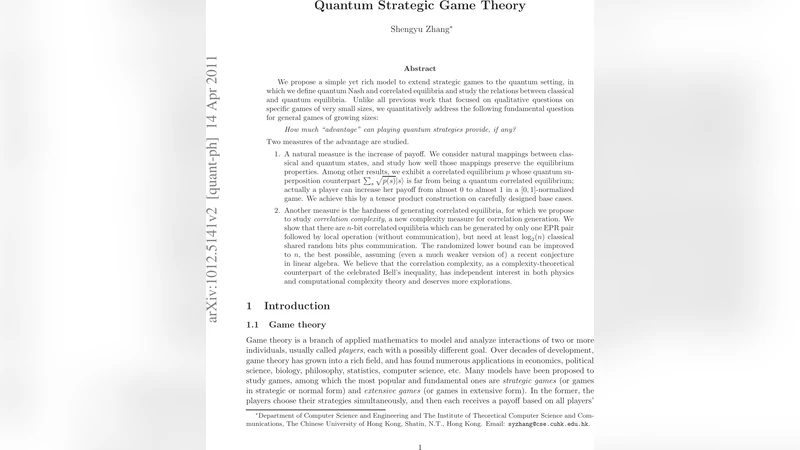
We propose a simple yet rich model to extend the notions of Nash equilibria and correlated equilibria of strategic games to the quantum setting, in which we then study the relations between classical and quantum equilibria. Unlike the previous work that focus on qualitative questions on specific games of small sizes, we address the following fundamental and quantitative question for general games: How much “advantage” can playing quantum strategies provide, if any? Two measures of the advantage are studied, summarized as follows. 1. A natural measure is the increase of payoff. We consider natural mappings between classical and quantum states, and study how well those mappings preserve the equilibrium properties. Among other results, we exhibit correlated equilibrium $p$ whose quantum superposition counterpart $\sum_s \sqrt{p(s)}\ket{s}$ is far from being a quantum correlated equilibrium; actually a player can increase her payoff from almost 0 to almost 1 in a [0,1]-normalized game. We achieve this by a tensor product construction on carefully designed base cases. 2. For studying the hardness of generating correlated equilibria, we propose to examine \emph{correlation complexity}, a new complexity measure for correlation generation. We show that there are $n$-bit correlated equilibria which can be generated by only one EPR pair followed by local operation (without communication), but need at least $\log(n)$ classical shared random bits plus communication. The randomized lower bound can be improved to $n$, the best possible, assuming (even a much weaker version of) a recent conjecture in linear algebra. We believe that the correlation complexity, as a complexity-theoretical counterpart of the celebrated Bell’s inequality, has independent interest in both physics and computational complexity theory and deserves more explorations.
💡 Research Summary
The paper introduces a general framework for extending classical strategic‑game concepts—namely Nash equilibrium and correlated equilibrium—to the quantum domain, and then investigates how much advantage quantum strategies can actually provide. Two natural mappings from a classical probability distribution over joint actions to quantum states are considered. The first mapping embeds the distribution as a diagonal density matrix, preserving the classical equilibrium when players perform local measurements. The second mapping creates a coherent superposition state whose amplitudes are the square roots of the classical probabilities. The authors show that the latter mapping can dramatically break equilibrium properties: they construct a family of games (with payoffs normalized to
Comments & Academic Discussion
Loading comments...
Leave a Comment