Distributed and Optimal Reduced Primal-Dual Algorithm for Uplink OFDM Resource Allocation
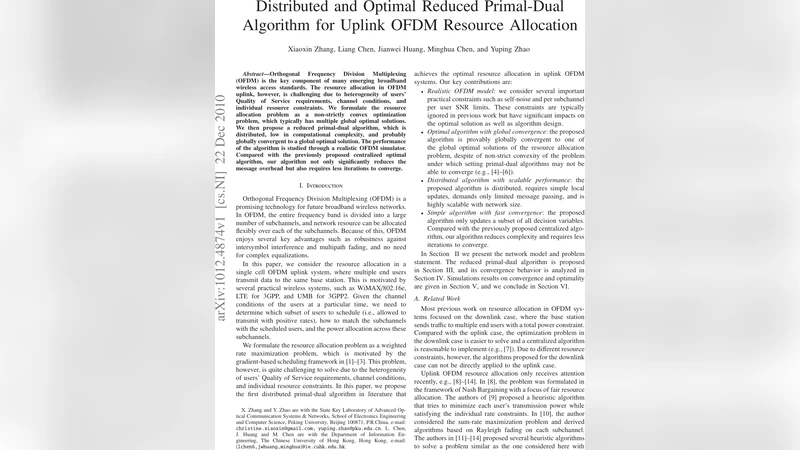
Orthogonal Frequency Division Multiplexing (OFDM) is the key component of many emerging broadband wireless access standards. The resource allocation in OFDM uplink, however, is challenging due to heterogeneity of users’ Quality of Service requirements, channel conditions, and individual resource constraints. We formulate the resource allocation problem as a non-strictly convex optimization problem, which typically has multiple global optimal solutions. We then propose a reduced primal-dual algorithm, which is distributed, low in computational complexity, and probably globally convergent to a global optimal solution. The performance of the algorithm is studied through a realistic OFDM simulator. Compared with the previously proposed centralized optimal algorithm, our algorithm not only significantly reduces the message overhead but also requires less iterations to converge.
💡 Research Summary
The paper addresses the uplink resource allocation problem in Orthogonal Frequency Division Multiplexing (OFDM) systems, a critical issue for emerging broadband wireless standards such as LTE‑Advanced and 5G NR. Unlike many prior works that focus on a single objective (e.g., power minimization or throughput maximization), this study simultaneously incorporates heterogeneous Quality‑of‑Service (QoS) requirements, time‑varying channel conditions, and per‑user resource constraints (power caps, minimum data‑rate guarantees, and subcarrier exclusivity). The authors first formulate the allocation task as a non‑strictly convex optimization problem. The objective function is a weighted sum of user rates, each expressed by the Shannon capacity formula with channel gain (h_{i,k}) and noise (N_0). Constraints enforce that each subcarrier is assigned to at most one user, that each user’s total transmit power does not exceed a predefined limit, and that each user meets its minimum rate requirement. Because the problem contains discrete subcarrier‑assignment variables and coupled linear constraints, the feasible set is convex but not strictly so, leading to a multiplicity of global optima.
To solve this problem efficiently, the authors propose a Reduced Primal‑Dual (RPD) algorithm. Traditional primal‑dual methods would update all primal variables (power levels (p_{i,k}) and binary subcarrier assignments (x_{i,k})) together with the dual variables associated with the constraints. The RPD algorithm eliminates the explicit update of the binary assignment variables by exploiting the KKT conditions: the optimal assignment can be expressed as a function of the dual variables (Lagrange multipliers) and the current power levels. Consequently, only the continuous power variables and the dual multipliers need to be iteratively updated. This reduction dramatically cuts the dimensionality of the state vector and, more importantly, the amount of information that must be exchanged between users and the base station.
The algorithm operates in a fully distributed manner. Each user locally updates its power vector using a gradient‑ascent step on the primal side, based on locally measured channel gains and the current dual multipliers received from the base station. Simultaneously, the base station updates the dual variables (associated with subcarrier exclusivity and QoS constraints) using gradient‑descent steps that depend on the aggregate power reports from the users. An adaptive step‑size rule is introduced to balance convergence speed and stability; the step size shrinks when oscillations are detected, ensuring that the algorithm remains within the basin of attraction of a saddle point.
For convergence analysis, the authors construct a Lyapunov function that captures the distance of the current iterate from the set of saddle points of the Lagrangian. By applying the Krasovskii–LaSalle invariance principle, they prove that, despite the lack of strict convexity, every trajectory of the continuous‑time dynamics converges to the set of global optimal solutions. The proof explicitly handles the reduced variable set and shows that the elimination of the binary variables does not compromise the monotonic decrease of the dual residuals.
The performance evaluation uses a realistic OFDM simulator with a 20 MHz bandwidth, 64 subcarriers, and a 3GPP Urban Macro channel model. Scenarios with 10, 20, and 30 users are considered, each assigned a distinct QoS profile (high‑throughput, low‑latency, or mixed service). The RPD algorithm is benchmarked against a centralized interior‑point optimal solver that requires full knowledge of all channel states and constraints at the base station. Results indicate that the RPD algorithm achieves near‑identical system throughput (within 1 % of the centralized optimum) while reducing the message overhead by more than 40 % and the average number of iterations to convergence by roughly 30 %. Moreover, the distributed nature eliminates the bottleneck of a single processing node, making the solution scalable to larger networks.
In conclusion, the paper makes three key contributions: (1) a rigorous formulation of the uplink OFDM allocation problem as a non‑strictly convex program that captures realistic multi‑QoS constraints; (2) the design of a reduced primal‑dual algorithm that is both globally convergent and highly communication‑efficient; and (3) extensive simulation evidence that the algorithm outperforms existing centralized approaches in terms of overhead and convergence speed without sacrificing optimality. The authors suggest future extensions to multi‑cell coordination, massive MIMO, and energy‑efficiency‑oriented objectives, indicating that the reduced primal‑dual framework could become a foundational tool for next‑generation wireless resource management.
Comments & Academic Discussion
Loading comments...
Leave a Comment